Key Points
- Security reports cite 195 per cent rise in terrorist attacks since March 2024
- Federal cabinet reviews two security assessments on worsening terrorism
- Drone attacks on police and security forces rise sharply
- Governor Faisal Karim Kundi will assume provincial executive powers
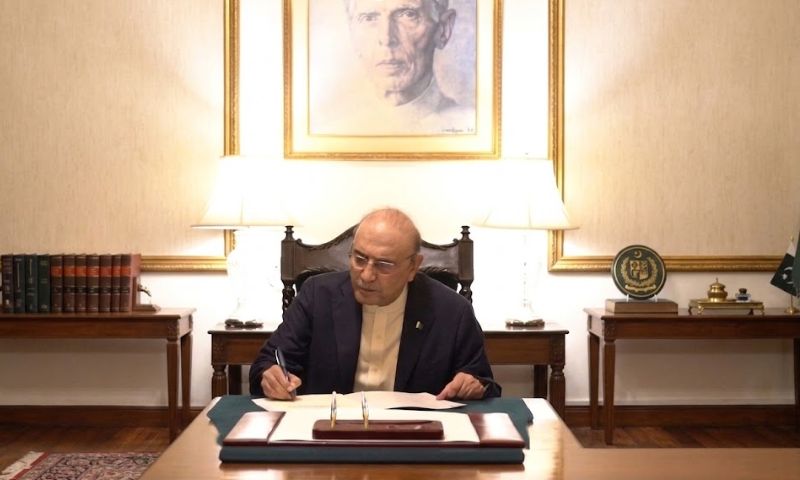
ISLAMABAD: Pakistan on Sunday imposed emergency and governor’s rule in the province of Khyber Pakhtunkhwa, after President Asif Ali Zardari signed the summary forwarded by Prime Minister Shehbaz Sharif.
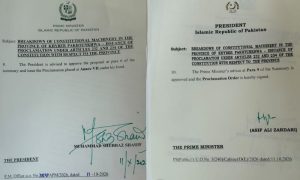
Earlier, the Pakistan federal cabinet decided on Sunday to impose an emergency in Khyber Pakhtunkhwa (KP) and introduce governor’s rule following a sharp increase in terrorist attacks.
The federal cabinet decision came in a meeting chaired by Prime Minister Shehbaz Sharif on Sunday, according to government sources.
The federal government took the step under Articles 232 and 234 of the Constitution, which deal with emergency provisions and the breakdown of constitutional governance in a province.
According to security analysts, the Cabinet decision was based not on political grounds, but on the neglect of security. The provincial government’s neglect of security became the main reason for the emergency.
“Frequent terrorist attacks in KP have not even seen condemnation by the provincial government,” said Syed Muhammad Ali, a prominent security analyst. “The KP government has received Rs 800 billion from the federal government for counter-terrorism and made no visible improvement in its specific security apparatus,” he added.
He said KP has a police force of 125000, out of which as many as 17000 are on protocol duties. They have a counter-terrorism force of only 3300, while only 25 are on regular deployment for counter-terrorism and critical security duties.
“What else would you call it, if it is not a neglect of security of the province?” he asked. “That is why I call the neglect of security, and not the political, the main reason for the imposition of emergency in the province.
According to analyst Ali, there were 1200 martyrdoms in KP and the provincial government has not condemned them even once. The provincial government was not moving to do necessary recruitment for counter-terrorism, he added.
The cabinet’s decision followed presentations of two special security assessments prepared by the KP police and intelligence agencies.
No formal notification confirming the imposition of emergency or governor’s rule was available at the time of reporting.
According to the cabinet decision, KP will be placed under emergency provisions, while separate administrative arrangements will be made for 12 districts facing serious security challenges.
Governor Faisal Karim Kundi is expected to exercise provincial executive powers if the proposed measures are approved and implemented in accordance with the Constitution.
The districts identified in media reports include areas of the former Federally Administered Tribal Areas (FATA), as well as Dera Ismail Khan, Lakki Marwat, Karak and Kohat.
Terrorist attacks rise 195 per cent
The security assessments presented to the cabinet reportedly recorded a 195 per cent increase in terrorist incidents in KP between March 1, 2024, and September 23, 2026.
According to the reports, 73 per cent of terrorist attacks recorded in the province during 2026 targeted police and security personnel, highlighting the pressure on law-enforcement agencies.
The assessments also pointed to a significant increase in the use of drones by terrorist groups. While no drone attacks were recorded against police and security forces in 2024, the number reportedly reached 170 in 2026.
The reports recorded 181 attacks involving improvised explosive devices (IEDs) in 2025 and 159 such incidents through September 2026. They called for strengthening the operational capacity of police and law-enforcement agencies to respond to changing terrorist tactics.
The assessments also noted that the Safe City surveillance programme remained limited to Peshawar, despite security challenges across the province.
They attributed the deteriorating situation partly to weaknesses in counterterrorism preparedness and the provincial government’s policies towards terrorist elements and their facilitators operating from Afghanistan.
These conclusions reflect findings attributed to the security assessments and have not been independently verified.
Pakistan constitutional provisions
Article 232 of the Constitution provides for the proclamation of an emergency under specified circumstances, including war, external aggression or internal disturbances beyond a provincial government’s capacity to control.
Article 234 deals with a situation in which the government of a province cannot be carried on in accordance with the Constitution.
It provides a mechanism for the president to assume, or direct the governor to exercise, specified provincial government functions, subject to constitutional requirements.
Any decision to invoke these provisions would have to follow the applicable constitutional procedures. The two articles address distinct circumstances and do not automatically establish the same form of federal intervention.
The cabinet decision comes amid strained relations between the federal government and the Pakistan Tehreek-e-Insaf (PTI)-led provincial administration, alongside persistent security concerns in KP..
Khyber Pakhtunkhwa, which borders Afghanistan, has faced repeated terrorist attacks targeting police, security personnel and civilians.