Key Points
- Traders blame road closures for disrupting Khyber Pakhtunkhwa-Punjab trade.
- They accuse Khyber Pakhtunkhwa government of ignoring inflation and unemployment.
- Business community says political agitation is worsening economic uncertainty.
- Protesters demand Chief Minister Sohail Afridi to call off the march.
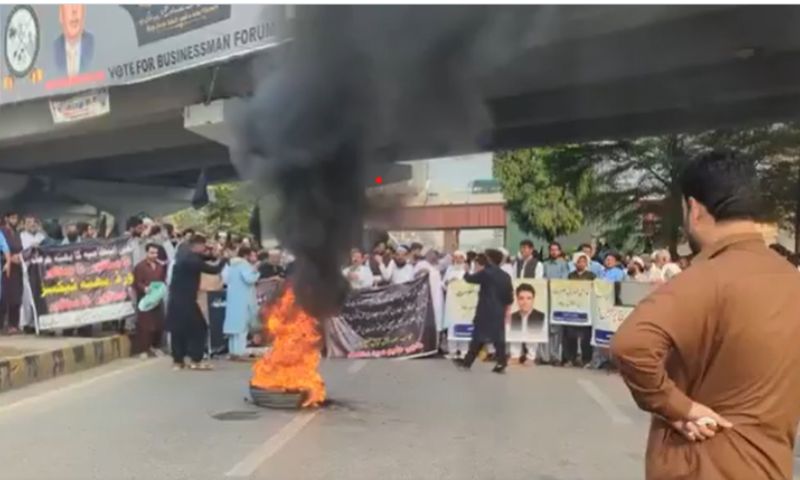
PESHAWAR, Pakistan: Civil society activists, traders and members of the business community staged a protest in Peshawar on Monday against the Pakistan Tehreek-e-Insaf’s (PTI) long march towards Islamabad, saying continued political agitation was adding to the economic difficulties faced by Khyber Pakhtunkhwa’s people.
The protesters gathered outside the Khyber Pakhtunkhwa Assembly and blocked Khyber Road for traffic, raising slogans against the provincial government and Chief Minister Sohail Afridi.
Protesters staged a demonstration outside the Khyber Pakhtunkhwa Assembly in Peshawar against the provincial government, chanting slogans including “Save the province, send Sohail home” and “Failed government, shame.” https://t.co/i41jNUtX47
— Shahzad Khan (@i_shahzadkhan) October 5, 2026
The demonstration came a day after Afridi launched the PTI’s latest protest march from Gandi Chowk in Lakki Marwat towards Islamabad, following the failure of talks between the federal government and the opposition party.
The protesters said people in Khyber Pakhtunkhwa had already been facing inflation, unemployment, insecurity and shrinking economic opportunities for years, but the provincial government was now diverting political and administrative attention towards a confrontation with the federal government.
They said the government should concentrate on governance, economic recovery, employment generation and restoration of peace rather than mobilising people for another prolonged political protest.
Traders said the PTI march was particularly damaging to the business community because road closures and restrictions were disrupting movement between Khyber Pakhtunkhwa and Punjab.
They said traders were already operating under severe economic pressure and could not afford additional losses caused by interruptions to the movement of goods and customers.
‘Business cannot stop’
The Peshawar protesters said the provincial government could not expect the business community to remain silent while political protests repeatedly disrupted normal commercial activity.
They said billions of rupees worth of goods move between Khyber Pakhtunkhwa and Punjab and that prolonged road closures affect not only traders but also transporters, wholesalers, retailers, daily-wage workers and consumers.
They argued that any prolonged disruption could have a multiplier effect, with delays in transportation increasing costs for businesses and ultimately affecting consumers.
The protesters also criticised what they described as the provincial government’s failure to maintain effective communication with traders.
They said they had repeatedly sought meetings with Chief Minister Sohail Afridi to raise their concerns but had not been given an opportunity to meet him.
According to the traders, government representatives in Punjab maintain regular engagement with the business community, whereas traders in Khyber Pakhtunkhwa face difficulties in getting their concerns heard at the highest level of the provincial government.
Political priorities questioned
The protesters accused the provincial government of failing to give sufficient attention to the problems confronting ordinary citizens.
They said inflation, unemployment, insecurity, poor economic opportunities and declining business activity required immediate administrative attention.
The protesters warned that if the government failed to address their concerns, they would expand their campaign to other parts of the province.
They said civil society and traders would mobilise the public against policies that, in their view, were harming economic activity and disrupting daily life.
The protest in Peshawar reflects growing concerns of the business community to the economic consequences of political road blockades, with traders arguing that they cannot sustain repeated interruptions to commercial activity.