
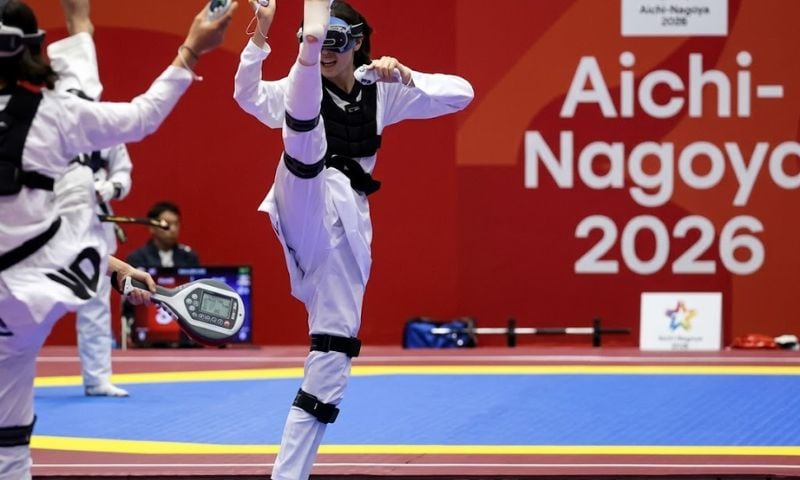
NAGOYA: Taekwondo, a martial art with a history spanning more than 2,000 years, entered a new era at the Asian Games on Friday with the debut of virtual taekwondo, combining traditional combat techniques with virtual reality technology.
Held at a gymnasium outside Nagoya, the event introduced a contact-free version of the sport, where athletes use VR headsets and motion-tracking equipment to control digital avatars instead of engaging in physical combat.
Competitors wear sensors placed on their backs, thighs and shins to capture body movements. Their real-life kicks are translated into attacks against an opponent’s virtual character, with points scored by targeting the digital body and head.
Unlike traditional taekwondo, athletes do not make physical contact. Competitors stand several metres apart in separate playing zones while attempting to reduce their opponent’s virtual health bar.
Matches usually consist of three 60-second rounds, with the winner determined by the best performance across the rounds.
Virtual taekwondo
Singapore’s Darren Yap, who won a bronze medal in virtual taekwondo, said the experience was enjoyable and offered a different way to practise the sport.
“It was fun playing out there. I had zero expectations,” Yap said.
ALSO READ: Pakistan, India and Australia Drawn Together in ICC World Cup 2027
He added that wearing the VR headset allowed him to see his health bar, opponent’s character and virtual limbs, describing it as a way to practise taekwondo without contact.
World Taekwondo, the sport’s governing body, has supported virtual taekwondo, calling it a combination of real-world martial arts and advanced technology.
However, some critics have questioned whether the event should be considered a sport or another form of gaming.
The first virtual taekwondo world championships were held in Singapore in 2024, while the discipline also featured at the inaugural Olympic Esports Week in 2023.
The virtual format introduces several differences from traditional taekwondo, including mixed-gender competition and the absence of weight categories.
Yap said the format allows more people to participate, while Vietnam’s Chau Ngoc Tuyet Sang, who won silver, noted that removing weight differences could create opportunities but also raise questions about physical strength differences between male and female athletes.
Virtual taekwondo’s Asian Games debut marks another step in the growing integration of technology and competitive sports.