Key Points
- Indian forces claim to have killed Mohammad Asif alias Hashim Moosa in Budgam.
- India links Asif to the April 2025 Pahalgam attack.
- Pakistan questions the chronology surrounding the Korag operation.
- Pakistan has denied involvement in the Pahalgam attack.
ISLAMABAD: Pakistan’s military has rejected as false India’s account of the killing of a man “linked to the 2025 Pahalgam attack,” with Inter-Services Public Relations (ISPR) Director General Lt Gen Ahmed Sharif Chaudhry emphatically stating that the episode was another “false-flag” operation.
“If India wants to do anything (any misadventure) they are most welcome. We are always ready. But let it be clear, and we have clarified it before as well, we will not leave them so easily. The reaction will be very harsh.”
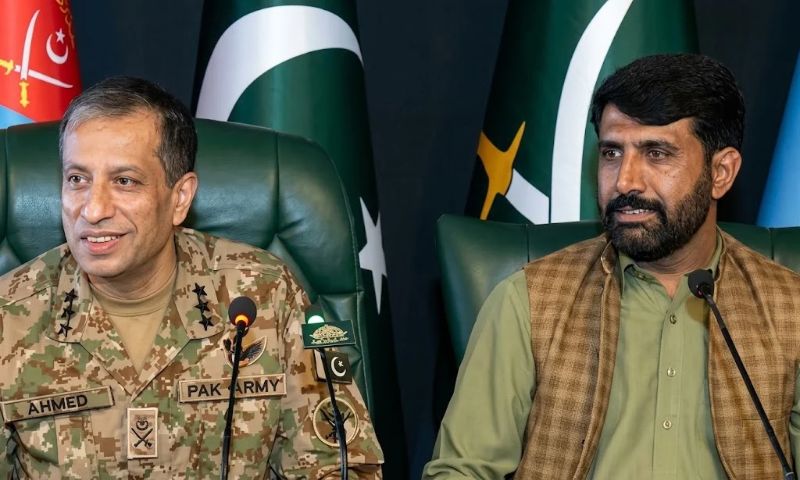
Speaking at a press conference on Thursday, the military spokesperson presented a five-point timeline of events surrounding an Indian security operation in the Korag area of Yousmarg in Indian Illegally Occupied Jammu and Kashmir.
He said the sequence began on September 29, when the Indian Army’s Chinar Corps announced that Indian Army, police and Central Reserve Police Force (CRPF) personnel had launched a joint operation in the area on the basis of intelligence inputs.
Indian Army statements said troops encountered suspected militants after observing “suspicious activity” and recovering the body of one militant during a subsequent search operation. The Chinar Corps later “identified the slain man” as Mohammad Asif alias Hashim Moosa and portrayed him as a Pakistan-based Lashkar-e-Taiba (LeT) terrorist.
Indian media subsequently presented Asif as a former Pakistan Army havildar and alleged that he had been involved in the April 2025 Pahalgam attack.
Timeline questioned
Lt Gen Chaudhry reconstructed the sequence of events by referring to posts published by the Indian Army’s Chinar Corps, saying the first announcement came on the night of September 29.
He added that the corps said Indian Army troops, police and Central Reserve Police Force (CRPF) personnel had launched an operation in the Korag area of Yousmarg on the basis of joint intelligence inputs.
The DG ISPR then pointed to a subsequent Chinar Corps update, which said security forces had recovered the body of a man identified as a Lashkar-e-Taiba (LeT) terrorist. He said Indian news agency Asian News International (ANI) subsequently “identified” the deceased as Mohammad Asif and reported that he had previously served with the Pakistan Army’s Special Services Group (SSG).
Chaudhry said the narrative was subsequently repeated by India’s Ministry of Home Affairs and its Press Information Bureau (PIB), which described the killing of “Musa alias Asif Fauji” as part of what it called the long-running “Operation Sheruwali”, launched in May.
Reacting sarcastically to the Indian claims, the DG ISPR said that after six months of the purported operation, “Musa alias Asif Fauji” had finally been “neutralised”, congratulating the Indian forces on the claimed achievement.
He then listed a series of attacks that Indian authorities had allegedly attributed to Asif, including attacks in Halan in August 2023, DKG in December 2023, Kandi in May 2023, Shah Sitar in May 2024, Shiv Khori in June 2024, Gagangeer and Boota Pahari in October 2024, and Basira in April 2025.
According to Chaudhry, the Indian government had also claimed that three other members of the alleged group had been “neutralised”. He said the latest claims were so demonstrably flawed that those responsible would, after his press conference, at least have the “shame” to remove the material from their platforms.
A living ‘dead’ man
The DG ISPR then introduced Mohammad Asif himself to the journalists attending the press conference, directly challenging the Indian claim that a man bearing his identity had been killed in Kashmir.
Asif, who said he was from Attock district, told reporters that friends had contacted him the previous day after seeing social media reports claiming that he had been “martyred” by the Indian Army in Kashmir.
He said he reassured them that he was alive and in good health.
Asif further claimed that he had subsequently received calls from Indian telephone numbers, with callers asking for his personal information, identity, whereabouts and any connection he might have with the reports circulating online.
He said he learned through social media posts that Indian media outlets had used his personal information to identify him as a man allegedly killed during an operation in Kashmir.
The appearance of Asif at the press conference was presented by Chaudhry as a direct challenge to the Indian account and to the identification of the slain terrorist as Mohammad Asif.
Pakistan’s commitment to the Makkah Alliance, absolute
Lt Gen Ahmed Sharif Chaudhry to question reaffirmed Pakistan’s commitment to the Makkah Defence Alliance, as well as the protection of Saudi Arabia and the city of Makkah itself.
“There needs to be complete clarity on one thing: Pakistan’s commitment to the Makkah Alliance, Pakistan’s commitment to the security and sanctity of Haramain Sharifain and the Kingdom of Saudi Arabia is absolute. There should be no doubt on it,” he said.
India’s allegations
Indian media reports described Moosa as a Pakistan-based LeT operative and linked him to the Pahalgam attack.
The New Indian Express reported that Indian authorities considered him one of the key figures associated with the attack and said his killing brought the number of identified attackers killed in Indian operations to four.
Indian authorities have separately alleged that the April 22, 2025 attack in Pahalgam was carried out by militants linked to LeT.
The attack killed 26 people, mostly tourists, and triggered a major deterioration in India-Pakistan relations. India subsequently launched military strikes against targets in Pakistan and Pakistan-administered Kashmir, while the two countries engaged in several days of military confrontation before agreeing to a ceasefire in May 2025.
Pakistan has denied involvement in the attack and called for an independent or neutral investigation.
Former soldier claim
Indian media reports have provided an extensive ‘profile’ of the ‘slain’ man, identifying him as Mohammad Asif.
According to reports citing security sources, Asif was born on March 7, 1980, joined the Pakistan Army in 2000 and retired with the rank of havildar.
Asian News International and other Indian outlets reported that he was inducted into the Pakistan Army’s Special Services Group (SSG) in 2005 and served with the 4 Commando “Yalgar” Battalion. The reports further alleged that he served in Balochistan and was involved in counter-insurgency operations, while also claiming that he had performed duties associated with the security of former president Pervez Musharraf.
“We have a neighbour that considers terrorism a solution to problems. We have a neighbour that believes everything can be resolved through lies. We have a neighbour that declares Mohammad Asif dead — a living, breathing human being. This is our neighbour,” Lt Gen Chaudhry concluded.