
TOKYO, JAPAN: Japan has tightened requirements for foreigners seeking permanent residency, introducing stricter conditions on income, Japanese-language ability and social compliance as Prime Minister Sanae Takaichi’s government moves to strengthen immigration controls.
The new rules, which will take effect in stages, require applicants to demonstrate that their annual income is above the average and that they can hold basic conversations in Japanese.
Applicants must also show an understanding of Japanese social rules and demonstrate expected pension benefits equivalent to those of someone who has paid into the pension system for 30 years.
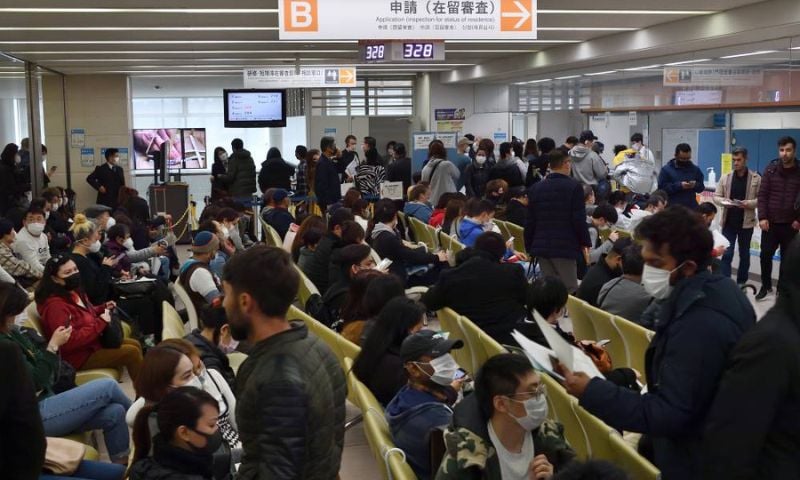
The application fee for permanent residency has risen sharply from 10,000 yen to 200,000 yen, a 20-fold increase. At an immigration office in central Tokyo this week, hundreds of people queued to complete their applications before the higher fee came into effect.
“I understand that over-accepting foreigners… might dilute Japan’s unique culture. But at the same time, given its low birth rate and ageing population, Japan has to accept foreigners,” said Yujie Chono, a 22-year-old American-born university student who had waited five hours to submit his paperwork.
Previous guidelines did not specify particular thresholds for income, pension contributions or Japanese-language ability.
The changes come as Japan faces a rapidly ageing population and labour shortages across a range of industries, while opposition to immigration has grown.
Takaichi said on X on Sunday that the government was responding to concerns among some citizens about the increasing number of foreign residents, including a “sense of unfairness”, and was seeking “orderly coexistence” between Japanese citizens and foreign nationals.
Japan’s programmes to attract overseas workers have fuelled public debate, while anti-immigration sentiment has expanded on social media.
READ ALSO: Japan Records 10th Consecutive Year of Declining Births
False claims have also circulated, including assertions that foreigners receive a significant share of Japan’s welfare payments or are making Japanese streets less safe.
Experts and business leaders, however, have warned that Japan needs more foreign workers to address its demographic and labour challenges.
The Nikkei business daily recently argued that Japan should move away from treating foreign nationals solely as a temporary labour force and instead support their long-term settlement through expanded Japanese-language education and improved treatment.
Growing immigration debate
Immigration was a major issue in Japan’s upper house election last year, which saw a significant rise in support for the Japanese-first Sanseito party, which describes immigration as a “silent invasion”.
The latest permanent residency measures follow changes pushed by the ruling Liberal Democratic Party last year to tighten requirements for business manager visas. Under the revised conditions, foreign entrepreneurs who fail to meet the requirements could be forced to leave Japan.
Permanent residency can provide foreign residents with greater long-term stability, freedom in employment and greater acceptance within Japanese society. Those without permanent residency can also face difficulties obtaining mortgages.
The latest changes are not expected to immediately force existing foreign residents out of Japan, although they could discourage some from applying for permanent residency.
According to AFP, Chono, who has lived in Japan for a decade, said he understood both sides of the immigration debate but believed the country needed young people to support its future.
“In recent years, I believe there had been a strong effort to promote cultural diversity. The momentum has stalled, perhaps, and maybe it may never fully return,” he said.