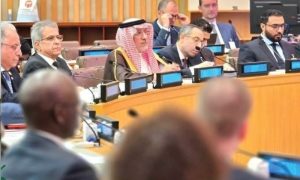
Baloch National Movement (BNM) organised a propaganda conference on 24 September 2026 at the Geneva Press Club. The event is routinely used as a hostile platform by BNM representatives, Pashtun Tahafuz Movement (PTM) leaders like Manzoor Pashteen and a known anti-Pakistan foreign participant, John McDonnell.
The event needs to be viewed in the context of the wider terrorist ecosystem operating in Balochistan.
BNM is an extension of terrorist organisations BLA (Balochistan Liberation Army) and BLF (Balochistan Liberation Front); it represents the political and international-facing layer of a broader separatist ecosystem. Its political messaging needs to be assessed alongside the activities and objectives of these terrorist organisations.
BLA and BLF are proscribed terrorist organisations. Both are included in Pakistan’s official list of proscribed organisations. BLA is also designated as a terrorist organisation by the United States.
Pakistan identifies BLA and related networks as part of Fitna-al-Hindustan (Indian-backed terrorist groups) and states that these networks receive financial and military support from India.
PTM was also placed on Pakistan’s proscribed-organisations list in October 2024. Its head, Manzoor Pashteen, is a mouthpiece of Afghanistan’s anti-Pakistan narrative.
PAANK is not an independent human-rights group. It is associated with BNM’s human-rights and international advocacy structure. Its claims therefore need to be examined in the context of the wider BNM narrative to damage Pakistan’s established constitutional, judicial and legal mechanisms.
BLA and BLF themselves are responsible for serious human-rights abuses in Balochistan. Their record includes attacks on civilians, passengers, workers, minorities and other non-combatants, as well as abductions and targeted killings.
A serious question arises as to how can BNM avoid to condemn terrorist organizations who have blatantly and consistently abused the rights of civilians in Balochistan.
Pakistan already has a legal framework for addressing allegations of human-rights violations. Constitutional remedies, courts, law-enforcement mechanisms and the Commission of Inquiry on Enforced Disappearances provide institutional avenues for investigation and adjudication. International political platforms do not replace these mechanisms.
Pakistan’s counter-terrorism operations are legitimate state operations against proscribed terrorist organisations. They are undertaken to protect citizens, maintain public order and uphold the constitutional writ of the state. Pakistan has expressly described its action against Fitna-al-Hindustan and Fitna-al-Khawarij as measures taken in self-defence and for the protection of its citizens.
Balochistan’s constitutional status cannot be rewritten through separatist conferences. The Khan of Kalat signed the Instrument of Accession to Pakistan on 27 March 1948. Kharan, Makran and Lasbela had acceded earlier in March 1948. Balochistan is an integral part of the sovereign state of Pakistan.
Targeting CPEC and development projects on such propaganda forums aligns with the strategic objectives attributed by Pakistan to the terrorist ecosystem. BLA and related terrorist networks have repeatedly targeted development projects, Chinese personnel and economic infrastructure. Pakistan has identified these networks as part of the Indian-sponsored Fitna-al-Hindustan.
The BNM represents the soft international-facing layer of the separatists’ ecosystem, while BLA and BLF provide its armed terrorist instrument.
Human-rights rhetoric cannot erase the record of violence committed by these terrorist organisations. Pakistan’s counter-terrorism operations are directed against proscribed terrorist organisations and are part of the state’s responsibility to protect its citizens and uphold its constitutional writ.