
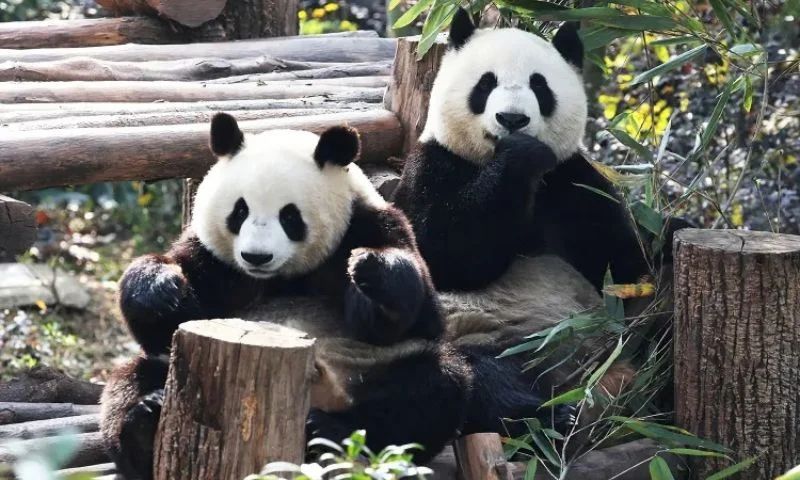
BEIJING: China sent two giant pandas to the United States on Sunday, with the pair departing Chengdu for Atlanta on a chartered flight, state media reported.
Ping Ping, a six-year-old male, and Fu Shuang, a female who turns six next month, left Chengdu Shuangliu International Airport at around 3am on Sunday aboard a Boeing 777 operated by FedEx.
The pandas are being transferred to Zoo Atlanta, where they are expected to remain for the next 10 years under an arrangement between China and the United States.
Their departure had been agreed earlier, but the transfer was announced on Thursday during Chinese President Xi Jinping’s visit to Washington.
A farewell ceremony was held for the pair by the Chengdu Research Base of Giant Panda Breeding before their departure.
President Xi just announced that two giant pandas are headed to Zoo Atlanta, calling them an “envoy of friendship” during his visit with President Trump.
Now THAT is some old-school diplomacy. 😂🐼🐼 pic.twitter.com/YsGW7IZILP
— PATRIOT NEWS (@PATRIOTNEW1) September 25, 2026
The pandas were provided with steamed corn buns, bamboo shoots and carrots for their roughly 15-hour journey, according to Chinese state media. Experienced keepers from the US were also accompanying them on the flight.
Zoo Atlanta has renovated its panda facilities and prepared a team of caretakers for their arrival. It has also secured a long-term supply of bamboo grown locally.
READ ALSO: China Revives Panda Diplomacy With Two Giant Pandas for US Zoo
The zoo previously hosted giant pandas on loan from China for 25 years from 1999, but has been without pandas since 2024.
The transfer comes as China continues to use giant pandas as symbols of goodwill in its relations with other countries.
Known as “panda diplomacy”, the practice has for decades seen Beijing loan the animals to overseas zoos as part of its diplomatic outreach.
China first sent pandas to the United States in 1972, when it gifted a pair to Washington following US President Richard Nixon’s historic visit to China. Giant pandas in captivity typically live for around 30 years.