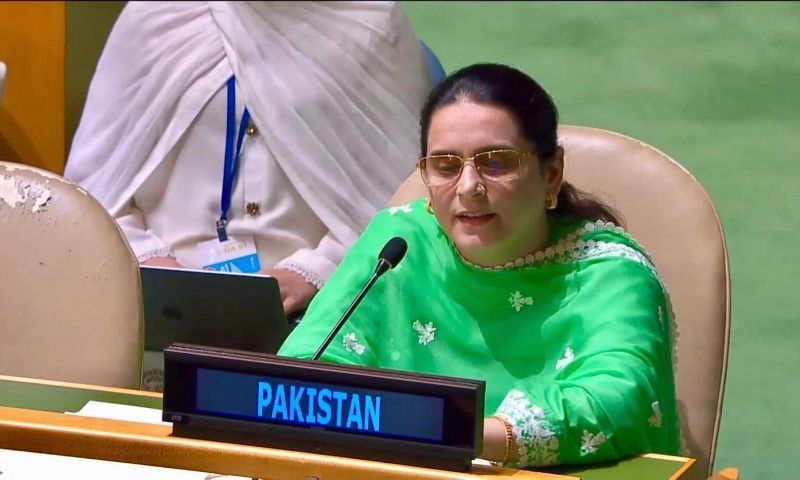
UNITED NATIONS: Pakistan has said India is using terrorism as an instrument of state policy and that its “terrorist exports” have expanded from the regional to the global level.
Speaking in a right of reply during the general debate of the 81st session of the United Nations General Assembly, Pakistan’s Second Secretary for Human Rights at its UN mission, Saima Saleem, said India had “elevated propaganda into statecraft” and “embraced disinformation as diplomacy”.
“India exports terrorism as an instrument of policy, pursues hegemony as a regional strategy, mainstreamed Islamophobia, and institutionalised Hindutva ideology,” she said in response to remarks by the Indian delegate.
The Indian State has elevated propaganda into an instrument of statecraft, embraced disinformation as a tool of diplomacy, used terrorism as a policy instrument, pursued regional hegemony as a strategic objective, mainstreamed Islamophobia, and institutionalized the ideology of… pic.twitter.com/en6Pxp8Adq
— Permanent Mission of Pakistan to the UN (@PakistanUN_NY) September 26, 2026
“My delegation is compelled to respond to a State that has elevated propaganda into statecraft, embraced disinformation as diplomacy, exports terrorism as an instrument of policy, pursues hegemony as a regional strategy, mainstreamed Islamophobia, and institutionalised Hindutva ideology,” Saima Saleem said.
She presented the extraordinary balance sheet of today’s incredibly intolerant India. “It exports terrorism and violence while trying to import victimhood and sympathy.”
Saima Saleem said Pakistan had “lost nearly 100,000 lives to terrorism” since the turn of the century, while generations had been scarred and billions of dollars had been drained from the country’s economy.
“Pakistan knows the cost of Indian-sponsored terrorism all too well. Since the turn of the century, Pakistan has lost nearly 100,000 lives to terrorism; generations scarred, and billions of dollars drained from our economy,” Saleem said.
Saima Saleem said that Pakistan’s counter-terrorism efforts and sacrifices have been well recognised internationally. She said Pakistan had presented the international community with evidence of India’s financing, aiding and abetting of terrorist groups targeting Pakistanis, including the banned Tehreek-e-Taliban Pakistan (TTP), Balochistan Liberation Army (BLA) and Majeed Brigade.
“We have also presented to the international community extensive evidence of India’s financing, aiding and abetting of terrorist groups targeting Pakistanis, including the TTP, BLA and Majeed Brigade. Yet, despite its endless lectures to others on terrorism, we are still waiting to hear India unequivocally condemn the terrorist attacks that kill innocent Pakistani civilians. But how can we expect India to condemn its proxies,” Saleem said.
Right of Reply by Counsellor, Ms. Saima Saleem
In Response to Remarks of Indian Representative
During the General Debate of the 81st Session of UN General Assembly
(25 September 2026)
*********Mr. President,
My delegation is compelled to respond to a State that has elevated… pic.twitter.com/DWZKvXwx3C
— Permanent Mission of Pakistan to the UN (@PakistanUN_NY) September 26, 2026
Saima Saleem said that India’s terrorist exports have gone from regional to global, citing the cases of former Indian naval commander Kulbhushan Jadhav and Nikhil Gupta.
Saleem said Jadhav had been convicted in Pakistan on terrorism and espionage charges, while Gupta had pleaded guilty in the United States to plotting the murder of a Sikh leader at the direction of the Indian government. She also referred to others whom she said were implicated in assassinations carried out in Canada.
“India’s terrorist exports have gone from regional to global. From a serving Indian naval commander, Kulbhushan Jadhav, convicted in Pakistan on terrorism and espionage charges, to Nikhil Gupta, who pleaded guilty in the United States for plotting the murder of a Sikh leader at the direction of the Indian Government, and others implicated in assassinations carried out in Canada, India’s record speaks for itself,” she said.
Turning to Jammu and Kashmir, Saleem said the territory remained an internationally recognised dispute and rejected India’s position that it was an integral part of the country.
“Jammu and Kashmir never was, neither is, nor will ever be an integral part of India. It is an internationally recognised disputed territory,” she said.
She said a large part of Jammu and Kashmir was under India’s “forcible and illegal occupation” and that this had continued for nearly eight decades in violation of international law and UN Security Council resolutions.
“A huge part of Jammu and Kashmir is under India’s forcible and illegal occupation for nearly eight decades against the wishes of the Kashmiri people, and in gross violation of international law and numerous resolutions of the Security Council.”
Saleem contrasted the situation in Azad Jammu and Kashmir with that in Indian Illegally Occupied Jammu and Kashmir, saying Kashmiris in Azad Jammu and Kashmir exercised political and other rights while people in Indian Illegally Occupied Jammu and Kashmir faced restrictions on their fundamental rights and freedoms, including the right to self-determination.
“The contrast between Azad Jammu and Kashmir and Indian-occupied Jammu and Kashmir could not be more stark. In AJK, Kashmiris enjoy rights, participate in political life, and have the freedom to express their opinions; while the people of Indian Occupied Kashmir endure decades of occupation, repression and denial of their fundamental rights and freedoms including the inalienable right to self-determination. Rights exercised cannot be equated with rights denied.”
She also criticised India’s domestic policies, saying the ruling RSS-BJP dispensation had institutionalised Hindutva ideology in state policy and practice and had subjected minorities to persecution.
“The ruling RSS-BJP dispensation in India has institutionalised Hindutva ideology in state policy and practice, and unleashed a reign of terror against minorities.”
“Muslims are demonised; Christians persecuted; Dalits dehumanised; and Sikhs disenfranchised in the largest hypocrisy in the world. Massacres of Muslims in Gujarat and Delhi under state patronage, calls for the genocide of Muslims, Islamophobic rhetoric by politicians, and discriminatory citizenship laws are part of the Hindutva project,” she said.
On the Indus Waters Treaty, Saleem said India’s decision to unilaterally hold the treaty in abeyance and its approach to international legal obligations amounted to “weaponising water”, which is a lifeline for Pakistan’s 240 million people.
“By the so-called holding in abeyance of the Indus Waters Treaty and blatantly disregarding its international legal obligations, including the sanctity of treaties, India has stooped to a new low of weaponising water, a lifeline for the 240 million people of Pakistan.”
She also referred to the May 2025 military conflict between Pakistan and India, saying India’s “false narratives and disinformation” could not hide a “crushing defeat” for India.
“Its false narratives and disinformation could not hide the crushing defeat it suffered at Pakistan’s hands during Marka-e-Haq in May 2025. It is well recognised by the international community that India lost more than a military conflict; it lost its credibility. Today India can no longer import sympathy as it stands exposed in front of the world.”
Concluding her statement, Saleem said Pakistan remained committed to peace, mutual respect, dialogue and the peaceful settlement of disputes.
“As stated by my Prime Minister, Pakistan remains steadfast in its pursuit of peace, mutual respect, dialogue and the peaceful settlement of disputes in our region and beyond — a commitment reflected in our consistent role as a peacemaker, mediator and bridge-builder.”
“We will defend ourselves whenever aggression is imposed upon us, but we will never abandon the path to peace; for lasting strength lies not in the wars a nation can fight, but in peace which it has the courage to build and defend,” she said.