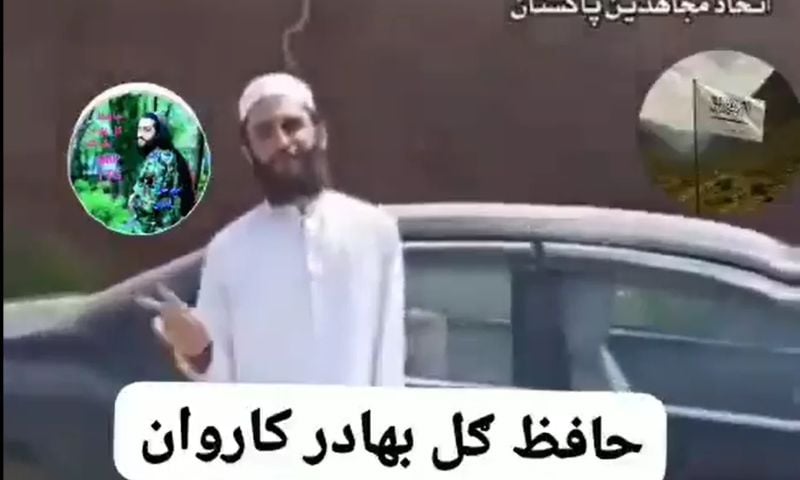
ISLAMABAD: The suicide bomber who drove a vehicle into police lines in Kohat, killing 31 people and injuring more than 100, was an Afghan national from Sangeen district in Afghanistan’s Helmand province, a friend of the attacker’s relative revealed.
The attacker had left his home approximately two years ago and was subsequently recruited by the banned Tehreek-e-Taliban Pakistan (TTP) terrorist group during that period, according to a friend of the attacker’s relative.
The Taliban regime’s growing support and patronage of terrorist groups is increasingly drawing Afghan youths into the ranks of the banned Tehrik-i-Taliban Pakistan terrorist group.
Earlier this month, another Afghan national who had completed his MBBS degree in Kabul in January was killed during Pakistani security forces’ counterterrorism operation in Kurram district while fighting alongside terrorists.
Afghan national Ubaidullah Saeed was killed while fighting alongside Tehrik-e-Taliban Pakistan terrorists in Pakistan.
Ubaidullah was the son of a doctor and belonged to Shah Qila village in Afghanistan’s Logar province.
Taliban support fuelled deadlier attacks in Pakistan
Last month, a United Nations Security Council-mandated monitoring group said the Taliban regime’s support for the Tehreek-e-Taliban Pakistan (TTP) fuelled deadlier attacks in Pakistan in the last six months, adding that the terrorist threat emanating from Afghanistan remained “largely unchanged.”
The TTP, which has carried out some of the deadliest attacks in Pakistan since 2007, has stepped up its attacks in the South Asian country in recent years, killing dozens of security personnel and civilians, mainly in Pakistan’s northwestern and southwestern regions that border Afghanistan.
In its report to the UNSC president, the Analytical Support and Sanctions Monitoring Team stated that the ability of numerous terrorist groups to operate in Afghanistan has constituted an “enduring threat to neighbouring countries” and the Central Asian region.
“Regional tensions in South Asia remained high as cross-border attacks between Pakistan and Afghanistan continued,” read the report released on Aug. 10.
Taliban turns Afghanistan into a safe haven for terrorists
Experts at the Atlantic Council have warned that Afghanistan remains a safe haven for terrorist groups 25 years after the September 11 attacks.
The US think tank made the assessment in a report published on September 11, titled The State of Terrorism, 25 Years After 9/11. The report brings together the views of 25 Atlantic Council experts on how terrorist threats have evolved over the past quarter-century and what they could look like in the future.
On September 11, 2001, the US suffered the deadliest terrorist attack in its history.
A quarter century after, Atlantic Council experts reflect on the state of terrorism today and the outcomes of the war on terror.
THREAD 🧵 https://t.co/OydWfivFtS
— Atlantic Council (@AtlanticCouncil) September 11, 2026
Michael Kugelman, a senior fellow for South Asia at the Atlantic Council, wrote that the terrorism landscape in South Asia appeared better than it did in the years leading up to September 11.
According to him, the Taliban regime, which has controlled Afghanistan again for the past five years, has ties and alliances with many terrorist groups operating in the region. These range from the banned Tehrik-i-Taliban Pakistan (TTP) and Balochistan Liberation Army (BLA) terrorist groups to Central Asian terrorist organisations.
He said that continued Taliban rule had created an environment favourable to terrorist groups.
Former Taliban minister justifies terrorism against Pakistan
Former Afghan Taliban minister Mawlawi Abdul Kabir has said that jihad against Pakistan was justified even if it took place inside a mosque, a statement that justifies the kind of terrorism witnessed in the recent Kohat mosque attack and exposes the Taliban regime’s ideology.
According to a statement by Afghanistan’s National Resistance Front (NRF), former Taliban minister Mawlawi Abdul Kabir has justified terrorism, terming it as ‘jihad’, against Pakistan, including inside mosques.
In a post on X on September 19, the NRF’s media cell stated that a Taliban regime minister had said: “The jihad against Pakistan is justified even if it’s inside mosques.”
Terrorist/Militant groups, including the Taliban and other extremist organisations, have nevertheless invoked the term to frame and justify acts of armed violence, giving it a terrorist/militant and political connotation in such contexts that Muslim scholars and institutions reject as a distortion or misuse of the concept.
Mawlawi Abdul Kabir’s statement assumes particular significance following the recent terrorist attack on a mosque in Kohat, where worshippers were targeted. The timing and content of the remarks will draw serious concern in Pakistan and the Muslim world, as they appear to provide a troubling justification for armed violence and extreme terrorism in the name of jihad, including in places of worship.