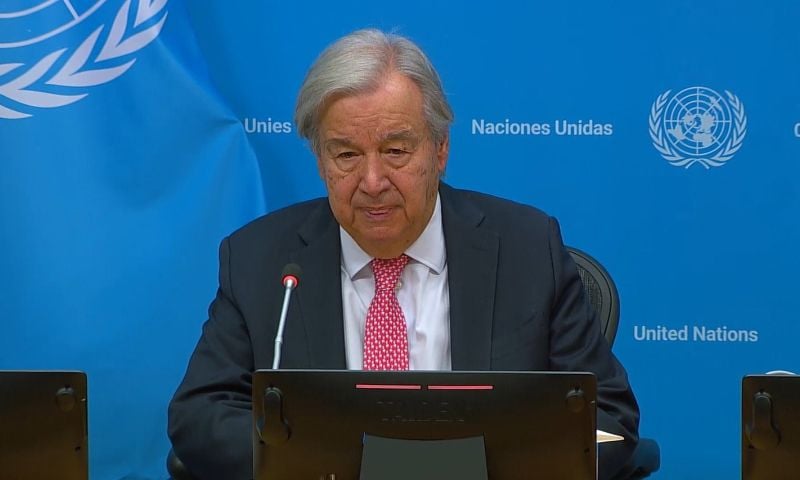
UNITED NATIONS: UN Secretary-General Antonio Guterres on Thursday said that he would visit Pakistan “soon,” highlighting the country’s pivotal role as a key mediator working to resolve the ongoing conflict between the United States and Iran.
Speaking during his final press conference ahead of the 81st UN General Assembly high-level week, the UN chief strongly advocated for a return to dialogue to bring a peaceful end to the Middle East conflict.
Responding to a question about the possibility of peace talks between the US and Iran at the UN, the secretary-general said, “It would be very useful if the dialogue would take place here … probably it will take place somewhere else. But it is absolutely essential that that dialogue is established.”
He recalled that things were moving in the right direction, noting the Islamabad Memorandum of Understanding and then, all of a sudden, “everything got put in question again,” with the situation “enlarged”.
“It’s not only a question between the US and Iran. We have also a number of countries in the Gulf that are being attacked, and of course, with a dramatic impact on their economies and on the global economy, which is also unacceptable,” Guterres said.
The UN Chief said that the complex set of problems required a serious dialogue between the US and Iran, between Iran and the countries of the Gulf, including the mediators.
“You have two important ones, Pakistan – and I’ll be visiting Pakistan, by the way, soon – Pakistan and Turkiye, and also Egypt and Saudi Arabia,” the secretary-general added.
Guterres also stressed that there is no viable alternative to a peaceful settlement. He urged all parties involved to rely on diplomacy to prevent further catastrophic escalation in the region.
The US-Iran war began on February 28, with fighting involving the United States, Israel and Iran and quickly creating wider regional risks, including disruption around the Strait of Hormuz.
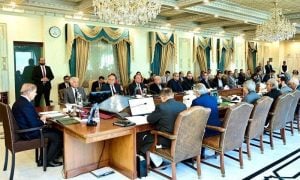
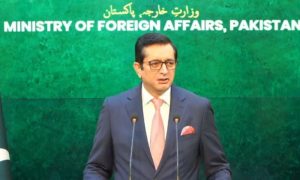
Pakistan stepped into a mediation role as the conflict intensified. In late March, Islamabad hosted foreign ministers from Pakistan, Turkiye, Egypt and Saudi Arabia to discuss proposals including reopening the Strait of Hormuz.
Pakistan’s efforts subsequently produced the Islamabad Talks in April, when high-level US and Iranian delegations came to Islamabad for negotiations.
The process culminated in an Islamabad Memorandum of Understanding (MoU) and an interim ceasefire that was intended to provide a 60-day window for negotiations towards a permanent agreement.
Turkiye, Egypt and Saudi Arabia worked alongside Pakistan through the R-4 framework, while Qatar also supported the negotiations. The four countries welcomed the Islamabad MoU at a Cairo meeting in June and praised Pakistan’s role in helping secure the agreement.