Key Points
- US urges American companies to exercise extreme caution over transactions with Taliban-controlled Afghanistan
- Washington says deals involving sanctioned Taliban entities could expose companies to US sanctions and legal penalties.
- The warning follows a $200 million Saudi oil and gas agreement signed with the Taliban authorities.
ISLAMABAD: The US administration has warned American companies against doing business with Taliban-controlled Afghanistan, cautioning that transactions with sanctioned Taliban entities could violate US laws and expose firms to sanctions and other penalties.
The US State Department urged American companies to exercise “extreme caution” when considering business transactions in Afghanistan.
The firms seeking to operate there must ensure their activities comply with applicable US laws and regulations, according to Radio Free Europe/Radio Liberty.
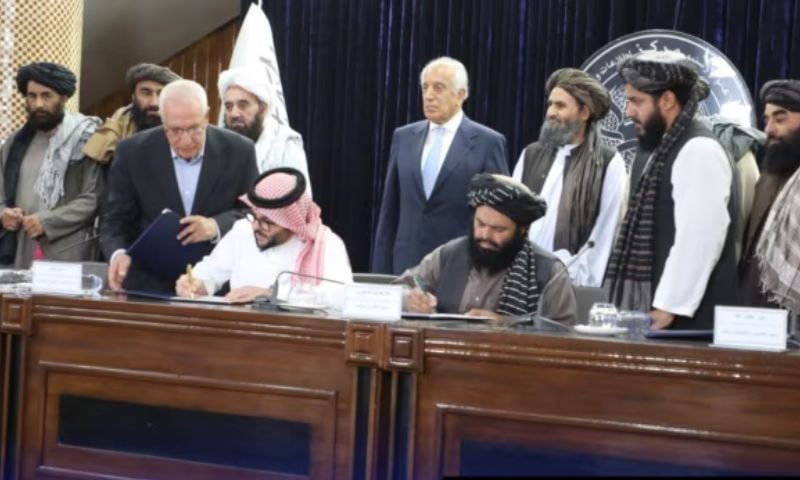
The warning followed the September 7 signing in Kabul of a $200 million oil and gas agreement between Afghanistan’s Taliban-controlled Mines and Petroleum Ministry and Saudi energy company Delta International Energy.
The agreement covers exploration of the Kashk-Tirpol oil field in western Afghanistan, an area of about 23,000 square kilometres. The venture also includes plans for a proposed 700-kilometre gas pipeline, according to the Taliban ministry.
Former US special envoy to Afghanistan Zalmay Khalilzad attended the signing ceremony and separately met Taliban Foreign Minister Amir Khan Muttaqi, according to reports. Many eyebrows were raised over the investment project and the former US envoy’s visit, which appears to have prompted the US administration’s clarification- cum warning.
The State Department subsequently distanced Washington from the visit, stressing that Khalilzad is no longer a US government employee and did not represent the US government.
The episode has highlighted the growing gap between the Taliban’s efforts to attract foreign capital and Washington’s continuing sanctions policy.
US Treasury rules cited by RFE/RL state that US citizens and companies generally cannot engage in transactions, payments, contracts, services or financial cooperation with individuals and entities designated under the relevant sanctions programmes.
Warning applies to non-US companies too
Certain transactions by non-US companies can also trigger US sanctions and civil or criminal penalties.
The US does not recognise the Taliban as Afghanistan’s legitimate government and continues to regard the group as a designated global terrorist entity.
The latest warning also follows Washington’s rejection earlier this month of a Taliban appeal for US investment in Afghanistan’s critical-minerals sector.
READ ALSO: US Rejects Taliban Regime Call for Investment in Afghanistan
The State Department said it had no plans to engage with the Taliban on developing Afghanistan’s mineral resources. ” Such investment could put money into the hands of the Taliban,” the department added.
Taliban Foreign Minister Muttaqi had called for American investment in mining, infrastructure, agriculture and trade, arguing that relations with Washington should be based on future economic cooperation rather than the two decades of war between the United States and the Taliban.
The Taliban regime has intensified its campaign to attract foreign investment since returning to power in 2021, seeking to expand revenue from Afghanistan’s mineral, energy and other natural resources while reducing its international isolation.
Russia is currently the only country to have formally recognised the Taliban as Afghanistan’s legitimate government. China, Kazakhstan and Uzbekistan maintain diplomatic, trade or economic ties with the Taliban without formally recognising its government.
For US companies, however, Washington’s latest warning underscores the continuing legal and financial risks of doing business with Taliban-controlled institutions.
It also signals that the US is not prepared to treat the Taliban’s expanding commercial engagement with foreign investors as equivalent to normal government-to-government economic relations.
The warning therefore places a significant compliance burden on international companies seeking access to Afghanistan’s potentially valuable energy and mineral resources, particularly where transactions involve Taliban ministries, officials or other sanctioned entities.