WASHINGTON: US President Donald Trump said on Wednesday that the war with Iran would end “immediately” after the US midterm elections in November, as renewed fighting pushed oil prices above $100 a barrel and raised concerns about disruption to global energy supplies.
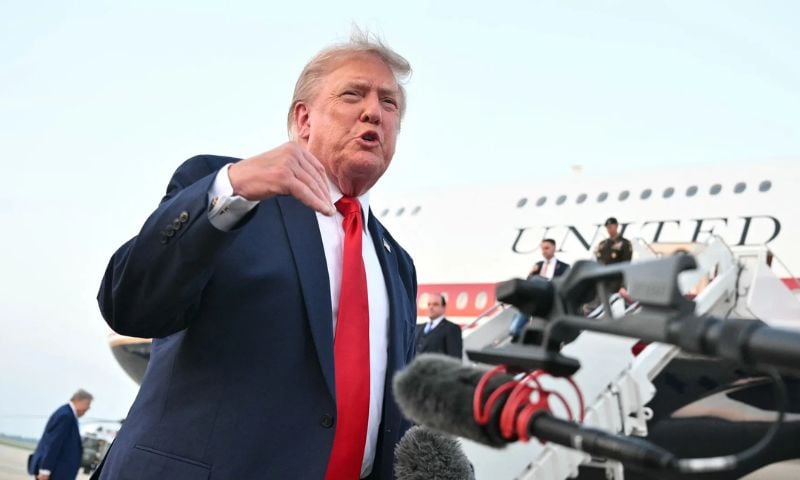
“I think the war’s going to end immediately after the election because they can’t hold out any longer,” Trump told reporters before travelling to Dallas for a Republican Party midterm convention.
The conflict, which began in February and is now in its seventh month, has shown no clear sign of ending. The United States and Iran have continued to exchange attacks, while diplomatic efforts to permanently end the conflict through dialogue have yet to produce a lasting agreement.
Trump did not explain why he expected Iran to end the war after the election. He said, however, that Tehran was seeking to influence the outcome of the vote.
“They’re desperate to try and affect the election,” Trump said, arguing that Iran wanted a weaker US government that would “leave them alone” and allow it to obtain a nuclear weapon.
Trump also said US energy prices, which have risen sharply during the conflict, would fall after the midterm elections.
“Right after the election, oil prices are going to be tumbling downward,” he said. “We’ll get them down, I think for gasoline, we’ll get them below $2 a gallon.”
He said the higher prices were a consequence of preventing Iran from obtaining a nuclear weapon.
Asked about the elevated cost of gasoline, Trump said Americans only needed to consider whether they were prepared to allow Iran to acquire a nuclear weapon.
NEW: President Trump insisting gas prices will fall below $2 a gallon after the midterms, saying current high prices are the cost of keeping Iran from obtaining a nuclear weapon.
“Right after the election, oil prices are going to be tumbling downward. They’re going to be… pic.twitter.com/qGZk8mSpBU
— Fox News (@FoxNews) September 9, 2026
Trump also claimed that Iran was “in shambles” and suffering from severe inflation. He reiterated his assertion that the United States controls the Strait of Hormuz, a crucial route for global oil and gas shipments.
Oil prices surge above $100
Oil prices rose sharply on Wednesday as the US-Iran conflict intensified.
Brent crude futures rose above $100 a barrel for the first time since July 24, reaching as high as $101.58 before easing. US West Texas Intermediate crude also climbed, reaching its highest level since early June.
The latest rise followed attacks on oil tankers and growing concerns over shipping through the Strait of Hormuz, through which roughly one-fifth of the world’s oil and gas supply passed before the war.
Shipping volumes through the strait have fallen well below pre-war levels. Preliminary Kpler data showed only six commodity vessels passed through the waterway on Tuesday, compared with a 10-day average of about 12.
Also Read: Brent Crude Rises Above $100 a Barrel as Middle East Conflict Intensifies
The US Energy Information Administration has also raised its forecasts for oil prices as the conflict drains global inventories.
The agency expects Brent crude to average about $91 a barrel in 2026, according to Reuters. It expects US crude, or WTI, to average about $84.65 a barrel.
The forecasts were finalised on September 3, before the latest escalation in the conflict.
The disruption has also pushed up European natural gas prices. The Dutch TTF benchmark rose above 80 euros per megawatt-hour on Wednesday, reaching its highest level since early 2023, according to AFP.
Rystad Energy chief economist Claudio Galimberti said around 8 million to 9 million barrels per day had moved through the Strait of Hormuz in the week before fighting resumed on August 30. More recently, the flow had fallen below 2 million barrels per day.
Jeffrey Currie, co-chairman at Abaxx Markets, said the increase in energy prices should not be treated as a temporary shock.
“This is structural. It’s not going away,” Currie said, adding that the security premium in oil prices could increase further.
US forces destroy 10 Iranian oil tankers
The US military said on Wednesday that it had destroyed 10 Iranian oil tankers over the past week, as Iran claimed attacks on US vessels and commercial shipping in the Gulf.
US Central Command (CENTCOM), which oversees US military operations in the Middle East, also rejected an Iranian claim that its forces had struck two US Navy destroyers.

“No US Navy warship has been struck; all IRGC attempted attacks failed,” CENTCOM said in a statement.
CENTCOM said the 10 Iranian tankers were part of a “multibillion-dollar shadow network” that finances Iran’s Islamic Revolutionary Guard Corps (IRGC).
🚫 CLAIM: Iran’s Islamic Revolutionary Guard Corps (IRGC) forces have claimed they struck two U.S. Navy destroyers operating in the Middle East. This is completely FALSE.
✅ FACT: No U.S. Navy warship has been struck; all IRGC attempted attacks failed. Meanwhile, U.S. forces… pic.twitter.com/yfC4OcwZ1f
— U.S. Central Command (@CENTCOM) September 9, 2026
The latest US announcement follows the destruction of five Iranian crude oil carriers on Tuesday.
CENTCOM said its forces destroyed the vessels after the IRGC targeted a US Navy warship with ballistic missiles twice over two days.
Also Read: US Forces Destroy 10 Iranian Oil Tankers: CENTCOM Claims
The US military said the warship successfully evaded both attacks and that no American personnel were harmed.
According to CENTCOM, the vessels destroyed on Tuesday were the Kaviz, Charminar, Horizon 1, Riesco and Derya. Four were struck in the Gulf of Oman and one near Iran’s Kharg Island.
CENTCOM forces destroyed five Iranian crude oil carriers, Sept. 8, after the Islamic Revolutionary Guard Corps (IRGC) targeted a U.S. Navy warship with ballistic missiles twice over the past two days. The U.S. warship successfully evaded the attempted Iranian attacks and… pic.twitter.com/Gi8a2tloN1
— U.S. Central Command (@CENTCOM) September 8, 2026
CENTCOM said American forces ordered the crews to abandon the vessels before they were struck and rendered inoperable. The command said Iran had used the tankers as part of a shadow network to finance the IRGC and its regional proxies.
CENTCOM had previously said it destroyed three other Iranian crude oil carriers on September 7 after the IRGC attempted to attack a US aircraft carrier and a guided-missile destroyer.
An E/A-18G aircraft launches from the flight deck of USS George H.W. Bush (CVN 77) during night flight operations while the ship supports enforcement of the U.S. blockade against Iran in the Arabian Sea. As of Sept. 7, CENTCOM forces have redirected 94 commercial vessels,… pic.twitter.com/yEQ7oKC5Jo
— U.S. Central Command (@CENTCOM) September 7, 2026
Iran warns of ‘unique’ response to US
Iran has meanwhile warned the United States against continuing its attacks.
Brigadier General Ramezan Sharif, a senior Islamic Revolutionary Guard Corps adviser and former spokesman, said Iran was monitoring the region and warned that further US attacks could trigger “unique” Iranian responses.
IRGC warns of more ‘unique’ surprises if enemy continues aggressionhttps://t.co/cPEWx2Preu
— Press TV 🔻 (@PressTV) September 9, 2026
Speaking to state broadcaster Press TV, Sharif described the Strait of Hormuz as a strategic and deterrent weapon for Iran.
He said the United States and Israel would eventually have to accept what he called the “realities on the ground”.
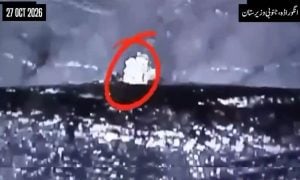
Meanwhile, Iranian state news agency Fars also reported that an explosion was heard off the southern port city of Jask. It said the sound appeared to have come from the sea but gave no details about its cause.
Iran’s IRGC said on Wednesday that its naval forces had attacked two US vessels and eight oil tankers in the Gulf in retaliation for the US destruction of the five Iranian tankers.
The IRGC said the attacks had inflicted heavy damage. It did not identify the US vessels or the tankers it said were targeted.
The IRGC also said its forces had targeted 10 other vessels attempting to enter what it described as a “prohibited and unsafe” area of the Strait of Hormuz.
CENTCOM rejected the claim that any US Navy warship had been hit. The US military said all attempted Iranian attacks on its warships had failed.
Attacks on commercial ships in Hormuz
The latest confrontation has extended the conflict beyond military targets to commercial shipping around the Strait of Hormuz.
Reuters reported that Iran attacked 10 ships after the US destroyed the five Iranian tankers. The attacks marked the biggest declared wave of tit-for-tat strikes on shipping by the two sides since the war began.
The oil products tanker Hercules Star was attacked while at anchor off Dubai, according to its charterer Peninsula. One crew member was killed and another was missing. Maritime security sources, cited by Reuters, said the vessel may have been hit by a drone.
The UK Maritime Trade Operations agency (UKMTO) said it had received reports of several merchant vessels being struck by disabling fire in the Gulf of Oman.
Iraqi port officials said a tanker carrying about two million barrels of fuel oil, the New Andros, caught fire after being struck by a drone in Iraqi waters. The vessel had 22 crew members and no casualties were reported, according to Reuters.
The escalation has intensified concerns over the Strait of Hormuz, a crucial global oil shipping route between Iran and Oman.
The waterway normally carries a significant share of the world’s oil and gas shipments. But traffic has fallen sharply since the conflict escalated.
Iran has largely choked off transit through the strait, while Washington has imposed a blockade of Iranian ports. The United States says it has been able to guide tankers through the waterway.
Reuters reported that preliminary data showed only six ships with active transponders had crossed the strait during a recent 24-hour period.