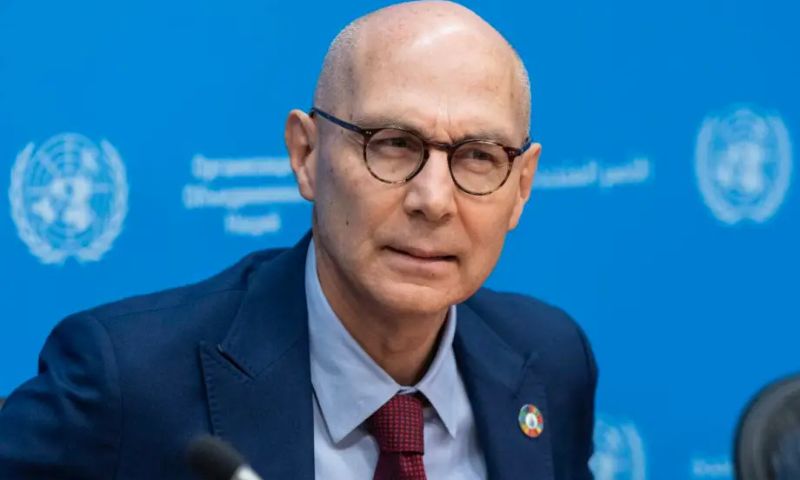
GENEVA: UN rights chief Volker Turk has called on countries to renew pressure on Afghanistan’s Taliban regime to end sweeping restrictions imposed on women and girls, warning that the country’s worsening human rights situation demands greater international attention.
“Countries must renew efforts to pressure the Taliban to end a raft of oppressive restrictions imposed on women and girls in particular,” Turk said in a statement.
“Today, the plight of many in Afghanistan is going from bad to worse,” he said.
“Yet, it seems the world has forgotten and abandoned the people of Afghanistan to a plight deepening by the day. The silence is deafening.”
Under the Taliban regime, women are banned from public places, including parks and from most jobs, while education for girls beyond age 12 is outlawed.
Around 2.4 million girls in Afghanistan have been denied access to secondary education since the Taliban returned to power in 2021, according to the UN.
Turk warned that fresh decrees this year were making “it more difficult for a woman to separate from a spouse, and implicitly authorise child marriage and violence against women and children”.
“Such restrictions imposed on women and girls — which amount to gender apartheid — have no place in any society.”
The UN rights office also highlighted numerous arrests of both men and women by the Taliban over alleged violations of restrictions such as dress code, beard length and playing or listening to music.
At least 449 men and women had been subjected to corporal punishment in just the first half of this year, it found.
It pointed to violations against religious minorities, former government officials and former members of the country’s defence and security forces.
HRW Warns Against Ties with Taliban
Earlier, Human Rights Watch (HRW) warned that ties with the Taliban regime without clear and measurable human rights benchmarks amount to a betrayal of Afghan human rights.
HRW issued the warning in a statement to the UN Human Rights Council, urging countries not to normalise engagement with the Taliban regime unless the regime meets specific and verifiable human rights standards.
Also Read: Ties with Taliban is Betrayal of Afghan Human Rights: Human Rights Watch Warns
The organisation called on states to recognise gender apartheid as a crime against humanity and support efforts by the International Criminal Court (ICC) to prosecute those responsible for gender persecution and other grave international crimes in Afghanistan.
The warning came as Richard Bennett, the UN special rapporteur on the human rights situation in Afghanistan, presented a new report on the impact of Taliban regime policies on children.
Bennett said the Taliban regime’s institutionalised system of discrimination, repression and ideological control was depriving Afghan children of inclusive and quality education, freedom of expression and meaningful participation in social and public life.
“Afghanistan’s children are growing up in an environment where discrimination, especially against girls and women, is being normalised,” Bennett said, warning that children were being denied the right to learn while their opportunities for the future were rapidly shrinking.
He expressed particular concern over the continued exclusion of girls from education beyond the sixth grade and their increasing exposure to gender-based violence, forced and child marriage, child labour and ideological indoctrination.