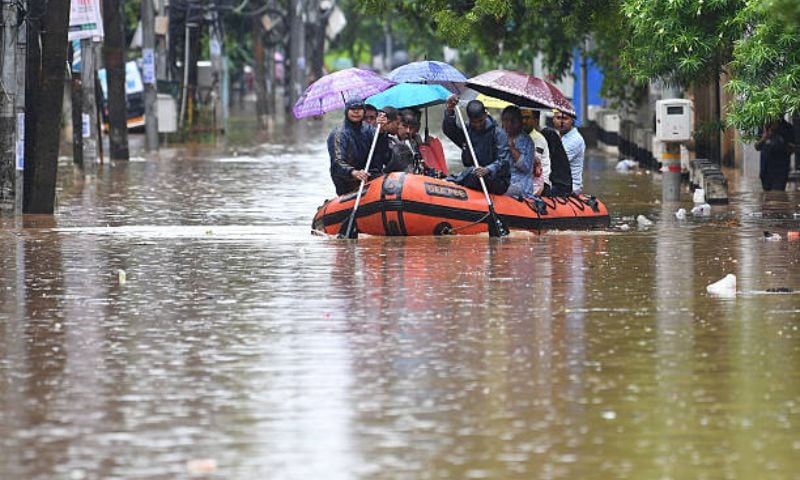
NEW DELHI: India is facing a potentially dangerous monsoon paradox, with the developing El Niño climate pattern expected to suppress overall rainfall while increasing the risk of intense and potentially destructive downpours.
Meteorologists are closely monitoring an El Niño event developing in the Pacific Ocean that could become one of the strongest recorded in recent decades.
Its potential impact on India is particularly significant because the phenomenon has historically been associated with weaker summer monsoons across much of the country.
However, the relationship between El Niño and India’s monsoon is more complex than simply producing drier conditions. Research has indicated that although El Niño can suppress the overall amount of summer rainfall, it may also increase the occurrence of extreme rainfall events.
In other words, a season can receive less rain in total while experiencing a greater number of short-duration, high-intensity downpours.
This distinction is becoming increasingly important as India experiences a changing pattern of rainfall, with periods of prolonged dryness sometimes interrupted by sudden and exceptionally heavy precipitation.
The southern state of Kerala has already provided an illustration of this pattern. Rainfall there has remained around 20 per cent below the normal level, yet exceptionally heavy rain during the first week of August caused flash floods and landslides that claimed 26 lives.
Scientists say such events demonstrate why rainfall totals alone may not provide a complete picture of the risks associated with an El Niño-influenced monsoon. El Niño develops when unusually warm surface waters spread across the central and eastern tropical Pacific. The resulting changes in atmospheric circulation can alter weather patterns far beyond the Pacific, including the behaviour of the South Asian monsoon.
For India, the phenomenon generally tends to weaken monsoon rainfall. Its influence can also become more pronounced as the monsoon season progresses, making the latter part of the season a period of particular concern for weather forecasters.
At the same time, the effect is not uniform across the country. Regional weather conditions, local geography and other atmospheric factors can determine where rainfall becomes concentrated and whether individual weather systems produce exceptionally intense precipitation.
This means that a weaker seasonal rainfall average does not necessarily translate into fewer weather-related hazards. Concentrated rainfall over a short period can overwhelm drainage systems, trigger flash flooding and destabilise slopes, particularly in mountainous and hilly areas.
READ ALSO: Nepal Floods: Is India Next?
Kerala, with its steep terrain and vulnerability to landslides, is particularly exposed to the consequences of intense rainfall. Climate researchers have increasingly warned that extreme rainfall events require greater attention because they can cause severe damage even when seasonal precipitation remains below average.
The developing El Niño is therefore being watched not only for its potential to reduce India’s total monsoon rainfall, but also for the possibility that rainfall could become more erratic and intense.
Forecasters expect the current El Niño to reach its strongest phase after India’s main monsoon season. Nevertheless, its developing influence has already heightened concerns over the timing, distribution and intensity of rainfall in different parts of the country.
For communities vulnerable to floods and landslides, the key question may consequently be less about how much rain India receives during the season and more about how quickly, where and when that rain falls.
The emerging pattern underscores the challenge facing weather authorities: a relatively dry monsoon can still contain episodes of extreme rainfall capable of causing major flooding, landslides and loss of life.