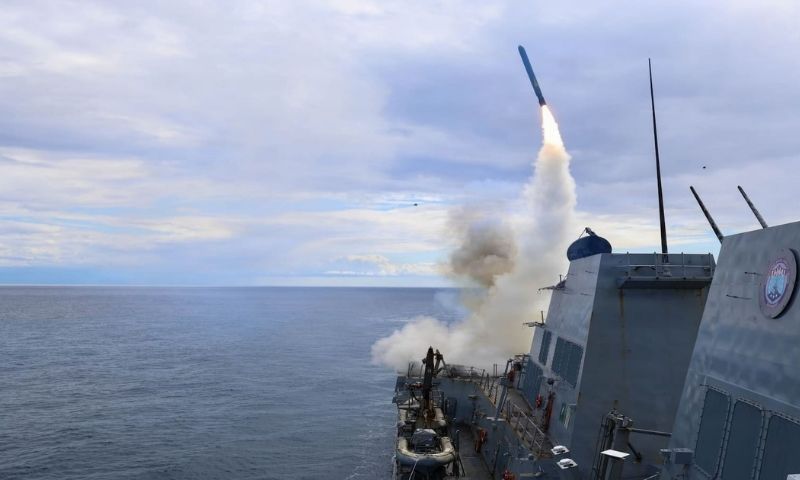
WASHINGTON: The United States carried out fresh strikes against Iran’s Islamic Revolutionary Guard Corps (IRGC) on Tuesday in response to attempted attacks on commercial shipping in the Strait of Hormuz and against US military personnel in the region, the US military said.
US Central Command said the strikes began at 12:00 pm local time, or 1600 GMT. It said the action followed recent attempted attacks by the IRGC against commercial vessels in the strategic waterway and American service members deployed in the region.
Today at 12 p.m. ET, U.S. forces began striking Islamic Revolutionary Guard Corps (IRGC) targets in Iran. The strikes follow recent attempted attacks by the IRGC against commercial shipping in the Strait of Hormuz and against American service members deployed to the region.
— U.S. Central Command (@CENTCOM) September 1, 2026
Iran’s Revolutionary Guards vowed to make Washington “regret” the attacks, while US President Donald Trump warned Tehran against retaliating.
“Severe punishment awaits the aggressors; the United States will regret its new attacks,” IRGC spokesman Hossein Mohebi said in a post on X, after explosions were reported in several areas around the Strait of Hormuz.
تنبیه سختی در انتظار متجاوزان است، آمریکا از حملات جدید خود پشیمان خواهد شد.
— سخنگوی سپاه (@Irgcspeaker) September 1, 2026
Trump warned that Iran would face another US attack “at a much harder and higher level” if it retaliated.
In a post on Truth Social, Trump also hinted at what he called “the biggest attack of them all”, saying it was “waiting in the wings” and that very little could be left of the Islamic Republic if it was carried out.
— Rapid Response 47 (@RapidResponse47) September 1, 2026
Explosions reported in southern Iran
Trump said the US strikes were retaliation for Iranian attempts to plant mines in the Strait of Hormuz. He reiterated his claim that there were no mines in the waterway.
He also said a US base in Jordan had successfully intercepted eight missiles fired by Iran.
Several explosions were reported east of Iran’s southern port city of Bandar Abbas in Hormozgan province, Iranian state media IRIB reported.
More than five explosions were heard around Masan village on Qeshm Island, while four further explosions were reported from the direction of the Strait of Hormuz, IRIB said.
Citing the deputy governor of Hormozgan province for political, security and social affairs, IRIB reported that there had been no casualties in the province at the time of the report.
Iran’s Fars News Agency separately reported that four projectiles had struck areas around Chabahar and Konarak in Sistan-Baluchistan province, citing the province’s deputy governor.
🔴 معاون امنیتی و انتظامی استاندار سیستان و بلوچستان از اصابت چهار پرتابه در شهرستانهای چابهار و کنارک خبر داد. https://t.co/q7Urvml9CL
— خبرگزاری فارس (@FarsNews_Agency) September 1, 2026
Iran’s state television reported that the US struck an airport in the southern Iranian province of Kerman on Tuesday.
“Minutes ago, the enemy US attack targeted Jiroft airport,” state television said.
Iran vows retaliation
Iran’s military general staff warned that the United States would pay a “heavy cost” for the latest strikes, according to Fars.
It said Iranian armed forces would deliver “crushing blows” against the United States in response to US attacks on targets in Sistan-Baluchistan and Hormozgan provinces.
The Iranian military also warned that continued US action would result in greater American losses.
Iranian Foreign Ministry spokesman Esmaeil Baghaei accused Washington of confusing negotiations with dictation and said such an approach would not work with Tehran.
“The Americans have mistaken the concept of negotiation for dictation, something that will definitely not work with Iran,” Baghaei told a news conference.
He accused Washington of acting in bad faith and said the US had become trapped in what he described as a strategic mistake.
اسماعیل بقایی، سخنگوی وزارت خارجه جمهوری اسلامی، با انتقاد از رویکرد آمریکا در مذاکرات گفت: «آمریکا مفهوم مذاکرات را با دیکتهکردن اشتباه گرفته.» او گفت: «نیروهای مسلح ما هیچ تعرضی را بیپاسخ نخواهند گذاشت.» pic.twitter.com/JwP1ekPIhN
— ايران اينترنشنال (@IranIntl) September 1, 2026
Iran accuses US of violating Islamabad MoU
Baghaei accused the United States of violating the Islamabad Memorandum of Understanding, saying the agreement had been signed at the highest level by Trump.
“The signature of the US president was on the Islamabad memorandum,” Baghaei said. He alleged that Washington had accepted commitments under the agreement but violated them about three weeks after it was signed.
Also Read: Qatar Urges US, Iran to Resume Talks Under Islamabad MoU Framework
He said Tehran would decide how to proceed with the agreement based on developments. He also accused Washington of continuing sanctions and a naval blockade while intensifying what he called an “economic war” against Iran.
Baghaei nevertheless said Iran would continue to use diplomacy when necessary to protect its national interests.
“We will certainly, taking all aspects into consideration, use the capabilities and tools of diplomacy wherever necessary, both to explain our positions and to secure and uphold the rights of the Iranian people,” he said.
Iran's FM Spox. Esmail Baghaei on the US:
They are accustomed to making excessive demands and have mistaken negotiation for dictating terms. pic.twitter.com/LRoQtRuLzb
— Clash Report (@clashreport) September 1, 2026
He added that Iran remained in routine contact with the International Atomic Energy Agency but denied that new negotiations were under way between Tehran and the UN nuclear watchdog.
Washington warns of escalation
The US Embassy in Israel warned American citizens across the Middle East of possible flight cancellations, airspace closures and travel disruption as tensions escalated.
“Due to tensions in the Middle East, the security environment remains complex with the potential for unforeseen escalation,” the embassy said in a security advisory.
The embassy warned that Iran and groups supportive of Tehran could target other US interests overseas or locations associated with Americans, including US businesses and other institutions.
NEW: U.S. Embassy Jerusalem issued a security alert.
Americans in the Middle East should "exercise heightened vigilance" due to potential escalation, flight cancellations, and airspace closures.
Iran and allied groups "may target U.S. interests overseas."
Not an evacuation… pic.twitter.com/l0G6ic4Mtw
— Clash Report (@clashreport) September 1, 2026
The US State Department separately urged American nationals in the Middle East to exercise heightened vigilance and warned of potential flight cancellations, airspace closures and travel disruptions.
Middle East: Due to tensions in the Middle East, the security environment remains complex with the potential for unforeseen escalation. Americans currently in the Middle East should exercise heightened vigilance and be aware of potential flight cancellations, airspace closures,… pic.twitter.com/hiM5RtXNOh
— TravelGov (@TravelGov) September 1, 2026
US embassies in Israel, Qatar and Jordan issued similar warnings, citing the possibility of unforeseen escalation.
US-Iran tensions over Hormuz
The latest strikes come after months of confrontation over the Strait of Hormuz, a critical global shipping route.
After six months of war, Iran has kept the strategic waterway closed while the United States has maintained a counter-blockade of Iranian ports.
Also Read: Strait of Hormuz Ship Transits Remain in Single Digits
On Sunday, Washington carried out its first known strikes on Iran in several weeks, hitting an Iranian island in the Strait of Hormuz. Tehran responded by attacking US military targets in the Middle East.
Washington said it had targeted Iranian rocket launchers on Larak Island to prevent Tehran from planting mines in the shipping lane.
Iran responded with missile and drone attacks aimed at Jordan and the United Arab Emirates.
US threatens further economic pressure
US Treasury Secretary Scott Bessent said on Tuesday that alternative oil routes could bypass the Strait of Hormuz within two years, reducing the strategic importance of the waterway.
“We have to de-risk everywhere in the world. We can see the Iranians are trying to use the Strait of Hormuz as a choke point,” Bessent said during an interview in Asheville, North Carolina.
.@SecScottBessent: "We have zero tolerance. We are going to economically asphyxiate this regime."
"My job is to make sure that they want to have a deal, and they will want to have one." pic.twitter.com/47jKGqsofj
— Rapid Response 47 (@RapidResponse47) September 1, 2026
He said the waterway was not a choke point for the United States but remained critical for many other countries.
“It will be bypassed in two years,” Bessent said, predicting that oil would instead move through pipelines across land.
Bessent also claimed Tehran is facing severe economic difficulties, saying it lacked access to hard currency and was dealing with very high inflation.
Asked about further sanctions, he said Washington was likely to announce a bank-related sanction this week and another the following week.
“We are going to economically asphyxiate this regime,” Bessent said, adding that Washington would target what he called the regime’s “ill-gotten assets”.
He said the United States would seek to prevent Iran from obtaining a nuclear weapon and from using highly enriched uranium, while also targeting its ability to project power through proxy networks.