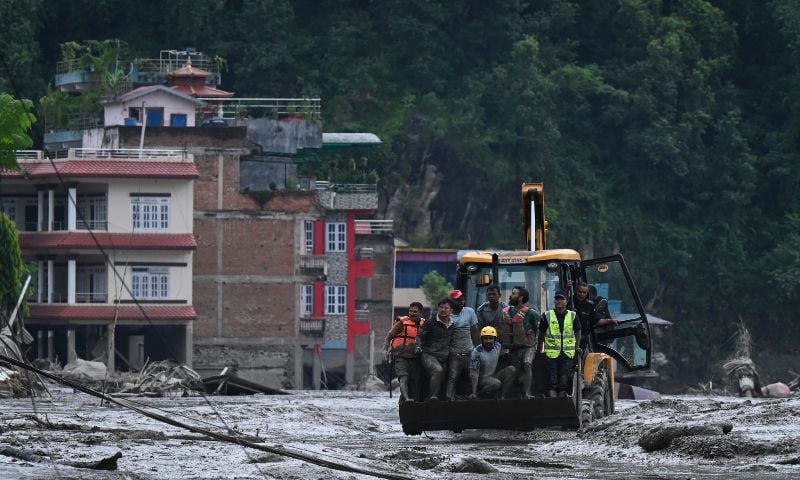
Kathmandu/Beijing: Rescuers are racing against time to locate hundreds of people still missing after devastating flash floods and mudslides struck the China-Nepal border region, killing more than 160 people and leaving a trail of destruction across mountainous communities and tourist areas.
More than 1,000 rescuers have been deployed on the Chinese side, using search dogs, drones, life-detection scanners and other equipment to scour areas buried under mud and debris.
Nepalese authorities are conducting their own large-scale search for missing residents, tourists, police and army personnel.
The death toll from devastating floods in Nepal has risen to 95, while 403 tourists remain missing.
The missing include 200 women and 203 men, with foreign nationals from 26 countries among those unaccounted for.
🇮🇳 India: 133 missing
🇺🇸 US: 47 missing
🇬🇧 UK: 33 missingThe… pic.twitter.com/POwg2vmN2J
— Sajjad Tarakzai (@SajjadTarakzai) August 26, 2026
The disaster has affected a region popular with trekkers and pilgrims, with hundreds of foreign tourists among those reported missing.
Hundreds Of Tourists Still Missing
Officials in Nepal said more than 100 Indian tourists, 54 from the United States, 34 from Australia and 33 from the United Kingdom are among the missing. More than 100 Nepalese nationals are also unaccounted for.
ALSO READ: Hundreds Missing After Nepal-Tibet Flash Flood Kills at Least 160
Dozens of Nepalese police officers and army personnel, along with power workers, are also missing after the floodwaters and mud swept through affected areas.
🔴 Les images en provenance du #Népal sont terrifiantes. Le séisme d’une magnitude de 4,4 qui s’est produit la nuit dernière au Tibet a déclenché des #avalanches de glace et des #glissements de terrain. Ils ont formé des embâcles sur les rivières de la région qui ont fini par… pic.twitter.com/XIdlQ76gii
— Guillaume Woznica (@GWoznica) August 26, 2026
The human cost was illustrated by the account of one survivor who told the BBC that her family was swept away in front of her. She and her son survived by climbing onto a rooftop as the floodwaters engulfed the area.
More Than 160 Dead In Chinese Side Of Border
On the Chinese side of the border, at least 160 people have died, and 558 remain missing after a massive mudslide swept over buildings in China’s southwestern border region on Wednesday morning, Chinese state media reported, citing local officials.
Of those missing on the Chinese side, 260 are foreign nationals.
Of all the videos of the Nepal flooding that I have seen so far, this one might be the worst.
These people had no chance.
🙏🙏🙏 pic.twitter.com/XIhUFNESDb— Brick Suit (@Brick_Suit) August 26, 2026
Surveillance footage broadcast by Chinese state media showed dozens of people running as a huge wall of mud and debris crashed through the area.
Nearly 800 personnel and more than 150 vehicles have been sent to the border region, while China’s fire service has deployed 431 personnel equipped with search dogs, life-detection scanners and small boats.
Civilian and military aircraft carrying relief supplies have also arrived in China’s southwestern border region.
Dangerous Conditions Slow Rescue Efforts
Rescuers face major obstacles in reaching the worst-hit areas. Narrow mountain roads have prevented large vehicles and heavy equipment from reaching the main disaster zone, although surrounding roads remain open for bringing in supplies from the rear.
Li Qipu, a member of China’s paramilitary People’s Armed Police, told state broadcaster CCTV that rescue teams were also concerned about “the instability of a reservoir lake upstream” and “the narrow mountain road”.
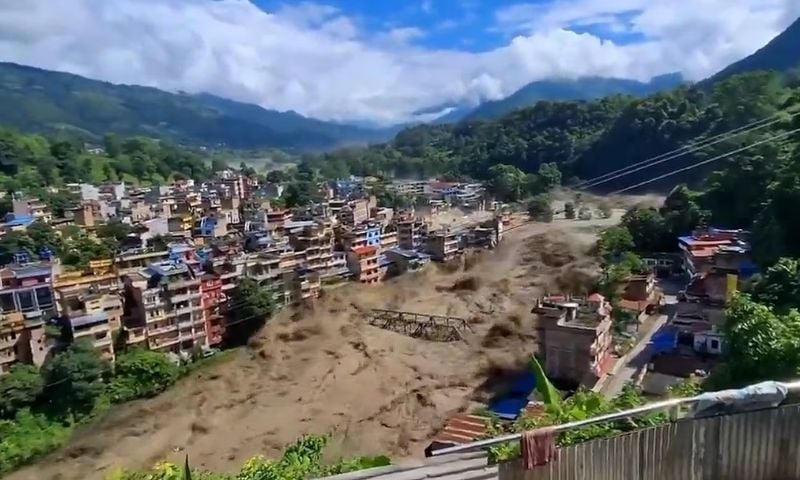
Drones are being used to survey areas that remain difficult or dangerous for rescuers to enter.
Overnight rainfall has added to the danger, with authorities warning that the risk of further landslides and rockfalls remains high.
Search Continues As International Aid Arrives
The United States, China, the European Union and India are among those that have pledged assistance or sent relief supplies as emergency operations continue.
The immediate priority remains finding survivors and accounting for hundreds of people whose whereabouts are still unknown.
Authorities are working to establish the full scale of the disaster while rescue teams continue clearing mud and debris from affected areas.
Landslide, Not Earthquake, Generated Seismic Energy
Authorities initially considered whether an earthquake had triggered the flooding. However, the US Geological Survey said the seismic energy detected during the disaster was instead generated by a landslide.
The finding adds to evidence that the sudden ground movement and subsequent release of mud and water played a central role in the disaster.
With more rain forecast and unstable slopes threatening further collapses, rescuers face a race against time to reach those still trapped or missing across the rugged China-Nepal border region.