
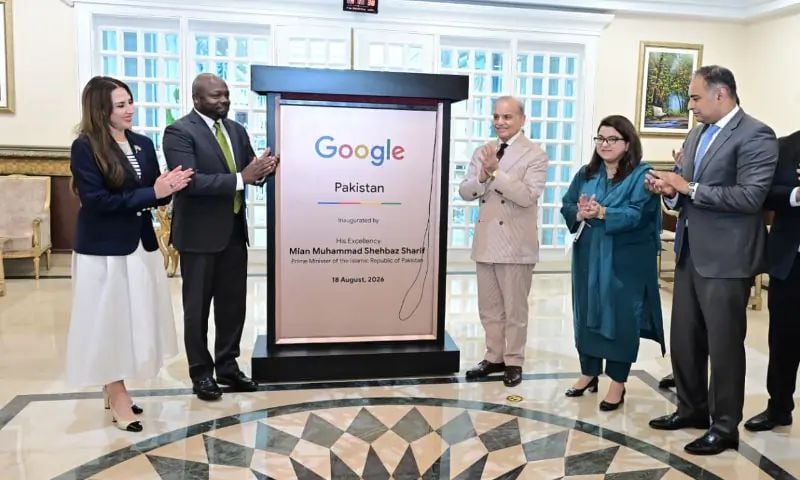
ISLAMABAD: Pakistan has begun assembling Google Chromebooks locally as the country’s information technology exports posted strong growth at the start of the new fiscal year, according to government officials.
IT exports increased by 18% year-on-year to $417 million in July 2026, marking a strong opening to fiscal year 2026-27 and reinforcing the technology sector’s growing contribution to Pakistan’s economy.
The latest figures follow a record performance in fiscal year 2025-26, when Pakistan’s IT exports rose 21% to $4.6 billion, compared with around $3.8 billion a year earlier.
Technology and digital services accounted for the largest share of the country’s services exports, which reached $10.02 billion in FY26, highlighting the increasing importance of the digital economy.
Google office seen as boost to technology sector
Federal Minister for Information Technology Shaza Fatima Khawaja said the opening of Google’s first office in Pakistan would help develop local talent and strengthen the country’s technology ecosystem.
Speaking to the media on Wednesday, Khawaja attributed the sector’s continued expansion to sustained private-sector growth and said Pakistan’s freelancing economy had crossed the $1 billion mark this year.
She said IT exports had maintained growth of around 20% annually over the past two and a half years, adding that the presence of Google and other international technology companies could encourage further foreign investment and attract additional global firms to Pakistan. “Google’s office reflects global confidence in Pakistan’s economy and leadership,” she said.
According to the minister, Prime Minister Shehbaz Sharif has also placed digital transformation at the centre of the government’s economic agenda through the Digital Nation Pakistan initiative.
She said progress had been made in areas including digitalisation, Federal Board of Revenue reforms, digital payments, the wider digital economy and e-governance.
Tax incentives offered to IT exporters
Khawaja said the IT sector had been given special incentives under the latest federal budget, including a final tax regime for exports and a 0.25% tax on export earnings.
She credited the Special Investment Facilitation Council (SIFC), the Ministry of IT and Telecommunication and its affiliated departments with helping establish Google’s operations in Pakistan.
The government has also expanded cooperation with Google on skills development. Khawaja said 350,000 Google certifications had been completed in Pakistan, while programmes were being developed to train 3,000 public officials.
More than 17,000 teams have taken part in the Learn AI programme launched in collaboration with Google Developer Groups, with women accounting for about 25% of participants.
In addition, around 50,000 developers have received training in gaming and animation, while 120 companies have undergone training in gaming and design.
Chromebook assembly line becomes operational
The government has also begun moving towards local production of Google Chromebooks. A Chromebook assembly line inaugurated last year at the National Radio and Telecommunication Corporation (NRTC) facility in Haripur is now operational, with an annual production capacity of up to 500,000 devices.
READ ALSO: Google Opens First Office in Pakistan, Marking New Era of Digital Partnership
Officials are also examining the possibility of exporting locally assembled Chromebooks, potentially opening another avenue for Pakistan’s technology and electronics manufacturing sector.
IT sector posts large trade surplus
Khawaja said IT exports generated a trade surplus of 85-86% in July, stressing that the sector’s relatively low dependence on imported heavy machinery means a significant proportion of export earnings remains within Pakistan.
She described the IT industry as an increasingly important pillar of the national economy. Adviser to the Federal Finance Minister Khurram Shehzad said Pakistan’s digital economy had started FY27 on a strong footing.
He noted that the $63 million year-on-year increase in IT export earnings in July reflected sustained expansion in the sector and growing international demand for Pakistani technology and digital services.
The government now hopes that stronger global technology partnerships, local device assembly, skills development and continued export growth will further strengthen Pakistan’s position in the international digital economy.