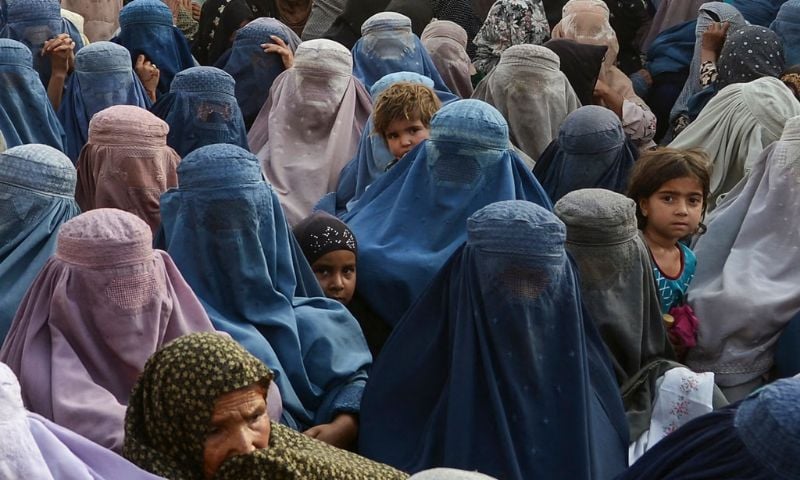
KABUL, Afghanistan: Five years after the Taliban returned to power in Afghanistan, women and girls continue to face sweeping restrictions on education, employment, healthcare and public life, with the latest UN Women data showing that nearly eight in 10 young Afghan women are now outside education, employment or training.
The Afghanistan Gender Index, described by UN Women as the most comprehensive assessment of women’s empowerment and gender equality since the Taliban takeover, found that Afghanistan has the world’s second-largest gender gap. Women are achieving only 17 percent of their potential to make choices and access opportunities, compared with a global average of 60.7 percent.
❌ Education⁰❌ Employment⁰❌ Training
Nearly 8 in 10 young women in #Afghanistan face this reality.
Yet 9 in 10 Afghans support girls’ education.
Afghan women and girls want to learn. To work. To have choices.
Their futures should be theirs.
Illustrated by @MonaChalabi pic.twitter.com/dhI8BbOGue
— UN Women (@UN_Women) August 18, 2026
UN Women Executive Director Sima Bahous said Afghan women remained an important but largely untapped resource for the country.
“Afghanistan’s greatest resource is its women and girls,” Bahous said, adding that women continued to support communities, run businesses, deliver humanitarian assistance and speak out against injustice despite severe restrictions.
Education and employment curtailed
The Taliban regime barred girls from secondary education within weeks of returning to power in August 2021. Women and girls were later excluded from universities, including medical education.
UN Women said the secondary-school completion rate for girls was on course to fall to zero following the education bans. Afghanistan is now the only country where girls are barred from secondary and tertiary education.
The restrictions extend to the workplace. Only 24 percent of Afghan women participate in the labour force, compared with 89 percent of men. Women are more likely to work from home or in lower-paid and insecure jobs.
No women hold positions in the Taliban regime’s de facto Cabinet or local offices. Women civil servants were removed from government payrolls by January 2026, while restrictions also prevent women from working for many non-governmental organisations and the United Nations.
Public life and healthcare restricted
The Taliban regime’s restrictions have also narrowed women’s access to public spaces and healthcare.
Women have been barred from parks, gyms and public baths and face restrictions on travel without a male relative, according to the report. The Taliban regime’s 2024 morality law also imposed strict requirements on women’s clothing and public conduct, including treating a woman’s voice as something that should be concealed in public.
Since December 2024, women have also been barred from studying medicine, midwifery, nursing, radiology and dentistry. The policy threatens the supply of female healthcare workers in a country where women often depend on female providers for medical treatment.