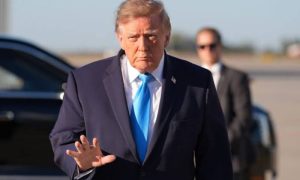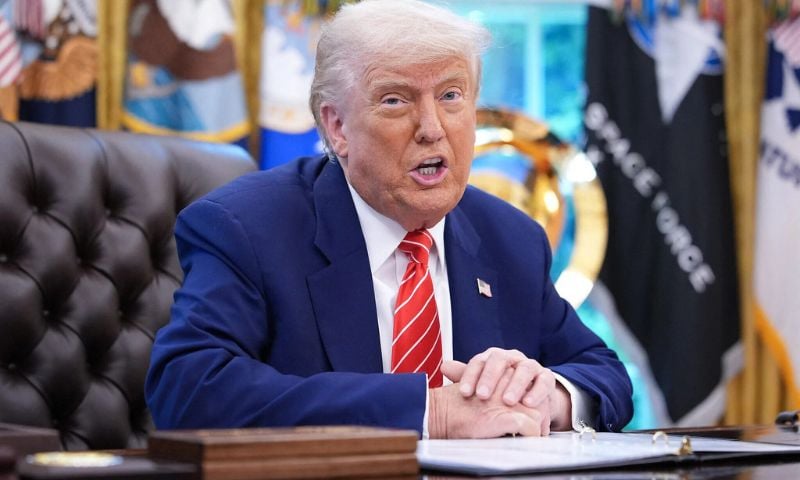
WASHINGTON: US President Donald Trump said Monday that Iran wants to reach a deal with Washington but is unwilling to accept the terms he considers necessary, as a 60-day negotiating period under the Islamabad MoU framework nears its end.
“They want to make a deal, but they are not going to make the kind of deal that I feel is necessary,” Trump told reporters in the Oval Office.
Trump again insisted that Iran must not be allowed to possess a nuclear weapon, saying that preventing Tehran from acquiring one was the reason for the US campaign.
“We’re in there for one reason: Iran cannot have a nuclear weapon,” Trump said. “Iran cannot have a nuclear weapon, and they won’t have a nuclear weapon.”
Trump said Washington was not seeking to extend the June memorandum of understanding with Iran, which was reached with Pakistani mediation and provided a framework for negotiations towards a comprehensive agreement. Asked whether he wanted to extend the arrangement, Trump replied: “No.”
The US President’s comments came as the 60-day period for negotiations established under the framework approaches its end.
Trump claims control of Strait of Hormuz
Trump also defended his recent suggestion that the United States could declare the Strait of Hormuz US territory.
He said US forces had “total control” of the strategic waterway through a blockade and described the idea of declaring it US territory as “a great idea”.
“We control it. We control it with the blockade,” Trump said.
Trump claimed the blockade had been effective and said millions of barrels of oil were continuing to move through the region each week.
“The strait is open, and the oil prices are coming down,” he said, adding that prices would continue to fall unless Washington decided to take “something far more drastic”.
.@POTUS on the Strait of Hormuz: “I like the idea of declaring it a territory. We have total control over the Strait.” pic.twitter.com/xovV3kc8Di
— Rapid Response 47 (@RapidResponse47) August 17, 2026
He also said Iran was “in big trouble”.
Trump asks Iran to ‘surrender’
Earlier, in an interview with Fox News, Trump said that Iran should “put up the white flag of surrender” to end the conflict.
Trump, speaking to Fox News, said he had “no time schedule” for his approach to Iran and that domestic political considerations, including the US midterm elections, were not influencing his thinking.
“I have no time schedule,” Trump added. “I’m not in a hurry…the midterms have nothing to do with my thinking,” the US President told Fox News.
President Trump also confirmed that a direct backchannel existed with officials of Iran’s Islamic Revolutionary Guard Corps (IRGC), describing them as “good poker players” but saying “they’re dying.”
Also Read: Trump Says Iran Should ‘Put Up the White Flag of Surrender’
Trump also reacted to the ongoing talks between Iran and Oman regarding control of the Strait. “If Oman gets in the way, we’ll bomb the shit out of them.”
President Trump told Fox News that Iran should “put up the white flag of surrender.”
“I have no time schedule,” Trump added. “I’m not in a hurry…the midterms have nothing to do with my thinking.”
The President confirmed there is a direct backchannel with IRGC officials.… pic.twitter.com/OAHFVWSQFs
— Trey Yingst (@TreyYingst) August 17, 2026
Meanwhile, Iran’s Foreign Ministry spokesperson Esmaeil Baghaei said that talks with Oman over shipping through Strait of Hormuz are long overdue due to the complexity of the subject, and the involvement of multiple actors.
Trump says Iran cannot have nuclear weapon
Meanwhile, in a post on his Truth Social platform, President Trump said on Monday that Iran cannot have a nuclear weapon “in any way, shape, or form”.
Trump said that this was and “always will be” the “number one Goal.”
The number one Goal is, and always will be, that Iran cannot have, in any way, shape, or form, a Nuclear Weapon. pic.twitter.com/qBtgdvfOZL
— The White House (@WhiteHouse) August 17, 2026
Meanwhile, Iran’s foreign ministry spokesman Esmaeil Baghaei told a news briefing on Monday that in the Islamabad MoU between the US and Iran, “there is no subject titled a 60-day deadline”.
“What was envisioned in the memorandum was merely a 60-day period for discussions regarding ‘lifting sanctions’ and the ‘nuclear issue,’ which, in the event of failure to reach a result, had the capability of extension.”
Baghaei said that the “flagrant violation of the memorandum” by the US halted discussions.
Iran's FM Spox. Esmail Baghaei:
There is no provision titled “60-day deadline” in the text of the memorandum of understanding.
The Islamic Republic of Iran never formulates its policies under pressure, ultimatums, or time deadlines.
What was stipulated in the memorandum was… pic.twitter.com/VMtKbOG9D7
— Clash Report (@clashreport) August 17, 2026
Islamabad MoU framework for peace
Under the Islamabad MoU, the US and Iran committed to halt military operations, reopen the Strait of Hormuz to commercial shipping and negotiate a comprehensive agreement covering Iran’s nuclear programme, US sanctions and a permanent ceasefire within 60 days.
Pakistan and Qatar are mediating between Tehran and Washington under the framework of the Islamabad MoU to permanently end the conflict.
Pakistan is mediating talks between Iran and the United States after helping secure a ceasefire on April 8 and hosting high-level talks between the two sides in Islamabad on April 12 and 13.
Pakistan and Qatar later co-mediated the first round of high-level talks in Lucerne, Switzerland, on June 21. The meeting was attended by US Vice President JD Vance and Iranian Parliament Speaker Mohammad Bagher Ghalibaf.
Following the meeting, Pakistan and Qatar said significant progress had been made in diplomatic efforts between Washington and Tehran.
US-Iran Islamabad MoU set to expire today
The 60-day negotiating window created by the Islamabad MoU between the US and Iran is set to expire today with no final peace agreement and no confirmed extension.
Iran has now rejected the idea of negotiating an extension, saying there is “no such thing” as a binding 60-day deadline and that Washington violated the MoU almost from the outset.
Tehran says it will not allow its policy to be dictated by what it calls artificial deadlines.
The text of the June agreement, however, gives Washington and Tehran up to 60 days to negotiate and reach a final deal, with an extension possible by mutual consent.
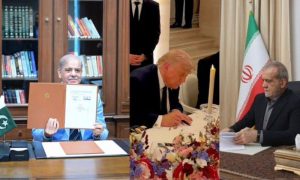
The disagreement surfaced days ahead of the 60-day deadline when both sides turned down the MoU while blaming each other for ceasefire violations and escalating the conflict once again before diverting the focus to the Strait of Hormuz.
The US position has been considerably tougher. President Donald Trump declared the agreement over on July 7 after renewed fighting.
Secretary of State Marco Rubio subsequently said an MoU could not remain alive if Iran was violating its provisions, particularly those concerning shipping through the Strait of Hormuz. At the same time, Rubio said Washington remained open to genuine diplomacy.
The dispute over Hormuz is now at the heart of the crisis. Iran says the waterway will remain closed until Washington lifts sanctions, unfreezes Iranian assets and withdraws its forces.
Tehran also wants compensation for wartime damage. Washington, by contrast, insists on unrestricted shipping and has pursued economic and military pressure to force Iran to reopen the strait. Or it insists that the US would continue a complete blockade of Iran.