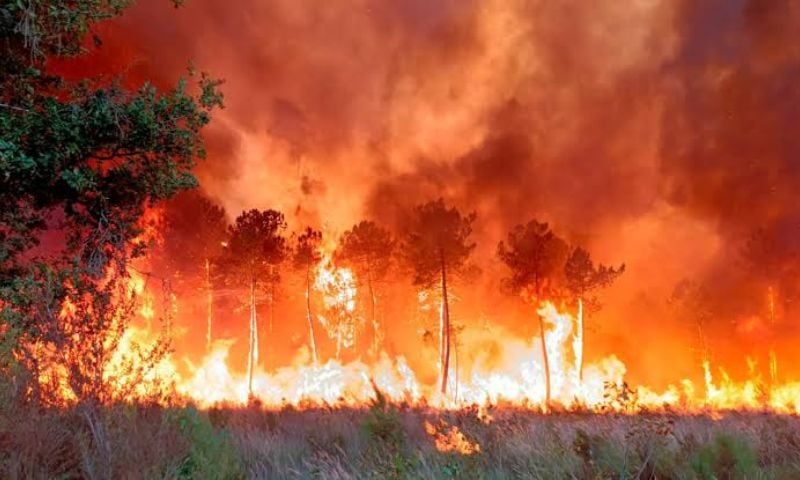
BRUSSELS: Wildfires continued to spread across parts of Europe on Sunday, with deadly blazes in Greece, a record-breaking fire in Belgium and major fires in Spain, France, Croatia, Germany and Britain putting communities under pressure after weeks of extreme heat and drought.
Two people died on the Greek island of Salamina, west of Athens, on Sunday as a fast-moving wildfire swept through residential areas, while more than 500 people were evacuated and several others were injured, Greek authorities said.
In Belgium, firefighters were battling the country’s largest wildfire on record. The blaze in the High Fens nature reserve had burned about 3,000 hectares and was advancing towards the German border, prompting evacuations and an international firefighting response.
The fires come amid a summer of exceptional heat and dryness across Europe. The European Commission’s Joint Research Centre said on August 12 that drought had affected large parts of Europe since spring, while forecasts pointed to warmer and drier conditions continuing into September.
Deadly fire hits Greek island
On Salamina, the fire broke out during Greece’s peak August holiday period, when large numbers of residents and tourists travel to the country’s islands.
A fast-moving blaze swept through the island west of Athens, killing an elderly couple, according to Reuters. More than 500 people were evacuated and five were taken to local health clinics.
About 192 firefighters, backed by aircraft, helicopters, volunteers and municipal water tankers, were deployed to fight the flames.
The coast guard and firefighting vessels were also mobilised, with authorities preparing for possible sea evacuations.
Strong winds had intensified the fire earlier in the day but eased later, helping firefighters in their efforts to contain it. The cause of the fire was not immediately known.
The incident followed a series of major fires elsewhere in Greece, including northern Greece, where hundreds of people were evacuated from the resort of Siviri earlier in August.
Belgium battles record wildfire
Belgium was facing an unprecedented fire emergency in the High Fens, a forested nature reserve near the German border.
The fire, which began on Friday, had consumed about 3,000 hectares by Sunday, more than twice the previous national record of 1,400 hectares set in 2011, Reuters reported.
Residents in several villages were evacuated as firefighters sought to prevent the flames from reaching populated areas.
Belgium received assistance from neighbouring countries, including Germany and Luxembourg, while Dutch helicopters also joined the firefighting operation.
The European Union had deployed three helicopters and two water-bomber aircraft following an emergency request from Belgium.
The blaze was also approaching Germany. Authorities in the German town of Monschau urged residents near the border to evacuate because of smoke, although officials did not expect the fire itself to cross into Germany.
Germany evacuates thousands
In western Germany, a major wildfire near the Belgian border forced more than 2,000 people to leave the village of Gey earlier this week.
The fire burned about 300 hectares and came within 300 metres of the village, Reuters reported.
The operation was complicated by unexploded Second World War ordnance in the area. Explosions were reported as the fire moved through the forest.
About 1,500 emergency personnel were involved in the response.
By Saturday, local authorities said the fire had been brought under control, although residents had not yet been allowed to return and emergency services continued to monitor the area.
Spain remains badly affected
Spain has been among the European countries hardest hit by the 2026 fire season.
A major wildfire in southwestern Spain near Niebla intensified earlier this month, with regional authorities saying the fire had spread beyond firefighters’ immediate ability to extinguish it.
By August 10, the blaze had covered nearly 20,000 hectares and forced about 500 people to evacuate. Other fires were also burning in Segovia and Castellón.
In northeastern Spain, another major fire in Aragón had burned more than 9,000 hectares and forced the evacuation of 16 towns, Reuters reported on Thursday.
A separate fire in Huelva province in southern Spain had consumed about 31,000 hectares and forced around 700 people to leave their homes.
Spain’s national weather agency AEMET had warned of temperatures reaching 40 degrees Celsius and very high to extreme wildfire danger during the peak-risk period around the August 12 solar eclipse.
France faces renewed fires
France has also been battling a succession of major fires after experiencing exceptional heat and dryness.
In the southwestern Landes region, a fire that began on Thursday had burned about 1,100 hectares by Friday and approached within two kilometres of the centre of Luglon.
Authorities evacuated 525 residents, while about 500 firefighters and six aircraft were deployed to contain the blaze. Regional official Gilles Clavreul described the situation as unfavourable and said the fire remained intense.
The latest fire followed a huge blaze near Arcachon Bay in July that burned more than 50,000 hectares and prompted the evacuation of about 220,000 people, according to Reuters.
Britain records record wildfire numbers
Britain has also experienced an exceptional wildfire season.
Fire services in England and Wales had responded to 966 wildfires by August 12, including 185 during the first part of August, according to figures cited by Reuters.
By August 14, the number of wildfires had surpassed the previous annual record of 1,017 set in 2025, Reuters reported.
A major fire in Stourbridge destroyed homes and forced evacuations as temperatures reached 38.1C in London on August 13, Britain’s hottest day of the year.
The UK government has issued emergency warnings over activities that could start fires. Around 45 million people are living in drought-affected areas, while about 27 million face water-use restrictions, according to Reuters.