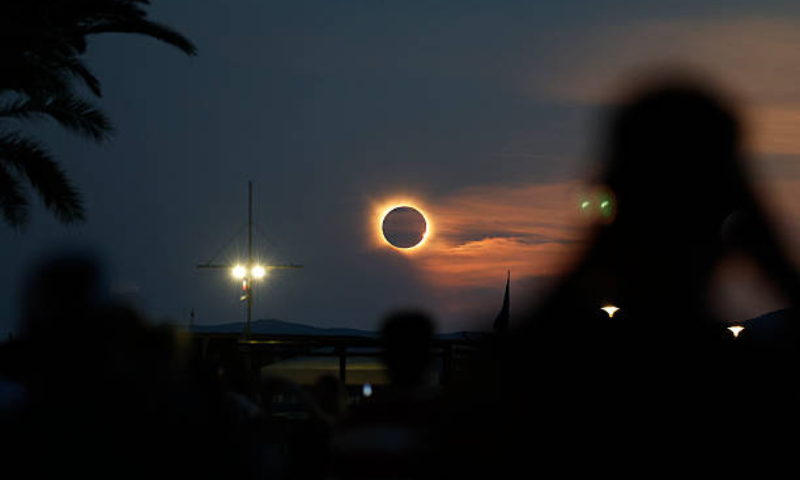
ISLAMABAD: Day briefly turned into night in parts of Spain on Wednesday as a total solar eclipse swept across the country, stunning thousands of spectators and creating an eerie twilight.
The eclipse was Spain’s first total solar eclipse in more than a century and the first visible from mainland Europe since 2006.
The Moon passed directly between the Earth and the Sun, blocking out the Sun’s bright surface and revealing its glowing outer atmosphere, known as the corona.
Crowds gathered along Spain’s northern coast and in the Balearic Islands to witness the spectacle, with many wearing protective glasses as the eclipse passed overhead.
Spain just went dark in the middle of the day.
Total solar eclipse. Absolutely unreal. 🌑🇪🇸
Tarragona, Spain 🇪🇸 pic.twitter.com/5jSn5LChmP
— Dylan K (@MightyDylanK) August 12, 2026
“It’s a sight I never would have imagined seeing,” said Isabel Troyano, a 56-year-old homemaker watching the eclipse with her son in Tarragona.
“I got goosebumps,” she told AFP.
Alejandro Cuesta, a 30-year-old nanoscience researcher, described the experience as “incredible”.
“I almost burst into tears. I got chills all over my body,” he said. “It was magnificent… the most beautiful thing I’ve seen in my entire life.”
A Shadow Across Europe
The eclipse began in the remote Arctic region of northern Russia before the Moon’s shadow moved south through Greenland and across Iceland.
The shadow then travelled across the Atlantic towards northern Spain.
Reykjavik, which experienced the eclipse near Keflavik, had not witnessed a total solar eclipse since 1433. Its next one is not expected until 2196.
In Spain, the narrow path of totality crossed the country diagonally from the northern coast towards the Balearic Islands.
A partial eclipse was also visible across much of Europe, as well as parts of Canada, the northern United States and north-west Africa.
Large crowds gathered in cities including London and Paris, while visitors at the Pic du Midi in the French Pyrenees were able to see the eclipse after clouds cleared shortly before totality.
A Fleeting Spectacle
A total eclipse occurs when the Moon completely blocks the Sun, briefly creating darkness during daylight.
As the Moon’s shadow passes over the Earth, temperatures can fall, shadows change shape and some animals respond to the sudden darkness.
But totality lasts only a few minutes.
The lunar shadow travels across the Earth’s surface at about 3,430km/h, according to the Paris Observatory.
The wider partial eclipse, during which the Moon gradually moves across the Sun, lasted about one hour and 45 minutes.
The event was livestreamed by NASA and the European Space Agency, allowing scientists to study the Sun’s outer atmosphere and learn more about solar winds and its magnetic field.
Crowds Gather In Spain
Spain had been preparing for the eclipse for months, with authorities expecting hundreds of thousands of additional visitors.
The government estimated that almost 450,000 extra tourists could generate about €347m ($400m) for the economy.
Nearly 25,000 police officers were deployed to help manage the crowds and traffic.
There had been concerns that high temperatures, cloud cover and the risk of wildfires could disrupt viewing conditions.
However, much of Spain benefited from clear skies, allowing spectators to experience the brief period of darkness.
British astrophysicist and science communicator Graham Jones described the Spanish viewing opportunity as particularly special because the narrow path of totality crossed much of the country.
More Eclipses Ahead
The eclipse was part of a sequence of rare events expected to cross the region in the coming years.
Another total solar eclipse will pass across southern Spain and northern Africa in August 2027.
An annular eclipse, in which the Moon appears smaller than the Sun and leaves a bright “ring of fire”, is expected to cross the Iberian Peninsula in 2028.
For those who witnessed Wednesday’s event, however, the few minutes of darkness offered a rare reminder of the scale and spectacle of the natural world.