Key Points:
- Students reject government concessions and continue protests
- Soren cancels three examinations amid mounting pressure
- Police used force as protesters marched on Assembly
- Students demand independent probe into recruitment irregularities
ISLAMABAD: Student and job aspirant protests over alleged irregularities in government recruitment examinations in India’s eastern Jharkhand state entered their 19th day on Wednesday.
The demonstrators are still refusing to end the agitation despite the government cancelling several examinations and offering further assurances.
The protesters, gathered at Jaipal Singh Munda Stadium in the state capital Ranchi, are demanding greater transparency in recruitment examinations conducted by the Jharkhand Public Service Commission (JPSC) and Jharkhand Staff Selection Commission (JSSC). They are also seeking an independent investigation into alleged irregularities.
The latest standoff follows Chief Minister Hemant Soren’s announcement that the government would cancel the 14th JPSC Civil Services examination and two other JPSC examinations.
Soren also said the government would investigate examinations conducted through TDPL, an examination agency facing allegations over the recruitment process.
ALSO READ: Indian Students March On Jharkhand Assembly Over Recruitment Exam Irregularities
The concessions, however, have failed to persuade protesters to call off their campaign. Student leaders say the government’s assurances do not address all their demands and have vowed to intensify the agitation.
The protesters are seeking instant reforms in the recruitment system, including enhanced transparency in examination procedures, action against agencies accused of irregularities and an independent investigation into allegations of question-paper leaks and other malpractice.
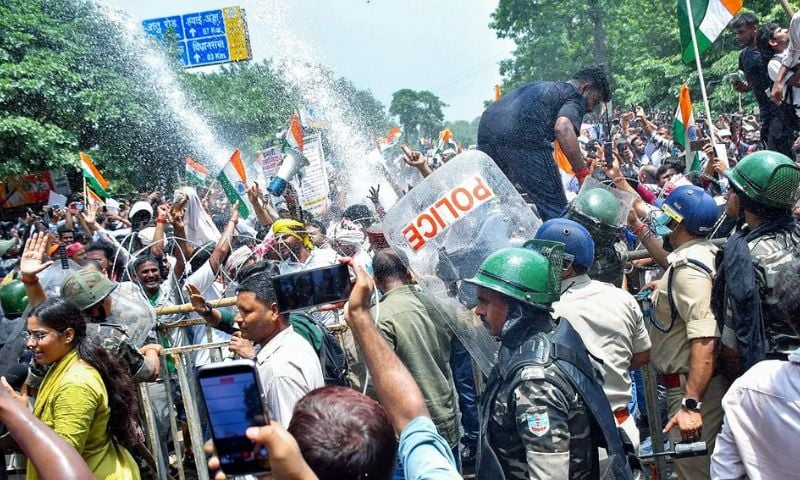
The latest phase of the agitation follows a confrontation on Monday, when police used tear gas, water cannon and batons to disperse protesters attempting to march towards the Jharkhand Assembly.
The demonstrators had climbed over police barricades, waved India’s national flag and shouted slogans as they moved towards the state legislature.
Some protesters pushed against barricades and scuffled with police, prompting officers to use force, television footage showed.
The police action has added a new dimension to the dispute, with protesters and opposition parties criticising the use of force against students and job seekers.
Opposition Congress leader Rahul Gandhi condemned the action, saying students had a right to peaceful protest and that dialogue was needed to resolve the dispute.
The confrontation also triggered fresh political activity on Tuesday, when members of the Akhil Bharatiya Vidyarthi Parishad (ABVP) marched towards the Assembly in protest against the police action. About 110 ABVP workers were detained during the demonstration, according to local reports.
The student movement has also adopted more confrontational forms of protest.
Some demonstrators have begun hunger strikes, with medical teams visiting the protest site to monitor their health.
India protestors silent procession
Protesters also held a silent procession from Jaipal Singh Munda Stadium to Albert Ekka Chowk and announced further demonstrations against the police action.
The dispute centres on allegations that irregularities in recruitment examinations have compromised the prospects of young people competing for scarce government jobs.
Students say examination leaks, questionable evaluation procedures and a lack of transparency can undo months or years of preparation.
The controversy has already resulted in official action. The former chair of the Jharkhand Public Service Commission was arrested over alleged examination irregularities, while three commission members have resigned, according to local reports.
The demonstrations began on July 25 and intensified as large numbers of students and unemployed young people gathered in Ranchi.
They have demanded cancellation of examinations they believe were compromised and called for a probe by India’s federal Central Bureau of Investigation (CBI).
Recent youth-led protests in New Delhi over alleged leaks in a national medical entrance examination put pressure on the federal government and contributed to the resignation of Education Minister Dharmendra Pradhan.
Jharkhand, one of India’s poorer states, has particularly intense competition for government employment, which offers relatively stable salaries and benefits.
Nearly 640,000 applications were submitted for one recent recruitment exercise involving just 2,025 posts, according to The Guardian.
Another recruitment drive drew more than 322,000 candidates for 510 vacancies.
The state government, led by Soren’s regional Jharkhand Mukti Morcha party in alliance with Congress, has held talks with protesters and said most of their demands have been accepted.
It has indicated that it remains willing to continue negotiations.
However, the sixth round of government-student talks failed to resolve the dispute, with both sides accusing the other of lacking seriousness.
Protesters have continued their occupation of the stadium and vowed to intensify the campaign.
Jharkhand’s recruitment controversy therefore extends beyond the cancellation of individual examinations.