UNITED NATIONS: Pakistan has urged the UN Security Council to take immediate and concrete action against Israel’s settlement expansion, settler violence and measures aimed at altering the demographic and territorial character of the occupied Palestinian territories, warning that the situation is approaching a “dangerous tipping point.”
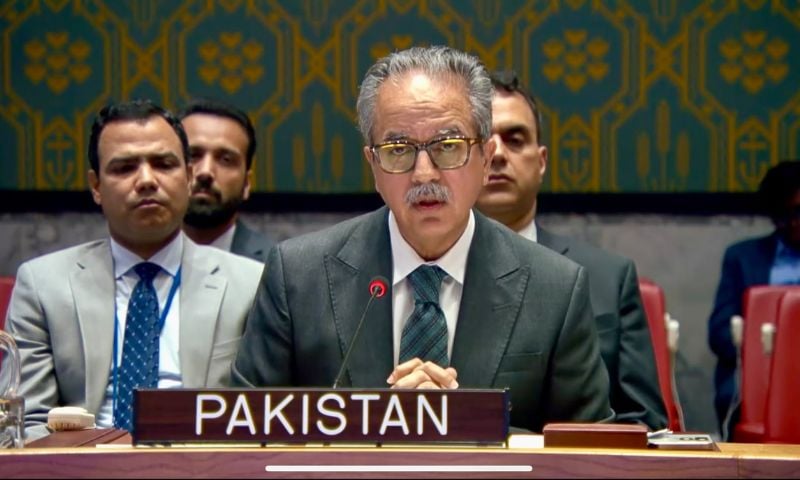
Speaking at an emergency meeting of the UN Security Council on the situation in the Middle East, Pakistan’s Permanent Representative to the UN, Ambassador Asim Iftikhar Ahmad, said the developments in the occupied West Bank represented a clear pattern of coordinated and illegal measures designed to entrench the occupation, facilitate de facto annexation and undermine prospects for a two-state solution.
Settlement expansion has reached an alarming scale. The expansion of settlement in the E-1 area, the launch of the ‘Crimson Thread’ project, and the settlement activities in the heart of West Bank are all part of a broader effort to fragment the Palestinian territory.
This is… pic.twitter.com/ERENw5tHic
— Permanent Mission of Pakistan to the UN (@PakistanUN_NY) August 11, 2026
Ambassador Asim Iftikhar said settlement expansion, including activities in the E-1 area and the so-called “Crimson Thread” project, was part of a broader effort to fragment Palestinian territory.
The Pakistani envoy warned that the West Bank was facing its largest displacement crisis since 1967, while escalating settler violence and expanded Israeli authority over land registration, administration and enforcement were further compounding de facto annexation in violation of UN Security Council resolutions and International Court of Justice advisory opinions.
Pakistan also demanded the immediate and full release of Palestinian revenues being withheld by Israel, stressing that the funds belonged to the Palestinian people and were essential for sustaining Palestinian institutions.
Statement by Ambassador Asim Iftikhar Ahmad, Permanent Representative of Pakistan to the UN,
At the UN Security Council Emergency Meeting on the Situation in the Middle East
(11 August 2026)
*****The two briefings we have heard today are in fact calls for action. The… pic.twitter.com/ERElTgcjSl
— Permanent Mission of Pakistan to the UN (@PakistanUN_NY) August 11, 2026
The Pakistani envoy expressed equal concern over escalating provocations at Al-Aqsa Mosque/Al-Haram Al-Sharif, citing the condemnation by eight Arab and Islamic countries of continued mass incursions by settlers.
On Gaza, Ambassador Asim Iftikhar described the humanitarian situation as extremely fragile and said President Donald Trump’s Comprehensive Plan to End the Gaza Conflict represented an important opportunity to alleviate suffering and establish a credible pathway towards Palestinian self-determination and statehood.
Pakistan welcomed positive developments under the Board of Peace towards implementation of the Gaza Peace Plan and UN Security Council Resolution 2803, while appreciating the mediation efforts of the United States, Egypt, Qatar and Turkiye.
However, Ambassador Asim Iftikhar warned that Israel’s continuing military escalation and rejection of the roadmap risked undermining the diplomatic process and jeopardising prospects for peace.
Pakistan placed five key demands before the Security Council, including an immediate halt to Israeli settlement activity and reversal of unlawful measures altering the status and character of the occupied Palestinian territory; an end to settler violence and accountability for those responsible; international protection for the Palestinian people; preservation of the historical and legal status quo at holy sites; and full, good-faith implementation of Resolution 2803 and the Comprehensive Peace Plan.
“The situation is approaching a dangerous tipping point,” the Pakistani envoy warned, stressing that failure to reverse the current trajectory could have “catastrophic” consequences for the two-state solution and peace and stability across the region.
Ambassador Asim Iftikhar said lasting peace could only be achieved by ending the Israeli occupation and enabling Palestinians to exercise their inalienable right to self-determination through an independent, sovereign, viable and contiguous State of Palestine based on the pre-1967 borders, with Al-Quds Al-Sharif as its capital.
He described this as the “only credible foundation” for a just, lasting and comprehensive peace.