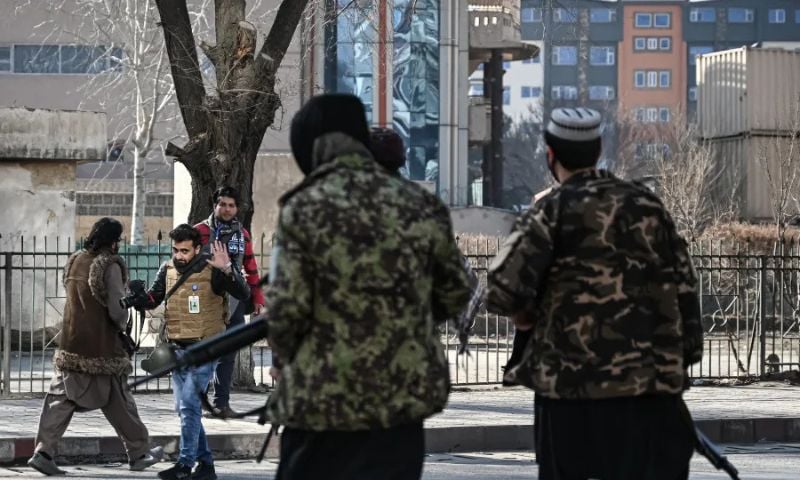
KABUL, Afghanistan: The Taliban regime has turned Afghanistan into an “information prison” by using laws and regulations to suppress journalists and dismantle independent media, Reporters Without Borders (RSF) said on Monday.
The Paris-based media watchdog said the Taliban regime had issued more than 20 national directives and numerous provincial orders since returning to power in August 2021, steadily tightening restrictions on press freedom.
RSF said criticism of the Taliban regime was prohibited, political debate had been silenced and journalists faced growing censorship, arrests, threats and other forms of pressure.
Women journalists have faced particularly severe restrictions, while the broadcasting of images of living beings has also been banned, according to the organisation.
RSF said the repression entered a new phase in January 2026 with the adoption of the Taliban regime’s Criminal Procedure Regulation of the Courts.
The regulation was drafted without public consultation and its text became available to journalists and human rights organisations through leaks, RSF said.
Although the regulation does not explicitly refer to the press, RSF said it provides no protection or exemption for journalists carrying out their work.
The organisation said Article 23 gives Taliban regime judges broad powers to suppress critical and dissenting views, creating what it described as a standing legal mechanism that could be used against journalists and commentators.
Under the regulation, insulting the Taliban leadership is punishable by flogging and up to six months in prison, according to RSF.
Insulting the Taliban’s supreme leader carries a sentence of one year in prison and 39 lashes, the organisation said.
RSF said the provisions effectively incorporated the ban on criticism into law and formalised censorship.
Célia Mercier, RSF’s head of South Asia, said the Taliban regime had systematically transformed Afghanistan into an “information prison”.
“Every new directive further shrinks the space for journalists and independent media,” Mercier said.
“By criminalising media professionals, the de facto authorities are seeking absolute control over the flow of information,” she added.
Mercier said hundreds of Afghan journalists had been forced to leave the country to escape repression, protect their lives and continue their professional work.
Press censorship and threats to journalists
RSF said press freedom gains made under the previous Western-backed government had sharply reversed since the Taliban’s return to power.
Freedom of speech had been regarded as one of the previous government’s achievements and among the strongest in the region, the organisation said.
Also Read: 231 Cases of Taliban’s Violence Against Women Reported
Journalists now face arrests, censorship, interrogations, threats and pressure linked to their reporting, online activity or affiliations, according to RSF.
More than half of Afghanistan’s media outlets have closed, while many journalists have fled the country or gone into hiding, the organisation said.
Women face additional restrictions, including bans on broadcasting female voices in some provinces, RSF said.
The organisation said the Taliban regime had progressively shifted from administrative and verbal restrictions towards a formal legal framework designed to control the flow of information.
RSF calls for repeal of restrictions
RSF called on the Taliban regime to repeal regulations restricting journalism on the basis of what it described as vague religious, moral or “national interest” provisions.
The organisation also urged countries used as transit points or destinations by Afghan journalists to consider the risks they face if deported or forcibly returned to Afghanistan.
It called on those countries to ensure the safety and protection of Afghan journalists by granting them visas.
RSF has consistently ranked Afghanistan among the world’s most restrictive environments for journalism.
The organisation ranked Afghanistan 175th out of 180 countries in its 2026 World Press Freedom Index, citing severe restrictions on independent reporting and media operations.
The latest assessment comes nearly five years after the Taliban returned to power.