When I was a young kid, my parents would periodically meet my class teacher at the Parent-Teacher meeting. Their primary concern was my behaviour in the classroom. They would anxiously ask, “Does he speak in class? Does he ask questions?” The teacher’s response was always a disappointed shake of the head, “No, he almost stays quiet.”
My parents would urge me to speak up, participate, and raise my hand. But I simply didn’t feel like asking.
I am reminded of a HADITH this moment. HOLY PROPHET (PBUH) wisely noted: “Asking good questions is half of knowledge.”
Yet, systematically and often voluntarily, we slam the door on that crucial half of knowledge inside our homes, our schools, and our colleges. Looking back and digging deeper into that childhood silence, I finally understand why I was afraid. My experience was not unique; it is shared by millions of children across the subcontinent.
In our environment, inquiry is treated as insubordination, and questioning the consensus is viewed almost as a crime. Holding an independent thought makes a person an outlier. Why? Because we are terrified of being separated from the herd. Friedrich Nietzsche captured this social pressure perfectly in his book, Thus Spoke Zarathustra:
“No shepherd and one herd! Everyone wants the same, everyone is the same: whoever feels differently goes voluntarily into a madhouse.”
We stay quiet because we are afraid of being sent to that proverbial madhouse. In my previous column, I explored how this fear of standing out stems from an ingrained need for institutional approval. But to understand how this mindset is systematically enforced, we must look at how we raise and educate our children. True societal change does not begin with high-level policy papers; it begins at home, with how we nurture a child’s mind. The tragedy of our society is that we have bound human dignity, worth, and character to degrees, titles, careers, and designations rather than knowledge, wisdom, and moral courage.
Walk into almost any school, college, or university classroom today, and you will find students who feel disoriented, hollow, and chronically distracted. Our educational institutions operate like assembly lines, churning out individuals equipped with test scores but stripped of genuine purpose. In Deschooling Society (Chapter 1), Ivan Illich highlighted the underlying flaw of this approach:
“Treatment is mistaken for health, social work for the improvement of community life, and police protection for safety. In the same way, schooling is mistaken for education.”
When education is reduced to credentials, human curiosity is sidelined. Students feel empty because the system demands compliance while starving their intellectual appetite.
Consider the disconnect in academic paths forced upon young people. I, myself, studied Biology in Matriculation, opted for Pre-Engineering in Fsc, pursued Business Administration for my undergraduate degree, and completed an M.Phil. in Management Sciences, only to spend my time now writing political, educational, and social commentary.
There was no unified line guiding those transitions. My experience is not unique; it is the standard journey for millions across the country. Because early academic guidance is virtually non-existent, students move blindly between whatever fields happen to be popular. If a student has a deep interest in philosophy, local academic options are extremely limited. If they want to study robotics, infrastructure and mentorship are rarely available. We try to fit very different minds into the exact same mould, and then wonder why original thinking disappears.
This broken framework is not an accidental failure; it is an intentionally designed apparatus functioning as intended. To understand why our system values obedience over critical inquiry, we have to look at two historical influences: Lord Thomas Babington Macaulay and John D. Rockefeller.
In Minute on Indian Education 1835(It is a 9-page document; everybody should read and know why this system is structured), Lord Macaulay explicitly detailed the objective of colonial schooling in the subcontinent:
“We must at present do our best to form a class who may be interpreters between us and the millions whom we govern; a class of persons, Indian in blood and colour, but English in taste, in opinions, in morals, and in intellect.”
The colonial administration was not looking to cultivate local philosophers, scientists, or independent leaders. They needed an obedient workforce of clerks to run the administrative machinery of the Empire. The system was structured to replace intellectual self-reliance with administrative compliance.
Across the Atlantic, industrial leaders sought a similar structural outcome for mass schooling. Through the General Education Board established in 1906, John D. Rockefeller funded educational reforms modelled on the Prussian mass-schooling system. It was a model organised around bell schedules, age segregation, and standardised instruction. The intent behind this approach was:
“We shall not try to make these people or any of their children into Philosophers or Men of Learning… The task we set before ourselves is very simple… we will organise children and teach them to do in a perfect way the things their fathers and mothers in an imperfect way.”
Both models shared a common design: mass education was structured to manage populations, not elevate human character.
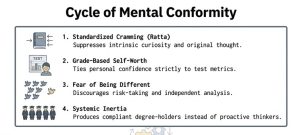
The civil service apparatus was introduced alongside this model to administer authority over subjects rather than serve citizens. Decades after independence, these same foundational patterns remain largely intact. Having personally sat for various government examinations, I have seen firsthand how heavily the testing apparatus relies on pure memorisation. Nearly all of these exams revolve around recall: memorising specific dates, historical years, arbitrary abbreviations, and lists of facts.
Students who excel at short-term memorisation regularly score highest. Meanwhile, applicants who attempt to analyse underlying concepts or question flawed premises are often penalised for deviating from the official answer key.
When grades and memory tests become the primary metrics of human worth, a student’s confidence breaks early. A child who is taught that their intellect is lacking simply because they do not excel at rote recall slowly loses faith in their own thinking. Shattered confidence compromises personal conviction, which weakens families and ultimately impacts the broader society.
This structural issue is particularly visible in the competitive examinations. It was meant to select strategic leaders, but one that often functions like an administrative bottleneck.
Consider the reality candidates face:
- Applicants must digest broad, complex subjects completely outside their academic background in a matter of months or years. Topics that normally take years of dedicated study to master.
- Examinations place heavy emphasis on adhering to standardised answer structures over presenting original analysis. (Analysing the Examiner’s report gives deep insights on the matter)
- The allocation system leaves little room for the vast majority of qualified applicants.
The data reflects the scale of the bottleneck. In the 2025 CSS examination, out of 12,792 candidates who sat for the written exams, only 355 passed the written stage. Ultimately, just 170 candidates were allocated posts due to limited state vacancies.
This leaves more than half of those who cleared every single requirement-written papers, medical screenings, psychological evaluations, and final interviews-unallocated simply because there are no available slots.
These young individuals are forced to either spend another year repeating the process or walk away with their self-worth heavily bruised.
Why do thousands put themselves through this process year after year? Because our social and economic landscape offers few alternative paths for social mobility and security. Let’s get back to Lord Macaulay’s minutes:
{They therefore beg that they may be recommended to the Governor-General for places under the Government-not places of high dignity or emolument, but such as may just enable them to exist. “We want means,” they say, “for a decent living, and for our progressive improvement, which, however, we cannot obtain without the assistance of Government, by whom we have been educated and maintained from childhood.”}
Now we have the answer. Because our social and economic landscape offers few alternative paths for social mobility and security. However, they are also being influenced by online portrayals of civil service perks; young people often pursue these posts for social standing rather than a genuine call to public service. Meanwhile, meaningful civil service reforms remain stalled year after year. What is the committee under Ahsan Iqbal doing? We don’t know!
In this scenario, we cannot sit back and wait for the state to fix an educational framework that has been struggling for generations. Interior Minister has recently acknowledged that the system has collapsed. Sane minds in the country know that the system has been collapsed since the death of Khan Liaquat Ali Khan. So, meaningful structural updates are hard to be executed. I have studied Mr. Chipps in 2nd year, same Mr. Chipps was being taught to my grandparents, maybe. We continue to teach outdated materials to children who are growing up in an era dominated by artificial intelligence and rapid global change. If an education system cannot update its core approach over several decades, waiting for top-down reform is not a viable plan.
Our children represent our most important responsibility. We cannot surrender their minds to a system that prioritises degree acquisition over deep character, genuine wisdom, and independent thought. This is why Homeschooling, already established internationally and gaining traction worldwide, is moving from an alternative lifestyle choice to a practical necessity. By taking direct responsibility for our children’s education, we can move past mechanical exam boards, replace rote memorisation with active inquiry, and focus on building intellectual confidence and strong character from an early age.
While the practical frameworks, legal considerations, and daily execution of homeschooling deserve a dedicated discussion of their own, which I will try in the coming days. But keeping it short, the journey toward real educational independence must begin within our own homes.