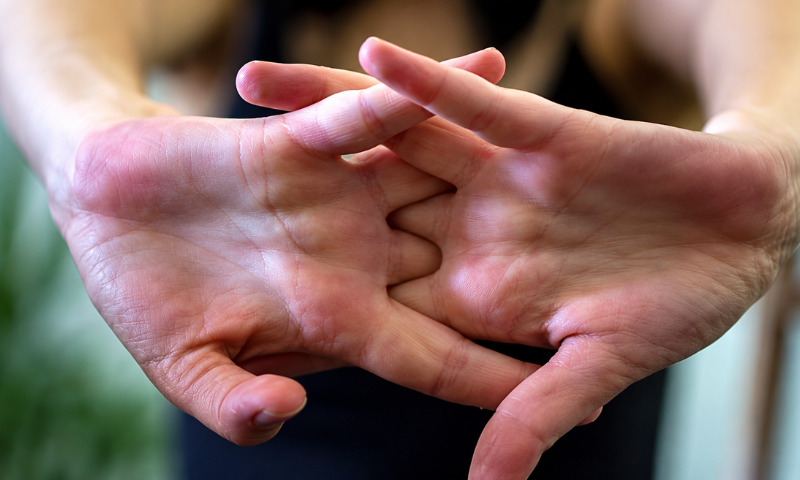
ISLAMABAD: Cracking your knuckles may sound alarming, but for most people, the habit is unlikely to cause lasting damage or increase the risk of arthritis, according to research examining the effects of habitual joint cracking.
The long-standing belief that cracking your knuckles leads to arthritis has been repeatedly challenged by scientific studies. Research comparing habitual knuckle-crackers with people who do not crack their joints has found no meaningful link between the habit and osteoarthritis.
What Causes The Cracking Sound?
The familiar popping sound is produced by changes inside the joint.
Knuckle joints are surrounded by synovial fluid, which lubricates and protects the joint. When a joint is pulled, bent or stretched, the space inside it temporarily expands, causing pressure in the fluid to fall.
Dissolved gases then form bubbles, producing the characteristic cracking sound as the joint undergoes this rapid change.

The sound can be surprisingly loud, reaching around 83 decibels in some circumstances.
Does Cracking Cause Arthritis?
For people who enjoy cracking their knuckles, the main concern is often whether years of doing so will damage the joints.
Studies have found little evidence to support that fear. Research involving habitual knuckle-crackers has found similar rates of degenerative arthritis compared with people who do not crack their knuckles.
Other research examining the frequency and duration of knuckle cracking also found no significant relationship between the habit and the development of osteoarthritis.
Claims that cracking causes permanently enlarged knuckles, loose tendons or general joint damage have similarly not been supported by convincing evidence.
When Cracking Can Become A Problem
Although ordinary knuckle cracking is generally considered harmless, excessive force can cause injuries.
Forcefully pulling or jerking a finger can, in rare cases, result in a sprain or other soft-tissue injury. Pain, swelling, instability or reduced movement following cracking should not be ignored.
The situation is different when it comes to the neck.
Be More Careful With The Neck
The neck contains the spinal cord and major blood vessels that supply the brain, making it considerably more sensitive to forceful manipulation. 
Excessive or poorly performed neck manipulation can cause serious complications, including nerve-related symptoms, dizziness and other injuries. Cracking your own neck forcefully is therefore not recommended.
Back and neck manipulation should be approached with considerably more caution than ordinary knuckle cracking.
What About Grip Strength?
Another concern is that frequent knuckle cracking might weaken the hands.
One older study reported weaker grip strength and greater hand swelling among habitual knuckle-crackers. However, subsequent research failed to find a significant relationship between knuckle cracking and reduced grip strength.
Some people also report that cracking provides temporary relief or makes a joint feel more mobile. This may be because stretching the joint briefly increases its range of movement, although the reasons some people find the sensation satisfying or relieving are not fully established.
Should You Stop?
For most people, there is little medical reason to stop cracking their knuckles simply because of fears about arthritis.
However, anyone who experiences pain, swelling or other symptoms should stop forcing the joint and seek medical advice.
People who want to break the habit can identify when and why they crack their joints — such as during stress, boredom or concentration — and replace the behaviour with another activity, such as using a stress ball or keeping their hands occupied.
So, while the sound may irritate everyone around you, occasional knuckle cracking itself is generally not considered a cause of arthritis or serious joint damage.