


Key Points
- Dhaka demands Hasina’s extradition from India
- Former premier vows to return in December
- Dispute threatens already-strained bilateral relations
ISLAMABAD: Bangladesh has expressed outrage over former Prime Minister Sheikh Hasina’s first public media interaction in New Delhi since she fled to India two years ago.
Bangladesh’s Ministry of Foreign Affairs said that it had conveyed its concerns to the Indian government before the event, warning of its possible impact on efforts to reset bilateral ties.
“Dhaka deeply regrets that despite concerns conveyed a priori to the Government of India about the likely ramifications of this event on the reset of our bilateral relations, this public event was permitted to be held,” the ministry said.
Dhaka has accused New Delhi of allowing an event that could further damage relations between the two neighbouring countries.
ALSO READ: Bangladesh Warns Hasina Event Could Hurt Ties with India
The statement renewed Dhaka’s demand for Hasina’s extradition, saying Bangladesh’s “repeated requests” for her return had not yet received a response from New Delhi.
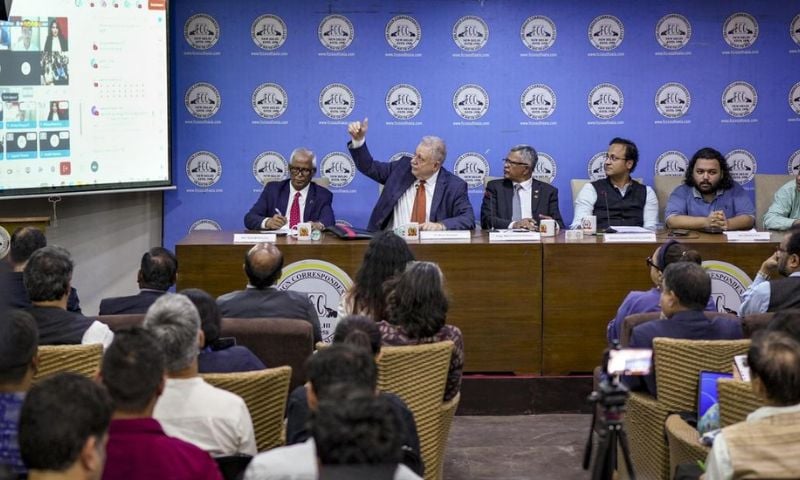
Hasina, who fled Bangladesh for India on August 5, 2024, after a massive student-led uprising brought down her government, addressed a gathering in New Delhi through an audio-only virtual press conference.
Those attending the event could hear Hasina but could not see her. She said she remained determined to return to Bangladesh in December and put the country on the “right track”.
Her remarks came at a particularly sensitive point in Bangladesh-India relations, with Dhaka seeking Hasina’s return to face legal proceedings in Bangladesh and New Delhi yet to agree to the extradition request.
Bangladesh said permitting Hasina to interact with the media from India had hurt public sentiment in the country and was “detrimental to the development of harmonious bilateral relations”.
Dhaka said it remained committed to maintaining a “constructive, mutually beneficial, and forward-looking relationship” with India. The ties must be based on sovereign equality, mutual respect, non-interference in each other’s internal affairs and national dignity, the ministry added.
Bangladesh terms Hasina’s remark an affront to its sovereignty
The government also described Hasina’s remarks as an “affront” to Bangladesh’s sovereignty. “The remarks are an insult to people who lost their lives during what it called the July Revolution,” it added.
The latest confrontation is rooted in the dramatic political upheaval that ended Hasina’s 15-year rule.
Student demonstrations that began over a government jobs quota system escalated into a nationwide movement in 2024. Eventually, the movement created one of the biggest political crises in Bangladesh in decades.
The unrest resulted in a violent crackdown and ultimately forced Hasina to leave office and seek refuge in India.
An interim administration subsequently took charge in Dhaka and began pursuing legal cases against senior figures from her former government.
In November last year, a special tribunal in Dhaka sentenced Hasina to death in absentia for alleged crimes against humanity linked to the crackdown on the 2024 protests.
Hasina has rejected the accusations and has criticised the proceedings against her.
Since the verdict, Bangladesh has repeatedly urged India to extradite her under the India-Bangladesh Extradition Treaty signed in 2013.
Bangladesh’s latest statement made clear that the extradition issue remains central to its concerns over Hasina’s continued presence in India.
India, for its part, has sought to distance itself from Hasina’s New Delhi event.
The Ministry of External Affairs said the government had no role in organising the programme and that a private media entity had arranged it.
The distinction is significant because Bangladesh’s criticism is directed not only at Hasina’s remarks but also at India’s decision to permit her to hold a public media interaction from its territory.
The episode risks complicating efforts to rebuild relations between the two countries following Hasina’s departure.
India had developed close political and security ties with Hasina’s government during her long tenure, including cooperation on border management, counterterrorism, connectivity and trade.
Her removal from power altered the political landscape in Dhaka and created a more complicated diplomatic environment for New Delhi.
The extradition dispute has consequently become a prominent test of India’s relations with the new political order in Bangladesh.
For Dhaka, Hasina’s return is critical to its efforts to hold former government officials accountable for the deaths and alleged abuses committed against the protesters.
Bangladesh’s Foreign Ministry said the latest event had caused “shock” and “aggrievement” and warned that such developments could undermine the rebuilding of bilateral relations.
The government’s statement also suggested that the issue extends beyond Hasina herself, saying the event had affected public sentiment in Bangladesh. “It risked undermining the principles on which Dhaka wants future relations with New Delhi to be based,” it added.
Hasina’s announcement that she intends to return in December adds another element of uncertainty and anxiety.
If she attempts to return, her legal status and the Dhaka government’s extradition demand could become an immediate diplomatic issue between the two countries.
For now, Bangladesh is pressing India for a response to its extradition requests, with no indication that New Delhi is prepared to surrender the former prime minister.