
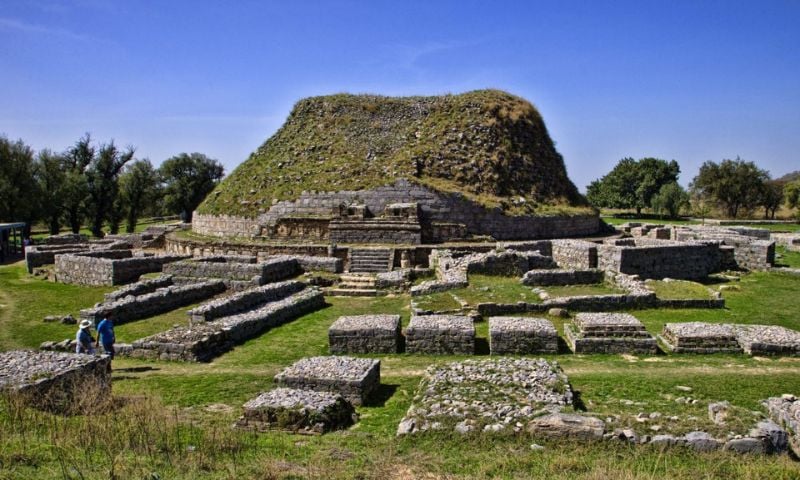
ISLAMABAD: In a historic move to safeguard one of South Asia’s most significant archaeological landscapes, Pakistan’s largest province, Punjab, has developed the first comprehensive long-term conservation strategy for the UNESCO World Heritage Property of Taxila.
The initiative marks a fundamental departure from decades of isolated restoration projects toward an integrated management framework designed to preserve the site’s authenticity and Outstanding Universal Value for future generations.
The initiative, spearheaded by the Punjab government, comes after years of natural deterioration, incompatible restoration methods, moisture damage, uncontrolled vegetation, erosion, and mounting environmental pressures threatened the integrity of the ancient Buddhist complex, which stands as a testament to the region’s rich Gandhara civilisation.
Major interventions underway at Mohra Moradu and Sirkap
The conservation programme has already commenced at Mohra Moradu, one of the finest Buddhist monastic complexes of the Gandhara period, where reinforced concrete structures installed decades ago over the Main Votive Stupa have been carefully removed and replaced with a lightweight protective shelter designed in accordance with internationally recognised conservation principles.
The project has also introduced discreet accessibility measures, including an earthen ramp for persons with disabilities that does not disturb the site’s original stone staircase.
Read Also: Must Visit Sites In Pakistan for Nature and Heritage Lovers
Archaeological investigations at the site have yielded remarkable discoveries, including the monastery’s original drainage system and a rediscovered historic sacred water well, enhancing both preservation efforts and archaeological understanding of the ancient settlement.
At Sirkap, conservation teams have removed extensive vegetation and accumulated debris that had concealed archaeological remains and accelerated structural deterioration. Work has focused on stabilising vulnerable masonry using compatible materials and minimum-intervention techniques, avoiding speculative reconstruction that could compromise the site’s historical integrity.
Read Also: Taxila: Echoes of an Ancient Crossroads
Scientific documentation and long-term planning
For the first time, the conservation programme is supported by comprehensive scientific documentation, including archival research, archaeological investigations, Geographic Information System (GIS) mapping, three-dimensional laser scanning, structural condition surveys, Heritage Impact Assessments, and material compatibility studies.
This technical baseline will inform future monitoring and conservation efforts, ensuring that interventions are guided by robust data rather than ad-hoc decision-making.
The programme has also resulted in the preparation of Taxila’s first Conservation Management Plan, establishing long-term policies for conservation, maintenance, visitor management, disaster preparedness, environmental monitoring, and institutional coordination. Additionally, legal and spatial protection has been strengthened through the delineation of buffer zones around component sites, providing clearer regulatory oversight.
Read Also: Buddha Bone’s Relics on Display in Taxila Museum
Enhancing visitor experience and institutional capacity
Beyond structural conservation, the strategy integrates proposals to improve visitor facilities, site interpretation, and museum display facilities to better present the site’s historical significance to both domestic and international audiences.
The multidisciplinary framework also encompasses digital documentation, accessibility improvements, and institutional capacity building, ensuring that Taxila’s management is equipped to meet contemporary challenges.
The Punjab government commissioned The Urban Unit to prepare Taxila’s first comprehensive master plan, followed by an implementation programme developed by NESPAK, marking a coordinated approach that replaces the fragmented restoration efforts of previous decades. The use of reinforced concrete and cement in earlier repairs had adversely affected the historic fabric of several monuments, and the new programme explicitly addresses these past errors through scientifically grounded, minimum-intervention conservation practices.
A model for heritage preservation in Pakistan
The Taxila conservation programme represents a paradigm shift in Pakistan’s approach to heritage management, moving from reactive, piecemeal restoration to proactive, integrated preservation. As one of the country’s most important cultural assets, Taxila’s safeguarding not only protects Pakistan’s historical legacy but also enhances its potential for cultural tourism and international recognition.
The initiative serves as a potential model for other UNESCO World Heritage Sites across the country, demonstrating that with political will, technical expertise, and long-term planning, Pakistan can preserve its rich archaeological heritage for generations to come.
Read Also: Japan’s $0.31m Investment Upgrades Conservation at Pakistan’s Taxila Museum
Taxila: Cradle of Gandhara Civilisation
Taxila, located in Pakistan’s Punjab province, is one of South Asia’s most significant ancient cities, dating back over 3,000 years. Strategically positioned at the crossroads of major trade routes, it served as the capital of the Gandhara kingdom and was ruled successively by Persian, Greek, Mauryan, and Kushan empires.
Renowned as one of the world’s earliest centers of learning, Taxila produced legendary scholars and witnessed the flourishing of Buddhist civilisation. The city declined in the 5th century CE after Hun invasions. Today, its ruins stand as a UNESCO World Heritage Site, preserving the rich legacy of Gandhara’s art, culture, and history.