
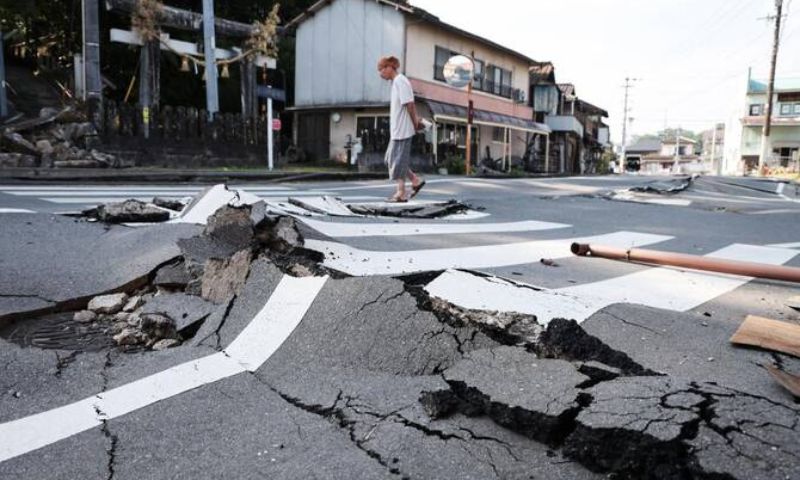
TOKYO: Japanese Prime Minister Sanae Takaichi on Monday visited communities devastated by last week’s powerful earthquake in Kumamoto Prefecture, where emergency crews and residents are struggling to clear debris amid extreme summer heat and ongoing shortages of water and fuel.
The 7.1-magnitude earthquake, which struck the southern Japanese island of Kyushu last Tuesday, has claimed 38 lives, according to prefectural authorities. Among the victims was a person believed to have died from heatstroke while sheltering inside a vehicle, while another death remains under investigation.
As recovery operations gathered pace, residents placed damaged furniture, household appliances and other debris outside their homes for collection. Construction of temporary accommodation has also begun in the towns of Uki and Hikawa to provide shelter for families who have lost their homes.
Authorities said more than 46,000 households remain without running water, while many communities are also facing fuel shortages. The difficult conditions have been compounded by scorching temperatures, with the Japan Meteorological Agency forecasting highs approaching 40°C, raising serious concerns over heat-related illnesses.
More than 8,500 people are still staying in emergency shelters, including community centres, school gymnasiums and classrooms. Many of these facilities lack adequate air conditioning, forcing some evacuees to spend nights in parked cars, public parks or outside their damaged homes.
Disaster management experts have repeatedly warned that overcrowded shelters with limited sanitation, privacy and cooling facilities can increase health risks for displaced populations following major natural disasters.
READ ALSO: Death Toll from Japan Earthquake Rises 200: Officials
During her visit, Prime Minister Takaichi toured one of the region’s best-equipped evacuation centres, which features cardboard beds, privacy partitions and air conditioning. However, the visit drew criticism on social media, with some users arguing that the facility did not accurately represent the conditions faced by most evacuees.
Meanwhile, fresh questions have emerged over a deadly explosion that occurred at a collapsed shopping mall after the earthquake. A local retailer operating inside the Aeon Mall admitted that two employees who later died in the blast had been instructed to return to the damaged building to secure the day’s cash takings if it was safe to do so.
Company executive Goji Yuse acknowledged the instruction while offering condolences to the family of 22-year-old Kurumi Otake, one of the victims. Speaking emotionally during a memorial service, Otake’s mother said she wished someone had prevented her daughter from re-entering the building.
Mall management believes the explosion was caused by a gas leak after approximately 3,000 shoppers had already been evacuated following the earthquake, although several employees remained inside. Rescue teams later recovered five survivors and the bodies of seven victims from the site.
Officials said the earthquake has also left 114 people injured, destroyed around 700 homes, and damaged more than 11,300 buildings, making it one of the most destructive earthquakes to hit the region in recent years.