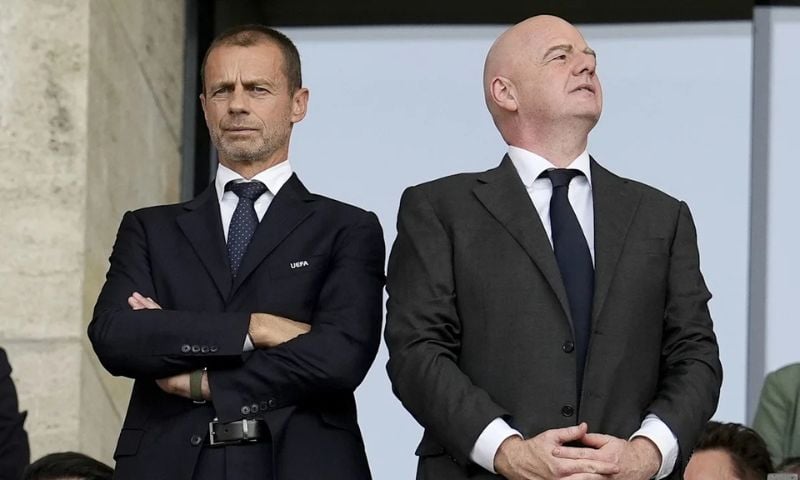
GENEVA, Switzerland: European football has declared open war on FIFA, with all 55 UEFA member associations unanimously threatening to withdraw from the World Cup and other global tournaments if the governing body pushes ahead with its contentious plan to hand over stakes in its competitions to private investors.
All 55 UEFA nations to BOYCOTT World Cup if FIFA goes ahead with controversial sell-off plan
‘World Cup CANNOT be treated as an investment product’
VIDEO: Prez Infantino explains proposal to sell off shares in tournament to private investors pic.twitter.com/9RpUVTcElu
— RTBreaking (@RT_Breaking) July 30, 2026
The dramatic escalation, agreed during an emergency virtual gathering on Thursday, marks the most severe confrontation between European football and FIFA since the collapse of the Super League project. At the heart of the dispute lies FIFA’s proposal to create a commercial entity that would sell up to 20 per cent ownership of the World Cup and other events to external backers.
UEFA issued a stark warning following the meeting: European teams will refuse to participate in any FIFA-organized competition unless the plan is entirely scrapped and FIFA provides binding commitments never to pursue similar commercial arrangements in the future.
Read Also: Why FIFA Wants to Sell a Stake in the World Cup
Football’s European governing body delivered a passionate defence of the sport’s integrity, arguing that the World Cup transcends commercial value and cannot be reduced to an investment vehicle.
“Generations of players, national teams, and supporters across every continent have built this legacy,” UEFA stated. “No part of it should ever be handed over to private investors. The World Cup belongs to football, and it must never be put up for sale.”
The English Football Association quickly voiced its support, confirming it stands “shoulder to shoulder” with its European counterparts in opposing the initiative.
🚨 BREAKING:
Several European football associations are reportedly discussing the possibility of boycotting a future FIFA World Cup if FIFA President Gianni Infantino moves forward with plans to sell a stake in FIFA’s commercial business to private investors.
The discussions… pic.twitter.com/Gmndoizrma
— GFN (@GFNIND) July 29, 2026
Widespread opposition across football
The proposal has triggered criticism far beyond Europe. The Asian Football Confederation and CONCACAF have both expressed frustration at being excluded from discussions, suggesting the plan was developed without proper consultation with football’s regional bodies.
FIFA’s leadership, headed by president Gianni Infantino, unveiled the proposal earlier this week, pitching it as a transformative opportunity to unlock substantial funding for football development worldwide. The plan would see a new subsidiary manage FIFA’s commercial rights, with external investors acquiring up to one-fifth of the entity’s shares.
Read Also: FIFA Opens Disciplinary Case Against Argentina After World Cup Final Incidents
The timing of the boycott threat casts immediate uncertainty over upcoming events, including next year’s Women’s World Cup in Brazil and the inaugural Under-15 World Cup scheduled for October in Azerbaijan. The potential absence of European nations would significantly diminish the commercial appeal and competitive prestige of these tournaments.
FIFA President Gianni Infantino’s plan to create a $20 billion company running the World Cup with private investors including the Kushner family was announced and immediately attacked by European soccer body UEFA. https://t.co/mvIK75sS8F
— The Boston Globe (@BostonGlobe) July 28, 2026
A clash over football’s soul
The dispute has quickly evolved beyond a financial disagreement into a fundamental battle over who should control football’s most cherished asset. European officials argue that the World Cup’s value is rooted in sporting merit and tradition, not shareholder returns, and warn that private ownership would inevitably place commercial priorities above the sport’s broader interests.
Critics have pointed to the timing and secrecy surrounding the proposal, with several confederations claiming they only learned of the plans through press reports rather than official channels. UEFA has described the approach as a “profound failure of leadership,” accusing FIFA of bypassing proper governance procedures.
European countries to boycott FIFA competitions over plan to sell stake in World Cup to Trump-linked investorshttps://t.co/xlHXka5K0R
— Peoples Gazette (@GazetteNGR) July 30, 2026
Uncertain future for global football
With FIFA setting a deadline of September 19 for member associations to respond to the proposal, the coming weeks will be critical in determining whether a resolution can be reached or whether European football follows through on its boycott threat.
The outcome will shape not only the future of the World Cup but also the broader governance structure of international football. For now, European football has drawn a clear line, and FIFA faces its most significant challenge yet.