
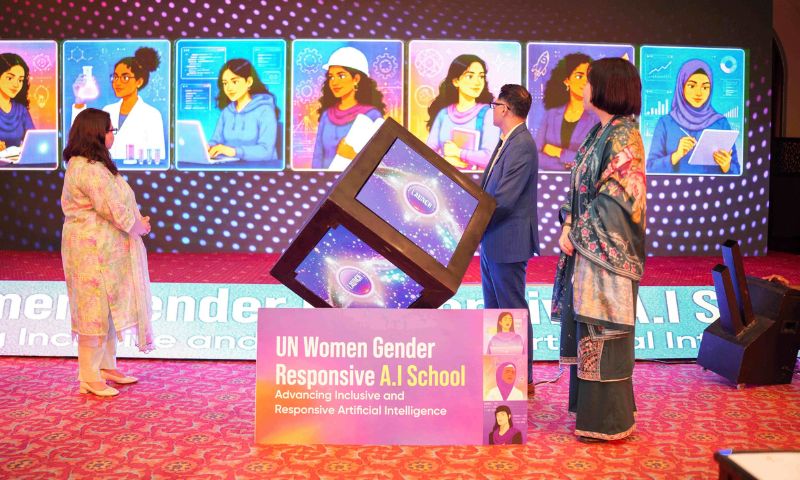
ISLAMABAD: In a landmark move that positions Pakistan as a regional pioneer in ethical artificial intelligence, the government has launched the UN Women Gender-Responsive AI School, the first initiative of its kind in the Asia-Pacific region to deliver a comprehensive national training programme across all branches of government, civil society, and the private sector.
The groundbreaking initiative, launched by the Ministry of Information Technology and Telecommunication (MoITT) in collaboration with UN Women Pakistan and with support from the Korea International Cooperation Agency (KOICA), aims to ensure that women and girls are not left behind in Pakistan’s rapidly evolving digital landscape.
The Artificial Intelligence School will equip policymakers, parliamentarians, government institutions, academia, civil society, and community leaders with the knowledge and practical skills to harness AI responsibly and ethically.
Read Also: How Artificial Intelligence Chatbots Are Undermining Academic Research?
The launch comes at a critical moment. According to UN Women’s analysis, only around two dozen of nearly 140 national AI policies worldwide make any reference to gender, a glaring gap that Pakistan is now moving decisively to address.
Three leaders. One shared vision. One inclusive AI future. 🚀
At the launch of the UN Women Gender-Responsive AI School Pakistan, Minister @ShazaFK, Sodam Baek (@KOICApak ), and @jamshedmkazi (UN Women Pakistan) reaffirmed their commitment to advancing gender-responsive AI. pic.twitter.com/Pomf1ApuS4— UN Women Pakistan (@unwomen_pak) July 30, 2026
By embedding gender equality, ethics, and inclusion into AI policy and governance, the initiative translates global commitments from the Global Digital Compact, the CSW67 Agreed Conclusions, and the Beijing+30 agenda into concrete national action.
Pakistan takes a bold step into the future of Artificial Intelligence.
The Ministry of Information Technology and Telecommunication, in partnership with UN Women Pakistan and with the generous support of KOICA Pakistan, has officially launched the UN Women Gender-Responsive Al… pic.twitter.com/7XgQAGpbcR— Malik Dr Robina Awan (@MalikDrRobina) July 30, 2026
Pakistan sets regional precedent
Speaking at the launch ceremony, Jamshed M. Kazi, Country Representative of UN Women Pakistan, hailed the initiative as a historic milestone that puts Pakistan ahead of the curve in the region.
“Pakistan is setting a new benchmark for the Asia-Pacific region through the UN Women Gender-Responsive AI School; the first initiative in the region to deliver a national Training of Trainers programme with tailored learning pathways for the executive, legislative, and judicial branches of government, as well as civil society and the private sector,” Kazi said.
“What begins here today is not following a precedent; it is setting one. Together with the Government of Pakistan, the Ministry of IT & Telecom and KOICA, we are investing in the leadership, institutions, and skills needed to build an inclusive, ethical, and gender-responsive AI future,” he added.
The wait is over! 🎉🇵🇰
The @MoitOfficial , in partnership with @unwomen_pak and with support from @KOICA_Pakistan, has officially launched the UN Women Gender-Responsive AI School Pakistan.
The future of AI starts today. 🚀#GenderResponsiveAI #AIforGood #DigitalPakistan pic.twitter.com/63wiC9MGfG— UN Women Pakistan (@unwomen_pak) July 30, 2026
Comprehensive curriculum for digital leadership
The AI School’s curriculum combines conceptual learning with practical application through tailored learning pathways covering AI foundations, gender-responsive and ethical AI, AI governance, prompt engineering, AI agents, and AI applications for public administration and inclusive development.
Ahead of its official launch, the initiative has already delivered specialised training programmes for parliamentarians, government officials, UN personnel, academia, and civil society, creating a growing national network of AI champions across Pakistan.
Read Also: Pakistan Mandates Artificial Intelligence Education for All University Students
Sodam Baek, Deputy Country Director of KOICA Pakistan Office, emphasised the importance of the investment in Pakistan’s digital future: “KOICA is proud to support the UN Women Gender-Responsive AI School as an investment in Pakistan’s inclusive digital future. By strengthening digital skills and promoting responsible AI, we are helping build an innovation ecosystem where women and girls can participate equally and contribute to sustainable development.”
Institutionalisation through national ownership
In a significant step towards long-term sustainability, MoITT and UN Women Pakistan signed a Memorandum of Understanding (MoU) during the ceremony to institutionalise the AI School, followed by its symbolic handover to the Ministry, reinforcing national ownership and ensuring the initiative’s continuity beyond initial donor support.
A defining moment for Pakistan’s AI future. 🤝🇵🇰@MoitOfficial and UN Women have signed an MoU to institutionalize the UN Women Gender Responsive AI School Pakistan, reinforcing national ownership and ensuring its long-term sustainability.#GenderResponsiveAI #DigitalPakistan pic.twitter.com/OnYzDJZjtZ
— UN Women Pakistan (@unwomen_pak) July 30, 2026
Delivering the keynote address, Federal Minister for Information Technology and Telecommunication Shaza Fatima Khawaja reaffirmed Pakistan’s commitment to inclusive digital transformation.
نہایت اہم ہے کہ ہماری خواتین ان جدید ٹیکنالوجیز کی محض صارف بن کر نہ رہیں بلکہ ان کی تعمیر و تشکیل میں فعال کردار ادا کریں۔
~ وفاقی وزیرِ آئی ٹی شزہ فاطمہ خواجہ کا یو این ویمن اے آئی کی تقریب سے خطاب pic.twitter.com/OrkLYtDMH1
— PMLN Punjab (@PMLNPunjabPk) July 30, 2026
“Artificial intelligence is transforming every sector of society, and Pakistan is committed to ensuring this transformation is inclusive and responsive,” Khawaja said. “Through our partnership with UN Women and KOICA, we are strengthening institutional capacity, advancing ethical AI governance, and creating opportunities for women and girls to lead and thrive in the digital economy.”
Building a national network of AI champions
A highlight of the event was the presentation of outcomes from the Training of Trainers programme, showcasing practical applications of AI in governance, parliamentary research, education, and community engagement, demonstrating that the initiative is already translating theory into tangible impact.
#DidYouKnow
🇵🇰 is one of the countries to host full national ToT track of the #UNWomenGenderResponsiveAISchool.
🎓 34 trainers have graduated
✨ At the launch, graduates showcased innovative AI solutions
Together with @MoITTOfficial and @KOICA_PK, we’re advancing inclusive AI pic.twitter.com/qxzJ5jkjZu— UN Women Pakistan (@unwomen_pak) July 30, 2026
Since 2024, the regional UN Women AI School initiative has trained more than 5,000 policymakers, UN personnel, civil society leaders, and young innovators across Asia and the Pacific. By institutionalising the AI School through a nationally owned platform, Pakistan has now positioned itself as a regional benchmark for gender-responsive AI governance.
Read Also: Artificial Intelligence Expert Predicts White-Collar Jobs Will Vanish by 2027
Aligning with national and global goals
The initiative contributes directly to Pakistan’s digital transformation agenda and the achievement of the Sustainable Development Goals, particularly SDG 5 (Gender Equality) and SDG 9 (Industry, Innovation and Infrastructure).