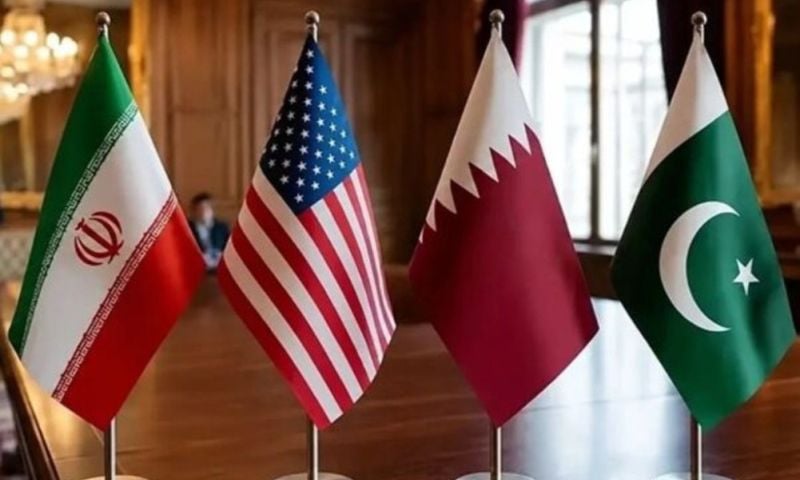
ISLAMABAD: The United States and Iran have submitted their responses to a joint proposal by mediators Pakistan and Qatar to resume peace talks to end months of conflict, as a pause in military exchanges has raised hopes for renewed diplomacy.
Washington and Tehran had responded to the Qatari-Pakistani proposal to restart talks under the Islamabad Memorandum of Understanding (MoU) framework, Al Arabiya reported on Sunday, citing sources.
Meanwhile, sources cited by Anadolu Agency said that the US and Iran had communicated their willingness to pursue dialogue and diplomacy to end the renewed hostilities and return to negotiations.
The reported diplomatic progress came after US President Donald Trump ordered a pause in military strikes against Iran following nearly two weeks of consecutive attacks, while Tehran also announced it had suspended attacks after no new US strikes occurred for two nights.
The Islamabad MoU, brokered by Pakistan, was signed in June to end hostilities between the two countries and pave the way for a lasting peace agreement to permanently end the conflict.
The Islamabad MoU was signed on June 18 by US President Donald Trump, Iranian President Masoud Pezeshkian, and Pakistan’s Prime Minister Shehbaz Sharif, following Islamabad brokered a ceasefire between Washington and Tehran.
Under the Islamabad MoU, the US and Iran committed to halt military operations, reopen the Strait of Hormuz to commercial shipping, and negotiate a comprehensive agreement covering Iran’s nuclear programme, US sanctions, and a permanent ceasefire within 60 days.
Pakistan, Qatar intensify mediation
Sources cited by Anadolu said that Pakistan and Qatar had intensified exchanges of messages between Washington and Tehran after receiving their responses to the joint de-escalation proposal.
Earlier this week, Pakistan and Qatar proposed that both countries return to their pre-July 9 positions as an initial step towards reviving stalled negotiations aimed at permanently ending the conflict, Anadolu reported, citing official sources.
Although the sources did not disclose details of the responses, they said both sides had expressed support for dialogue and diplomacy to resolve the conflict.
The current pause in military operations had strengthened hopes that negotiations could resume after being derailed by fighting around the Strait of Hormuz and subsequent regional escalation, sources cited by Anadolu said.
A source, cited by Al Arabiya, said that Iran had not withdrawn from negotiations but had merely suspended them while remaining prepared to continue dialogue in accordance with the US-Iran Islamabad Memorandum of Understanding.
Talks with Iran ‘happening at every level’
US Ambassador to the United Nations Mike Waltz said that talks between Washington and Tehran are “happening at every level”.
Speaking to NBC News, he said, “What we are constantly seeing though, is on the Iranian regime’s side, they are divided; there is internal fighting”
“The president is keeping all options on the table,” says @USAmbUN on Iran.
“Talks are ongoing. They’re happening at every level… what we are constantly seeing though, is on the Iranian regime’s side, they are divided, there is internal fighting…” pic.twitter.com/vfyKKdAsAm
— Rapid Response 47 (@RapidResponse47) July 26, 2026
Earlier, Mike Waltz told “Fox News Sunday” that President Trump is giving negotiations with Iran “some space”.
Mike Waltz said that the United States remained “locked and loaded” for more attacks and that “more assets have gone into the region,” but that Trump is “giving talks some space — he’s giving it a little bit of room.”
Prior to Friday, the US military had announced strikes on Iran for 13 consecutive nights, in the largest rekindling of the war since an April ceasefire.
Trump says diplomacy offers better path
The diplomatic developments followed President Trump’s decision to halt further strikes against Iran.
According to Axios, Trump declined on Friday to approve a proposed military operation after receiving another strike plan from Pentagon officials, instructing the military not to launch fresh attacks.
Also Read: Trump Orders Halt to New US Military Strikes on Iran: Report
The report said Trump had approved strike plans daily for 13 consecutive days before deciding to pause the campaign.
Speaking to reporters at the White House on Saturday, Trump said he still retained the option of continuing or escalating military action but believed diplomacy offered a better path.
“We’re talking to [the Iranians] right now. I think they’re getting more and more serious as the days go by. We’re locked and loaded and ready to go, but we’re talking to them,” Trump said.
Axios reported that the president believed the military campaign had achieved as much as it reasonably could at this stage.
CNN, quoting an unidentified Pentagon source, separately reported that US operations against Iran were “on hold”, despite Trump’s warning on Friday that Washington retained the option of launching strikes “at a much higher level”.
The New York Times reported, citing two people briefed on the matter, that proposals for further escalation had also been shelved partly because of concerns over diminishing supplies of Patriot interceptor missiles and other defensive munitions.
According to CNN, Vice President JD Vance and Chairman of the Joint Chiefs of Staff General Dan Caine expressed concerns during a White House meeting on Friday about the potential consequences of expanding the conflict.
CNN reported that Caine told Trump that available military options remained viable but warned of their broader implications.
Iran suspends operations
Iran announced on Sunday that it had halted attacks against countries in the Middle East after the United States suspended strikes over the previous two nights.
Army spokesman Mohammad Akraminia said the US attacks had continued until two nights earlier before stopping.
“Since our strategy has essentially been retaliatory, we have also halted our retaliatory operations,” Akraminia said as quoted by Iranian media.
However, Iran’s army warned that the conflict would widen if Washington resumed military operations.
A senior Iranian source told Reuters on Sunday that Iran will halt its own attacks as long as the US maintains its pause on strikes, but Tehran remains sceptical of US intentions.
“Iran’s position remains ‘attack for attack’: if the attacks stop, Iran will also halt its operations. That message has already been conveyed to the United States,” the source told Reuters, a day after Washington halted attacks following 13 successive nights of air strikes.
Iran, Oman talks over Strait of Hormuz
Separately, Iran said it had made progress in talks with Oman on future management of the Strait of Hormuz, one of the world’s most strategically important shipping lanes.
Foreign Ministry spokesman Esmaeil Baqaei said senior Iranian and Omani officials held several rounds of discussions in Tehran on Friday and Saturday, led by the two countries’ deputy foreign ministers.
According to Baqaei, the talks focused on developing common principles and practical mechanisms to ensure safe commercial navigation while protecting the sovereign rights of both countries.
He described the discussions as “useful” and said technical and political consultations would continue.
The Strait of Hormuz, bordered by Iran and Oman, carries a substantial proportion of global oil and liquefied natural gas exports and remains critical to international energy markets.
Earlier in June, Tehran and Muscat said they would discuss introducing transit service fees for vessels using the strait, a proposal opposed by the United States.
Oman also said ships could use its territorial waters while transiting the waterway, a position that drew criticism from Iran and contributed to renewed tensions between the neighbouring countries.
Responding to questions on Sunday, Baqaei said there had been no changes in commercial shipping through the Strait of Hormuz despite the recent conflict.
According to Axios, Trump opted against authorising a 14th consecutive night of strikes after an Omani delegation arrived in Tehran for discussions on possible arrangements concerning the reopening and future management of the Strait of Hormuz.