Key Points
- Pakistan to assume SCO chairmanship for 2026-27
- Islamabad seeks regional support on Afghan security concerns
- Foreign minister holds talks with Chinese, Iranian counterparts
ISLAMABAD: Pakistan has called on the Shanghai Cooperation Organisation (SCO) to press Afghanistan’s Taliban to honour their counter-terrorism commitments, as Islamabad has been facing a growing threat from terrorist groups operating from Afghan territory.
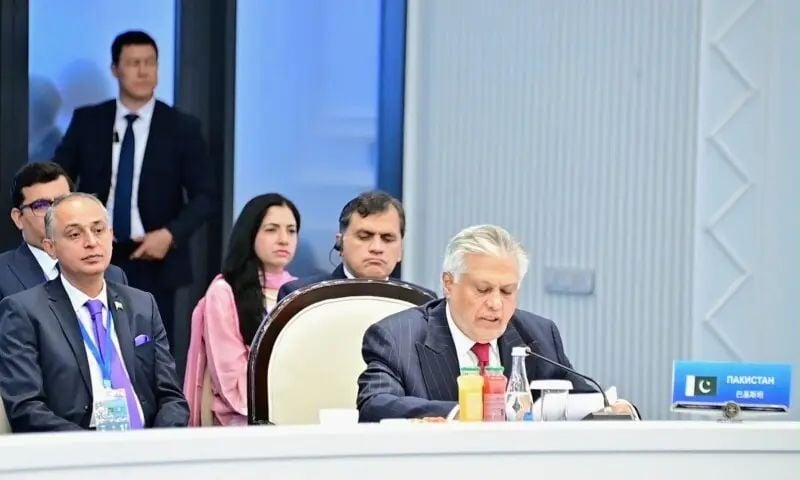
Deputy Prime Minister and Foreign Minister Ishaq Dar made the remarks at the SCO Council of Foreign Ministers meeting in Cholpon-Ata, Kyrgyzstan.
He said durable peace, stability and economic development in the region would remain elusive unless the threat of terrorism emanating from Afghanistan is eliminated.
Dar said Pakistan sought a “peaceful, stable, regionally integrated and prosperous Afghanistan” but described cross-border terrorism as one of the country’s most serious security challenges.
He told the gathering that terrorist organisations continued to recruit, train and operate from Afghan soil and alleged that the Taliban administration had failed to curb their activities.
According to Pakistan’s foreign minister, more than 560 Pakistanis have been killed in over 2,000 terrorist attacks so far this year.
The minister made these remarks in the event of a new wave of terrorism in Pakistan’s western provinces bordering Afghanistan.
Diplomatic exchanges between Islamabad and Kabul over security and the presence of armed groups, including Tehreek-e-Taliban Pakistan (TTP), have not yielded so far.
Pakistan says terrorists uprooted from its territory are maintaining sanctuaries inside Afghanistan. The Taliban administration has repeatedly denied allowing Afghan territory to be used against other countries, but the situation on the ground is the other way round.
Pakistan emphasises the SCO agenda
Addressing the SCO agenda, Dar said the 10-member bloc should prioritise digital inclusion, narrowing the technological divide and strengthening energy security over the coming decade.
He said the organisation had evolved significantly since its origins as the Shanghai Five in the 1990s as a platform encompassing security, economic cooperation, development and cultural exchanges.
Dar also highlighted Pakistan’s recent diplomatic role in facilitating dialogue between the United States and Iran.
He described the Iran-US Islamabad memorandum of understanding signed in June as a “historic breakthrough”. He urged the international community to build on ongoing US-Iran technical talks to support a lasting settlement in the Middle East.
On the sidelines of the meeting, Dar held separate discussions with Kyrgyz President Sadyr Nurgozhoevich Zhaparov, Chinese Foreign Minister Wang Yi and Iranian Foreign Minister Abbas Araghchi.
According to Pakistan’s Foreign Office, Wang congratulated Pakistan on assuming the SCO chairmanship for 2026-27 and expressed support for Islamabad’s hosting of the SCO Heads of State Summit in 2027.
Pakistan is due to take over the rotating chairmanship of the SCO for the 2026-27 term, placing it at the centre of the regional organisation’s agenda at a time of heightened geopolitical tensions across South and Central Asia.