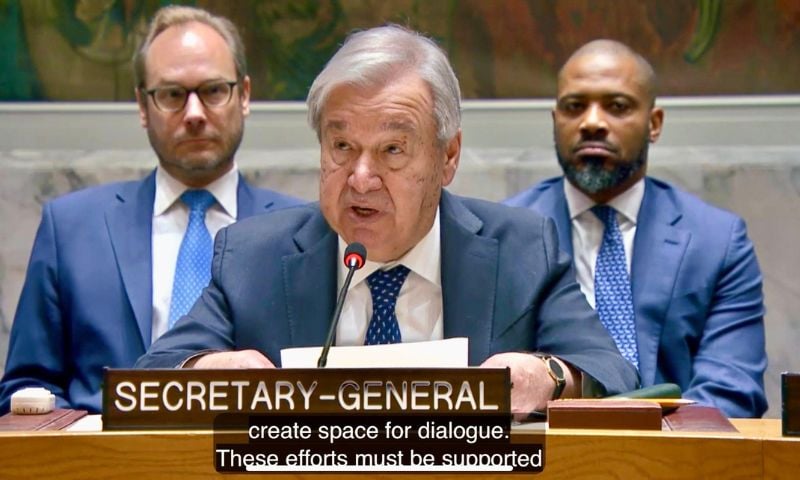
UNITED NATIONS: United Nations Secretary-General Antonio Guterres has commended Pakistan’s efforts to promote peaceful conflict resolution at the UN Security Council (UNSC), describing the country’s diplomatic initiatives as vital in helping reduce regional tensions and encouraging dialogue at a time of mounting global instability.
Speaking during an open debate of the Security Council convened under Pakistan-sponsored Resolution 2788 (2025), Guterres stressed that diplomacy and mediation remain the most effective tools for preventing and resolving conflicts, particularly as violence continues to spread across the Middle East and other regions.
The debate focused on strengthening the peaceful settlement of international disputes under the UN Charter. Resolution 2788, introduced by Pakistan during its presidency of the Security Council last year and adopted unanimously, calls for greater use of negotiation, mediation, conciliation, arbitration and judicial mechanisms before disputes escalate into armed conflict.
Addressing delegates, Guterres warned that military action could not deliver lasting peace and urged all parties involved in regional conflicts to exercise restraint.
“As conflicts intensify across the Middle East and beyond, military solutions cannot provide sustainable peace,” he said, cautioning that the region was approaching an increasingly dangerous phase where successive crises were fuelling one another.
He noted that escalating confrontations were overshadowing political objectives and called on all sides to halt hostilities, protect civilian infrastructure and recommit to diplomatic engagement.
The UN chief also stressed the importance of safeguarding international freedom of navigation through strategic waterways, including the Strait of Hormuz and the Bab al-Mandab, describing uninterrupted maritime access as essential for regional and global stability.
Recognising Islamabad’s diplomatic engagement, Guterres praised Pakistan and other regional countries for their mediation efforts aimed at lowering tensions and creating opportunities for dialogue.
He said such initiatives deserved broader international support and should be strengthened in pursuit of durable political solutions.
The Secretary-General also voiced concern over developments in the occupied West Bank, pointing to continued settlement expansion, large-scale displacement, Israeli military operations and what he described as gradual annexation of Palestinian territory.
Pakistan’s Permanent Representative to the United Nations, Ambassador Asim Iftikhar Ahmad, welcomed the Secretary-General’s recommendations, describing them as practical, forward-looking and highly relevant to strengthening the UN’s role in conflict prevention.
Our profound appreciation to the UN Secretary-General for his thoughtful, practical and forward-looking recommendations presented today at the Security Council pursuant to Pakistan-sponsored UNSC Resolution 2788 (2025). Sustained implementation of these recommendations would… pic.twitter.com/9vL4oHLvO2
— Asim Iftikhar Ahmad, PR of Pakistan to the UN (@PakistanPR_UN) July 23, 2026
Addressing the Council, Ambassador Ahmad said Resolution 2788 reflected Pakistan’s long-standing belief that diplomacy should serve as the first line of defence against conflict rather than a tool employed only after violence has erupted.
He argued that the UN Charter already provides sufficient mechanisms for the peaceful settlement of disputes, but their implementation has often been delayed, inconsistent or selective, reducing opportunities for early intervention.
The Pakistani envoy also highlighted Islamabad’s recent diplomatic engagement in West Asia, saying Pakistan had worked alongside partner countries to facilitate dialogue between Iran and the United States in an effort to ease regional tensions.
Expressing concern over renewed hostilities, he urged all parties to return to negotiations, emphasising that setbacks in diplomacy should lead to greater, rather than reduced, diplomatic efforts.
Ambassador Ahmad further called for stronger implementation of Security Council resolutions, expanded use of mediation and fact-finding missions, enhanced support for the Secretary-General’s good offices and closer cooperation between the United Nations and regional organisations.
He concluded by saying the true success of Resolution 2788 would be judged not by its unanimous adoption but by its consistent implementation, adding that the greatest achievements of diplomacy are often the conflicts that never occur because dialogue remains open and restraint prevails.