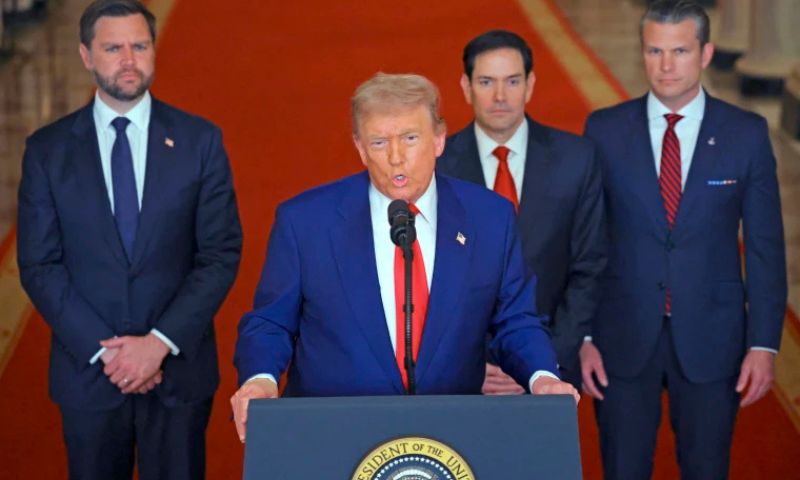
WASHINGTON: US President Donald Trump said on Thursday he was close to deciding whether to launch a “massive attack” on Iran, on a scale larger than strikes already witnessed during the months-long conflict with Tehran.
Speaking to the news website Axios, Trump said he was weighing military action on a scale larger than previous strikes.
“I am considering a massive attack. Bigger than ever before. I am close to making a decision. We are all set for it,” Trump was quoted as saying.
The US President acknowledged that such action would carry consequences but said he had not yet made a final decision or set a deadline.
Trump said Israel “would join in two minutes if I ask them to”, before adding: “We don’t need anybody.”
He also said there would be consequences if Israel became involved, appearing to refer to possible Iranian retaliation.
According to Axios, Trump claimed Iranian officials wanted to negotiate but were not yet prepared to reach an agreement.
Exclusive: Trump says he's "close" to decision on "massive attack" against Iran https://t.co/cT0ofF2Lip
— Axios (@axios) July 23, 2026
Trump warns Houthis of ‘major military punishment’
Trump’s remarks came after he earlier warned Iran and Yemen’s Houthi militia of “major military punishment” after the group launched missile and drone strikes on oil tankers in the Red Sea.
“The US will hold Iran responsible, in that the Houthis are a Surrogate and/or Proxy of Iran, and major military punishment will be inflicted upon Iran and, of course, the Houthis themselves” should the militia launch further attacks, Trump said on his Truth Social network.
“A year ago the United States of America attacked, very powerfully, the Houthis, for their interference with commerce and trade, by shooting at ships,” Trump said. “Since that time, and during our conflict with Iran, they have acted very responsibly.”
“Unfortunately, now they are starting up again, shooting at two Saudi Arabian ships last night,” the US President said.
— Rapid Response 47 (@RapidResponse47) July 23, 2026
Also Read: Trump Threatens Yemen’s Houthis with ‘Major Military Punishment’
The latest escalation has heightened fears that the conflict is expanding beyond the Strait of Hormuz, threatening another critical global shipping route through the Bab al-Mandab Strait.
Oil markets reacted sharply to the growing uncertainty. Brent crude, the international benchmark, climbed above the symbolic $100-per-barrel mark on Thursday.
UN chief warns region nears ‘edge of the unimaginable’
The escalating conflict prompted fresh warnings from United Nations Secretary-General António Guterres, who told the UN Security Council that the Middle East was approaching a dangerous tipping point.
“The situation is getting out of control. It is teetering on the edge of the unimaginable,” Guterres said.
“The region is being pulled into an ever-widening circle of confrontation. One crisis feeds another. One escalation triggers the next.”
Warning of increasing instability, Guterres said conflicts were growing in “number, complexity, length and scope” while “impunity is spreading”.
He called for international navigational rights through the Strait of Hormuz and Bab al-Mandab to be fully restored and stressed that “diplomacy is the only way forward.”
The situation in the Middle East is getting out of control.
It's time to step back.
My clear & consistent message to leaders:
The fighting must stop everywhere.
Freedom of navigation must be restored.
Diplomacy is the only way forward. pic.twitter.com/ZfOdMyq1Td
— António Guterres (@antonioguterres) July 23, 2026
Turning to Gaza, Guterres said civilians continued to suffer despite the ceasefire, with killings continuing as Israel expanded its control over the territory.
He also warned of “creeping annexation”, violence and large-scale displacement in the occupied West Bank.
Western govts take precautionary measures
The deteriorating security situation prompted several governments to adopt precautionary measures.
Britain announced on Wednesday that it was temporarily withdrawing diplomatic staff from Iran.
Germany said on Thursday it would withdraw two naval vessels from the Red Sea.
The US State Department also issued a travel advisory urging American citizens across the Middle East to prepare for possible flight cancellations and wider disruptions to air travel caused by the conflict.
Authorities warned that commercial flights could be suspended at short notice as security conditions deteriorated.
Worldwide Caution: Due to heightened tensions in the Middle East, the security environment remains complex with the potential for unforeseen escalation.
Americans currently in the Middle East should exercise caution and heightened vigilance and should be prepared for flight… pic.twitter.com/PNSVFgfPpP
— TravelGov (@TravelGov) July 23, 2026
Gulf states and Jordan condemn Iranian attacks
The Gulf Cooperation Council (GCC) and Jordan jointly condemned Iran’s continuing attacks, describing them as “a clear act of aggression that violates the United Nations Charter and international law.”
In a joint statement, the seven countries reaffirmed their inherent right to self-defence under Article 51 of the UN Charter and called on the Security Council to recognise the right of affected states to defend themselves.
The statement also urged the Council to adopt an urgent resolution demanding an immediate end to Iranian attacks and reaffirmed support for freedom of navigation through both the Strait of Hormuz and the Bab al-Mandab.
Meanwhile, Kuwait’s Ministry of Defence said the country’s Al-Abdali border crossing with Iraq had once again come under attack by hostile drones.
Military spokesman Brigadier General Saud Abdulaziz Al-Otaibi said the strike caused material damage but no casualties.
“The Armed Forces affirm their continued execution of their missions and duties with high efficiency, and their adoption of all necessary measures to protect the homeland’s borders and preserve its security and stability,” he said in a statement.
بيان رقم (79)
صرّح المتحدث الرسمي لوزارة الدفاع، العقيد الركن سعود عبدالعزيز العطوان
تعرّض منفذ العبدلي الحدودي، مساء اليوم، لاستهدافٍ متكرر بطائرات مسيّرة معادية، أسفر عن وقوع أضرار مادية، دون تسجيل أي إصابات بشرية، ولله الحمد.
وأضاف أن الجهات المختصة باشرت، فور وقوع الحادث،… pic.twitter.com/za5WNTqAcd
— KUWAIT ARMY – الجيش الكويتي (@KuwaitArmyGHQ) July 23, 2026
The Al-Abdali crossing, Kuwait’s principal land border with Iraq, was also targeted last week and in April.
Pakistan vows to defend Saudi security
Prime Minister Shehbaz Sharif on Thursday reaffirmed Pakistan’s unwavering commitment to Saudi Arabia’s security and pledged to work closely with the Kingdom and the international community to safeguard maritime trade through the Red Sea, the Strait of Hormuz and the wider region during a telephone conversation with Saudi Crown Prince and Prime Minister Mohammed bin Salman.
According to the Prime Minister’s Office, PM Sharif assured the Saudi Crown Prince that Pakistan would continue supporting efforts to preserve peace, security and regional stability while ensuring the uninterrupted flow of lawful maritime commerce through some of the world’s most strategically important waterways.
Islamabad : 23 July, 2026.
Prime Minister Muhammad Shehbaz Sharif held a telephone conversation with His Royal Highness Prince Mohammed bin Salman bin Abdulaziz Al Saud, Crown Prince and Prime Minister of the Kingdom of Saudi Arabia, this morning.
During their most cordial… pic.twitter.com/XlzeKKj4rg— Prime Minister's Office (@PakPMO) July 23, 2026
“The Prime Minister expressed Pakistan’s condemnation, in the strongest possible terms, of the dastardly attacks carried out by the Houthi militia against Saudi oil tankers in the Red Sea,” Prime Minister Sharif office said and added that such actions were totally unacceptable, constitute a clear violation of international law, threaten freedom of navigation and commercial shipping, and undermine regional peace, security, and stability.
Pakistan condemns Houthi militia attacks
The Prime Minister reaffirmed Pakistan’s complete solidarity with Saudi Arabia and stated that he, along with Field Marshal Syed Asim Munir and the entire Pakistani nation, stands firmly and resolutely with the Saudi leadership and brotherly people of the Kingdom at this critical time.
PM Sharif reiterated Pakistan’s unwavering support for the Kingdom’s security, sovereignty, territorial integrity, and prosperity.
Also Read: Pakistan Vows to Defend Saudi Security, Safeguard Red Sea and Strait of Hormuz Shipping
During the conversation, Prime Minister Sharif strongly condemned the Houthi militia’s attacks on Saudi oil tankers in the Red Sea, describing them as “totally unacceptable.”
The Prime Minister assured the Saudi Crown Prince that Pakistan would continue to work very closely with the Kingdom, as well as with the international community, in support of peace, security, stability, and the uninterrupted flow of lawful maritime commerce in the Red Sea, Strait of Hormuz and the wider region.
Crown Prince Mohammed bin Salman appreciated Pakistan’s steadfast support and the close fraternal ties between the two countries.
Pakistan’s warning over maritime threats
The conversation followed Pakistan’s strong warning a day earlier that any hostile act targeting Pakistani-flagged ships or the country’s maritime interests would be treated as a serious threat to national security.
In a statement on Wednesday, the Foreign Office condemned continued Houthi threats against Saudi Arabia and commercial shipping in the Red Sea, saying they jeopardise regional stability, freedom of navigation and the uninterrupted flow of global trade.
The Foreign Office also reaffirmed Pakistan’s support for Saudi Arabia’s security, sovereignty and territorial integrity, while stressing that Islamabad reserves the right, in accordance with the UN Charter and international law, to take all necessary measures, including lawful self-defence, to protect its maritime assets and national interests if threatened.