
Key Points
- Tokyo cites growing China-Russia military cooperation
- Exercise conducted near remote Okinotori atoll
- Japan vows close monitoring of regional activity
ISLAMABAD: China and Russia conducted a joint live-firing exercise inside waters claimed by Japan as its Exclusive Economic Zone (EEZ), prompting Tokyo to protest through diplomatic channels.
Japan also highlighted the growing military coordination between Beijing and Moscow amid rising tensions in East Asia.
Japanese officials said the exercise took place on Sunday about 180 kilometres southwest of Okinotori, Japan’s southernmost territory in the Pacific Ocean.
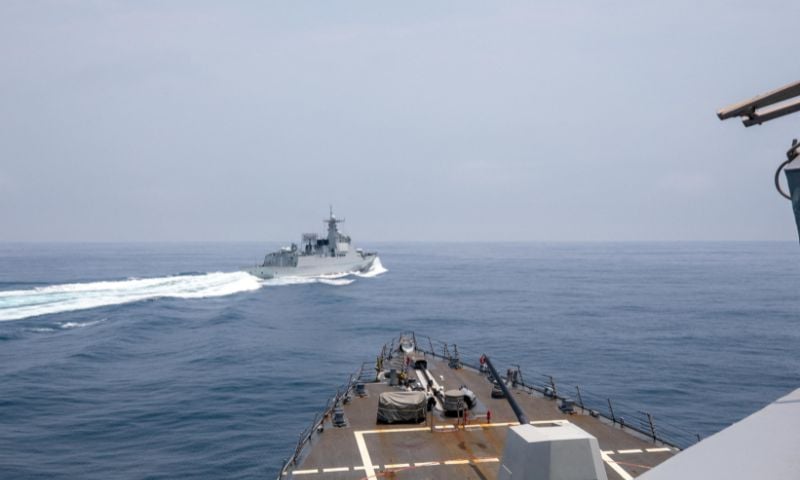
The drill involved a Chinese Navy Luyang III-class guided missile destroyer using machine guns during manoeuvres conducted alongside a Russian naval vessel.
According to Japan’s Defence Ministry, a fleet consisting of three Chinese naval ships and a Russian frigate was first detected at around 2:00 am local time, approximately 330 kilometres southwest of Okinotori before moving northeast.
During the operation, the Chinese destroyer reportedly issued warnings to nearby vessels before commencing the live-fire exercise.
Chief Cabinet Secretary Minoru Kihara described the incident as part of a trend of increasing military cooperation between China and Russia.
“Tokyo sees the drill as part of a move by the two militaries toward strengthening their cooperation,” Kihara told a press briefing on Tuesday.
Japan conveyed its concerns to Beijing through diplomatic channels, warning that the exercise “could have endangered the navigation of nearby ships.”
Although military exercises are generally permitted under international law within another country’s EEZ, Tokyo viewed the activity as a potential safety risk and a signal of growing strategic coordination between its two powerful neighbours.
ALSO READ: Japan Deploys Long-Range Missiles Near China
Japanese media reported that this was the first time the Defence Ministry had publicly disclosed a Chinese live-fire drill inside Japan’s EEZ.
This was the latest in a series of increasingly frequent joint military operations by China and Russia.
Last month, Chinese and Russian air forces conducted joint bomber patrols over waters surrounding Japan. Their navies also carried out a major joint exercise earlier this month, reflecting a steady expansion of defence cooperation that has accelerated in recent years amid strained relations with the United States and its allies.
Kihara said the live-firing drill prompted Japan to mobilise both aircraft and naval assets to monitor the situation.
“We will continue to monitor with concern the behaviours by Chinese and Russian vessels in the waters around our country,” he said.
Under Takaichi’s leadership, Japan has continued to move away from the strictly pacifist security posture that characterised much of its post-World War II history.
Encouraged by its alliance with the United States and growing concerns over regional threats, Tokyo has increased defence spending, expanded military planning and strengthened its capabilities in the country’s southwestern island chain, according to AFP.
The waters around Okinotori have long been a source of disagreement between Japan and China. Tokyo maintains that Okinotori qualifies as an island under the United Nations Convention on the Law of the Sea (UNCLOS), entitling it to a 200-nautical-mile EEZ. Beijing, however, argues that the feature is merely a rock and therefore does not generate such maritime rights.
Meanwhile, maritime tensions between the two countries remain high in the East China Sea. Earlier this month, vessels from the Japanese and Chinese coast guards confronted each other near a group of disputed uninhabited islands known as the Senkaku Islands in Japan, and the Diaoyu Islands in China.
Both sides accused the other of intruding into their territorial waters and claimed to have driven the opposing vessels away.
China and Japan compete over claims on the islands
The islands, located between Taiwan and Japan’s Okinawa prefecture, have been a persistent source of diplomatic friction for decades. It remains one of the most sensitive flashpoints in the broader rivalry between Asia’s two largest economies.
Against this backdrop, Sunday’s joint China-Russia live-fire exercise is likely to reinforce Japanese concerns about an increasingly coordinated military presence by Beijing and Moscow in waters surrounding the country, adding another layer of complexity to an already tense regional security environment.