


Key Points
- Education Minister and Prime Minister Modi face resignation demands
- Sonam Wangchuk’s detention fuels anger
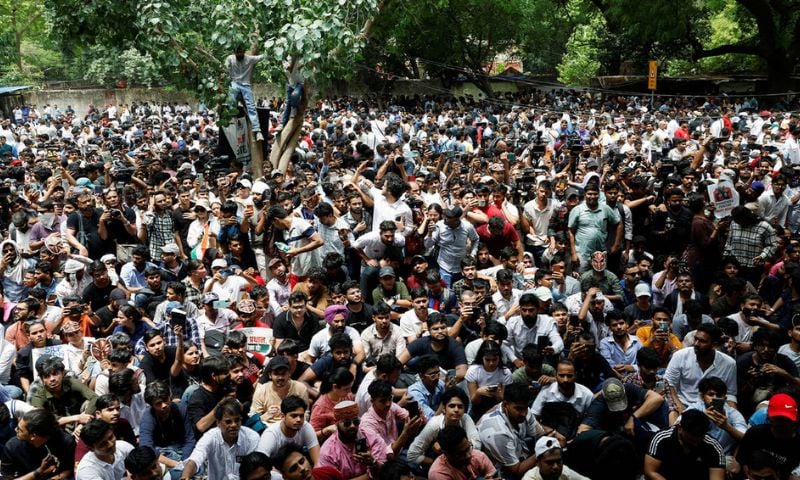
ISLAMABAD: Thousands of supporters of India’s youth-led Cockroach Janta Party (CJP) gathered in New Delhi on Monday, vowing to march towards Parliament despite a police ban.
The protestors intensify pressure on Prime Minister Narendra Modi’s government over a major exam paper leak scandal and growing youth discontent.
The planned demonstration coincides with the opening of Parliament’s monsoon session and centres on demands for the resignation of Education Minister Dharmendra Pradhan and Prime Minister Narendra Modi.
Protesters accuse the Modi government of failing to prevent repeated leaks of competitive examination papers, which affect millions of students across India.
The movement has rapidly evolved from an online campaign into one of the most significant youth-led protests of Modi’s third term in office.
Tensions escalated after authorities transferred prominent activist and educator Sonam Wangchuk to a government hospital on Saturday following more than three weeks of hunger strike in support of the protesters.
Wangchuk, 59, described the campaign as a fight against injustice and fear, while his supporters accused authorities of suppressing dissent.

A Delhi court later ruled that officials were within their rights to move him to hospital because of concerns over his deteriorating health, according to The Guardian.
Delhi Police denied permission for the march and imposed restrictions on public gatherings in central New Delhi, citing heightened security requirements around Parliament and key government installations.
Authorities warned that any unauthorised assembly could face legal action.
Marchers defy restrictions
Despite the restrictions, organisers insisted the march would proceed and said discussions with government representatives were underway.
The Cockroach movement emerged in May following widespread outrage over examination paper leaks, particularly affecting candidates for medical and government recruitment tests.
ALSO READ: India’s Youth Protesters Demand PM Modi’s Resignation Over ‘Corrupt Education System’
What began as a social media campaign quickly gained traction among students frustrated by unemployment, widespread corruption and failures in the education system.
The movement’s organisers say it attracted more than 22 million followers on Instagram within days of its launch, according to Reuters.
Several opposition parties, farmer organisations and civil society groups have expressed support for the protests, expanding the movement beyond its student base.
Analysts say the campaign has become an important test of the Modi government’s ability to respond to youth grievances at a time when concerns over jobs and educational opportunities remain high.
Rise of India’s ‘Cockroach’ Movement
The movement traces its origins to a controversy in May 2026, when Chief Justice of India Surya Kant, during a court hearing, used the term “cockroaches” in criticising individuals who had allegedly entered professions using fake qualifications.
The remarks were widely interpreted on social media as targeting unemployed youth, triggering a backlash among students and young job seekers.
Although the judge later clarified his comments, public anger had already snowballed. Activist Abhijeet Dipke responded by launching the Cockroach Janta Party (CJP), deliberately adopting the term as a symbol of protest.
The term and the party launch transformed what supporters viewed as an insult into a rallying cry against unemployment, examination scandals and broader frustrations with the political establishment.
The movement gained momentum after a series of examination paper leaks disrupted the futures of millions of candidates, many of whom had spent years preparing for highly competitive tests.
Through social media campaigns, street protests and student mobilisation, the CJP rapidly evolved from an online protest into a nationwide youth movement. It also attracted support from civil society groups, academics and opposition parties concerned about transparency, accountability and opportunities for India’s younger generation.
By July, its rallies were drawing thousands of participants across India. By now, it has turned the campaign into one of the most significant expressions of youth discontent in India. It has also posed an unexpected political challenge to Prime Minister Narendra Modi’s government.