
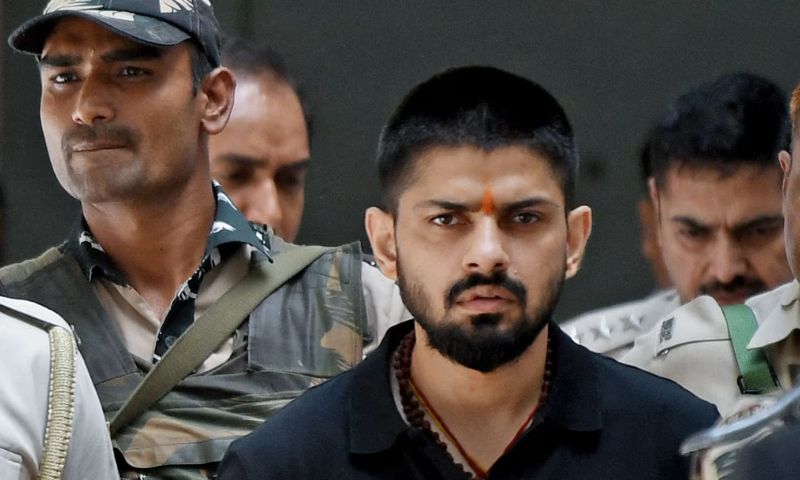
NEW DELHI: A major international law enforcement operation led by the United States Federal Bureau of Investigation (FBI) has brought renewed attention to the expanding global footprint of organised crime networks originating from India, with authorities identifying the Lawrence Bishnoi gang as a sophisticated transnational criminal organisation operating across several continents.
Dubbed Operation Hard Ball, the coordinated crackdown resulted in the arrest of 24 suspects in the United States, Canada and Spain, while prosecutors announced indictments against 37 individuals connected to the network.
The investigation centres on jailed Indian gangster Lawrence Bishnoi, who US authorities accuse of directing murders, extortion schemes and international drug trafficking operations from prison in the western Indian state of Gujarat through smuggled mobile phones.
His close associate, Goldy Brar, whose real name is Satinderjeet Singh Brar, remains a fugitive. The FBI has announced a reward of up to $50,000 for information leading to his arrest.
Indian authorities welcomed the US indictment relating to Bishnoi and several associates in connection with the 2023 killing of Sikh leader Hardeep Singh Nijjar outside a gurdwara in Surrey, British Columbia. The case severely strained diplomatic ties between India and Canada.
In September 2023, Canadian Prime Minister Justin Trudeau told Parliament that Canadian authorities were investigating “credible allegations” linking agents of the Indian government to the killing. The indictment states that Bishnoi and Brar directed the killing.
India’s Ministry of External Affairs described the case as evidence of the growing threat posed by transnational organised crime and reiterated its commitment to strengthening cooperation with the United States in tackling organised criminal networks and terrorism.
Security experts, however, argue that the significance of Operation Hard Ball extends well beyond the Bishnoi organisation. They say it reflects a broader transformation in India-linked organised crime, which has increasingly expanded beyond domestic criminal activity into complex international operations targeting overseas communities.
According to US prosecutors, the Bishnoi network relied on violence, extortion, narcotics trafficking and intimidation to establish influence among sections of the Indian diaspora. Investigators say the organisation demanded millions of dollars from business owners in North America and ordered violent reprisals against those who refused to comply.
Analysts note that Indian organised crime has a long international history. During the 1980s and 1990s, fugitive gangster Dawood Ibrahim established the notorious D-Company syndicate, operating through Dubai and later Karachi with extensive networks involved in smuggling, narcotics trafficking and extortion across Asia, the Gulf region and Europe. Another prominent figure, Chhota Rajan, later developed a rival criminal organisation operating across South-East Asia before his arrest in Indonesia in 2015.
Counter-narcotics specialist Shreekumar Menon said the Bishnoi network represents a newer generation of organised crime. Unlike earlier syndicates that depended heavily on geographical safe havens and rigid command structures, the current network is said to operate through decentralised international cells, encrypted communications, diaspora contacts and digital technology.
He observed that the rapid expansion of the Indian diaspora, particularly across North America, has created fresh opportunities for criminal organisations to establish overseas operations. Investigators say that the gang combines local criminal associates in India with operatives abroad responsible for identifying targets, collecting extortion payments, moving narcotics and acquiring firearms.
Authorities also say that encrypted messaging platforms have enabled jailed leaders to direct operations remotely, while social media has become an effective tool for recruitment, intimidation and projecting influence.
Law enforcement agencies in Canada, the United States and Britain have reported cases in which business owners received extortion threats linked to India-based criminal networks. Experts say criminal activity that once centred on local disputes and contract killings within India has increasingly followed migration patterns, financial networks and digital communication channels across international borders.
The investigation has highlighted the growing challenges facing law enforcement agencies, which must increasingly rely on intelligence sharing, joint investigations and coordinated arrests involving multiple jurisdictions. Operation Hard Ball brought together agencies from the United States, Canada, Spain and India, underlining the increasingly international nature of organised crime investigations.
Ajay Sahni, Executive Director of the Institute for Conflict Management, said the latest operation does not represent the beginning of the internationalisation of Indian organised crime but rather demonstrates that international law enforcement agencies are now responding more effectively to a threat that has developed over several decades.
He argued that advances in encrypted communications, cryptocurrencies and inexpensive international travel have fundamentally altered the way criminal organisations function, allowing loosely connected groups to coordinate activities across continents without the hierarchical structures that characterised earlier syndicates.
According to Sahni, while the principal criminal activities—including extortion, narcotics trafficking, contract killings and financial crime—have remained largely unchanged, modern technology has significantly increased the speed, geographical reach and resilience of these networks.
He further observed that organised crime has become increasingly global while policing largely remains confined within national legal systems, enabling criminal organisations to exploit differences in jurisdiction, legal procedures and diplomatic processes.
Former senior Indian intelligence officer Avinash Mohananey similarly described the Bishnoi organisation as the latest phase in the evolution of India-linked organised crime rather than an entirely new phenomenon.
He said previous Indian criminal syndicates, including D-Company and the Chhota Rajan network, had also established extensive international operations involving extortion, contract killings, narcotics trafficking and overseas safe havens. In his view, those organisations were significantly weakened only through sustained intelligence sharing and close cooperation between law enforcement agencies across multiple countries.
Mohananey added that the coordinated action undertaken by US authorities and their international partners has the potential to significantly disrupt the Bishnoi network, reinforcing the importance of cross-border collaboration in combating increasingly sophisticated transnational organised crime.