


ISLAMABAD: Pakistan and China have discussed the latest regional and international developments, including the renewed escalation between Iran and the United States, reaffirming their commitment to close strategic coordination and enhanced cooperation on issues of mutual interest.
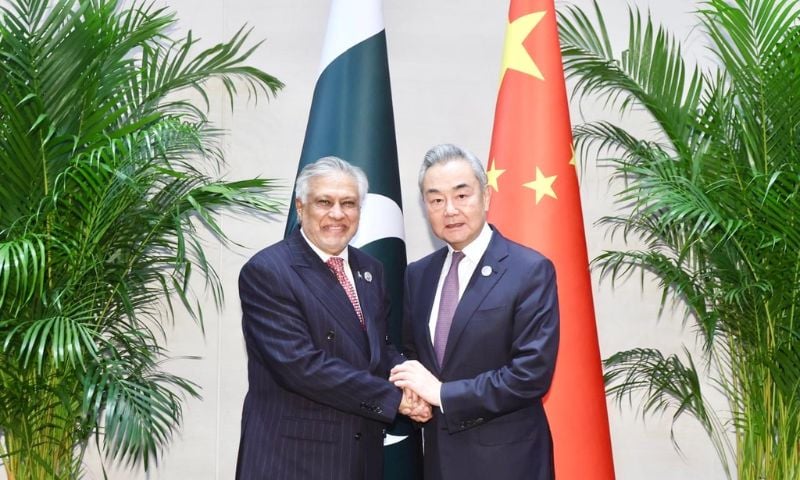
Pakistan’s Deputy Prime Minister and Foreign Minister Ishaq Dar held a meeting with Chinese Foreign Minister Wang Yi in Shanghai on the margins of the World Artificial Intelligence Cooperation Organisation (WAICO), a Foreign Office statement said on Thursday.
“The two sides also exchanged views on the latest regional and global developments and reaffirmed their resolve to maintain close coordination on issues of mutual interest,” it said.
The two leaders reviewed the broad canvas of Pakistan-China bilateral relations and reaffirmed their shared commitment to further deepening the All-Weather Strategic Cooperative Partnership.
“They underscored the importance of advancing high-quality development under CPEC 2.0 and enhancing collaboration in trade, investment, science and technology, the digital economy, and artificial intelligence,” it said.
Deputy Prime Minister/Foreign Minister Senator Mohammad Ishaq Dar @MishaqDar50 held a bilateral meeting with H.E. Chinese Foreign Minister Wang Yi in Shanghai on the margins of WAIC.
The Deputy Prime Minister/Foreign Minister was accompanied by Ms. Shaza Fatima Khawaja @ShazaFK,… pic.twitter.com/5rbIoEkEBu
— Ministry of Foreign Affairs – Pakistan (@ForeignOfficePk) July 16, 2026
The two sides also discussed the latest regional and international developments and reaffirmed their commitment to maintaining close coordination on issues of mutual interest. The meeting underscored the strength of the Pakistan-China strategic partnership and reflected the shared resolve of both countries to deepen cooperation in innovation, emerging technologies and artificial intelligence-driven development.
The Deputy Prime Minister was accompanied by Shaza Fatima Khawaja, Minister for Information Technology & Telecommunications, Ali Mustafa Dar, Advisor to the Chief Minister of Punjab on Artificial Intelligence (AI) and Special Initiatives, Bilal Bin Saqib, Chairman of the Pakistan Virtual Assets Regulatory Authority (PVARA), and officials of the Foreign Ministry.
Also Read: US, Iran Exchange Fresh Military Strikes as Regional Tensions Escalate
Pakistan calls for restraint
Meanwhile, mediator Pakistan urged all parties to avoid actions that could further undermine regional peace and stability.
Speaking at the Foreign Office’s weekly media briefing in Islamabad, spokesperson Tahir Andrabi said Pakistan continued to support diplomacy and the implementation of the Islamabad Memorandum of Understanding as an enduring framework for promoting peace, mutual respect and shared prosperity.
“The Islamabad MoU remains an enduring framework for promoting peace, mutual respect and shared prosperity,” Andrabi said.
He said Pakistan would continue encouraging all parties to end hostilities and resume technical-level negotiations under the Islamabad MoU and the Pakistan-Qatar Joint Statement issued on 22 June.
Andrabi said Pakistan remained actively engaged with regional and international partners to support de-escalation efforts and a peaceful resolution of the crisis.
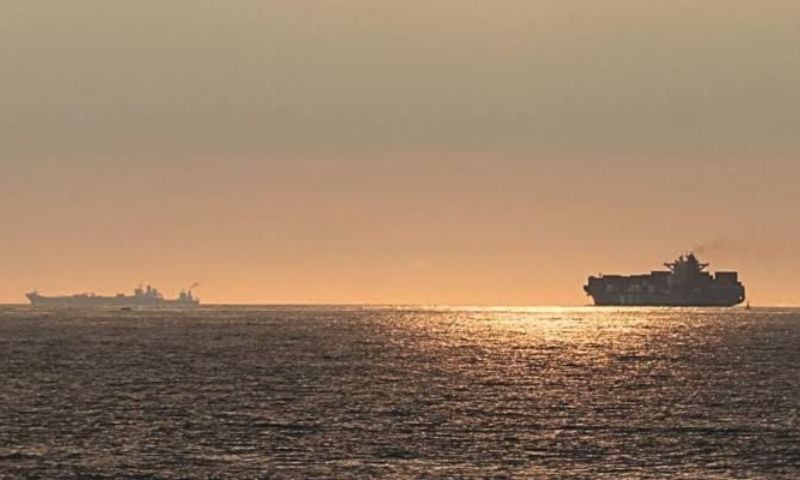
He also warned that continued tensions around the Strait of Hormuz were affecting countries across the Global South by disrupting global energy supplies, trade and food security.
He expressed hope for the early normalisation of the security situation in the waterway and stressed the importance of ensuring the continued safety and freedom of international maritime navigation.
— U.S. Central Command (@CENTCOM) July 16, 2026
The US military said it had completed another wave of precision strikes against military targets in Iran, with the Pentagon saying the operation was intended to further degrade Tehran’s ability to threaten international shipping through the Strait of Hormuz.
According to the US Central Command (CENTCOM), the latest operation concluded at 9 p.m. Eastern Time on Wednesday after coordinated strikes authorised by President Donald Trump.
U.S. Air Force F-35A stealth fighter aircraft are refueled by a KC-135 Stratotanker while flying patrols over the Middle East. pic.twitter.com/KSbmYTH2LT
— U.S. Central Command (@CENTCOM) July 16, 2026
China calls for ‘free and safe passage’ through Strait of Hormuz
China on Monday called for the Strait of Hormuz to remain open to international navigation, urging all parties to ensure the “free and safe passage” of vessels through the strategic waterway amid renewed military tensions between the United States and Iran.
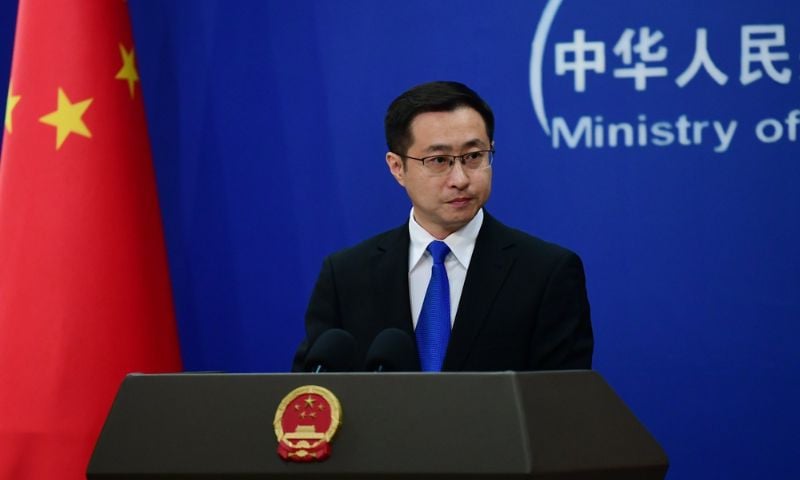
Speaking at a regular press briefing in Beijing, Chinese Foreign Ministry spokesperson Lin Jian said the situation in the Strait of Hormuz should be “properly handled”.
“The Strait of Hormuz is a strait for international navigation. Resuming free and safe passage in the strait at an early date serves the interests of all sides,” Lin said.
He added that China stood ready to work with relevant countries and the international community to maintain communication and promote regional stability.
Islamabad MoU framework
The Islamabad MoU was signed on June 18 by US President Donald Trump, Iranian President Masoud Pezeshkian and Prime Minister Shehbaz Sharif after Pakistan brokered a ceasefire between Washington and Tehran.
Under the Islamabad MoU, the US and Iran committed to halt military operations, reopen the Strait of Hormuz to commercial shipping, and negotiate a comprehensive agreement covering Iran’s nuclear programme, US sanctions, and a permanent ceasefire within 60 days.
Pakistan and Qatar subsequently co-mediated the first round of high-level negotiations in Lucerne, Switzerland, on June 21.
The talks were attended by US Vice President JD Vance and Iranian Parliament Speaker Mohammad Bagher Ghalibaf.