
Key Points
• Focus on AI-driven shipyard automation
• Part of broader robotics push in Japan
• Targets labour shortages, productivity gains
ISLAMABAD: Nvidia is partnering with Japanese companies to develop artificial intelligence-powered robots for shipbuilding and other industrial applications, according to Japanese media.
The partnership represents the latest step in the US chipmaker’s expansion into robotics and physical AI technologies.
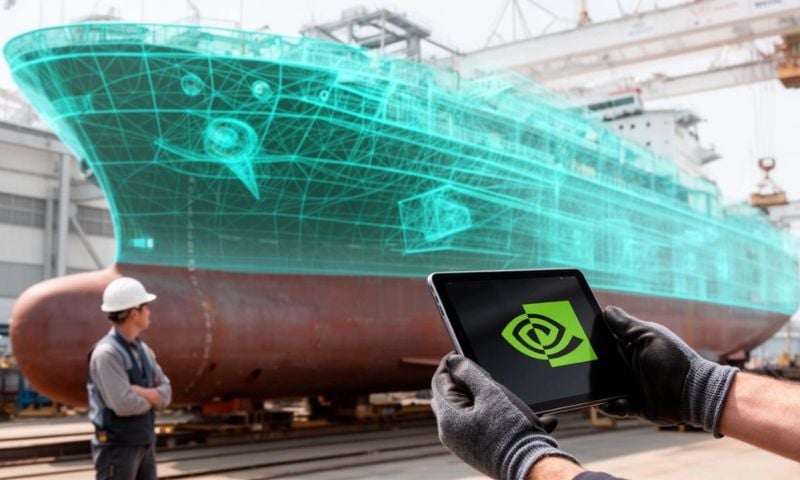
According to Japanese media reports, Nvidia will work with Kawasaki Heavy Industries to build a next-generation AI-enabled shipyard in Japan.
The project aims to build autonomous robots that will assist human engineers with manufacturing, logistics and industrial operations. The initiative is expected to combine Nvidia’s AI and simulation technologies with Kawasaki’s expertise in heavy industry, including shipbuilding.
Nvidia deepening AI partnerships
The project indicates Nvidia’s deepening partnerships across Japan’s industrial sector.
Chief Executive Jensen Huang announced this week that the company was collaborating with Japanese robotics leaders, including Fanuc and Yaskawa Electric, to accelerate the development of AI-powered robots capable of adapting to real-world environments.
Huang said the next generation of robots would be able to learn new tasks more quickly and operate safely alongside human workers. “This rapid learning and safe collaboration are being made possible by physical AI and virtual training robot gyms.”
Japan is increasingly turning to automation and AI to address labour shortages caused by an ageing population, depopulation and a shrinking workforce.
Industries ranging from manufacturing and warehousing to healthcare and construction are investing heavily in robotics to maintain productivity and competitiveness.
The country has long been a global leader in industrial robotics, accounting for a significant share of the world’s robot production and deployment.
ALSO READ: Nvidia Unveils AI-Powered Laptop Chip For Windows Computers
The latest initiative also reflects the rapid evolution of artificial intelligence in robotics. Traditional industrial robots have been widely used for decades in automotive and electronics factories, performing repetitive tasks such as welding, painting and assembly.
However, these machines typically operate in highly controlled environments and require extensive programming for specific tasks.
New era of AI-enabled robots
Advances in generative AI, machine learning and computer vision are now enabling a new generation of robots that can perceive their surroundings, make decisions and adapt to changing conditions with far less human intervention.
Physical AI
Often referred to as “physical AI,” these systems combine sophisticated software with sensors and robotic hardware to interact with the real world.
Industry experts believe such technologies could transform sectors where automation has historically been difficult in complex or unpredictable working environments.
Shipbuilding is considered one of the most challenging sectors. Modern shipyards involve large-scale operations, heavy materials and a wide variety of tasks that are often performed outdoors or in changing conditions.
AI-powered robots could help automate activities such as material transport, inspection, welding and quality control, potentially improving safety while reducing costs and construction times.
Nvidia has emerged as one of the key technology providers behind this shift. Originally known for graphics processing units used in gaming, the company has become a dominant force in the AI industry by supplying the advanced chips that power machine learning systems.
Digital twins
It has also developed software platforms that allow companies to train robots in virtual environments, known as digital twins, before deploying them in real-world settings.
The company’s growing presence in industrial AI mirrors a global trend. Governments and businesses across Asia, Europe and North America are investing billions of dollars in robotics and automation.
They seek to offset labour shortages, improve efficiency and strengthen supply chains. Analysts expect the market for AI-enabled robotics to expand rapidly over the coming decade as advances in computing power and AI models make autonomous systems more capable and affordable.
The latest shipbuilding initiative underscores how AI is moving beyond data centres and software applications into factories, warehouses and industrial facilities, potentially reshaping the future of manufacturing worldwide.