


WASHINGTON: US President Donald Trump said on Tuesday he had abandoned his proposal to impose a 20% reimbursement fee on cargo transiting the Strait of Hormuz after Gulf states offered to invest billions of dollars in the United States.
Speaking to reporters at the White House during a meeting with Iraqi Prime Minister Ali Ali-Zaidi, Trump said he preferred increased investment over charging ships using one of the world’s busiest maritime trade routes.
“I don’t like the concept of a fee, but at the same time, it’s not fair that we’re protecting this Strait for the entire world,” Trump said.
He said he had initially proposed the charge because the United States had long borne the cost of securing the strategic waterway despite relying little on Gulf oil.
“We’ve been doing that for many, many years. It was never fair to me that we would be guarding the Strait… we don’t need the oil, at all,” Trump said. “It wasn’t important for us, but it was important for allies… including the major Gulf state countries.”
“The Gulf states are going to invest a tremendous amount of money into the United States and that was very satisfactory to me. I actually think it’s much better.”
The US President added that “nobody should be able to charge a fee for the Strait.”
.@POTUS: “The Gulf States are going to invest a tremendous amount of money into the United States, and that was very satisfactory to me. I think it’s actually much better.” https://t.co/gSgGloeM4A pic.twitter.com/Wm0IRreSOS
— Rapid Response 47 (@RapidResponse47) July 14, 2026
Also Read: Strait of Hormuz is Open to All Ship Traffic Except for Iran: Trump
Earlier on Tuesday, Trump announced the policy change in a post on his Truth Social platform.
“I have decided to replace the 20% United States Reimbursement Fee with Trade and Investment Deals that the various Gulf States will be making into the United States,” he wrote.
Trump said the investments would be “massive” and would support American factories, manufacturing and employment.
In the same statement, he declared that the Strait of Hormuz was “open to ALL Ship traffic except for Iran” and announced what he described as a “FULL Blockade” on vessels travelling to or from Iranian ports or carrying Iranian cargo.
Trump credited the US military with maintaining freedom of navigation through the strategic waterway and reiterated that Iran would never be allowed to acquire a nuclear weapon.
— Rapid Response 47 (@RapidResponse47) July 14, 2026
Trump accuses Iran of escalation
The US President accused Iran of initiating the latest round of hostilities after fighting was halted after the Pakistan brokered Islamabad memorandum of understanding between the US and Iran.
“I gave them a chance. I wanted to give them a chance at making a deal,” Trump told reporters.
“They shot first, and that was a big mistake, because we have been knocking the hell out of them.”
“Do you have any regrets about lifting the naval blockade or giving the sanctions waivers?”@POTUS: “No. I gave them a chance. I wanted to give them a chance at making a deal… and they shot first, and that was a big mistake that they shot first—because we have been knocking… pic.twitter.com/AdG8IZnOJa
— Rapid Response 47 (@RapidResponse47) July 14, 2026
US to resume blockade of Iranian ports
The United States was set to resume its naval blockade of Iranian ports in Strait of Hormuz.
According to US Central Command (CENTCOM), the blockade was scheduled to take effect at 4:00 p.m. Eastern Time (2000 GMT) on Tuesday as part of Washington’s effort to increase pressure on Iran.
The announcement followed a third consecutive night of reported US strikes on Iranian military targets aimed at reducing Tehran’s ability to threaten shipping in the Strait of Hormuz.
Iranian state media reported explosions in several cities, including Bushehr, home to the country’s only operational nuclear power plant.
Lowest ship passage through Hormuz
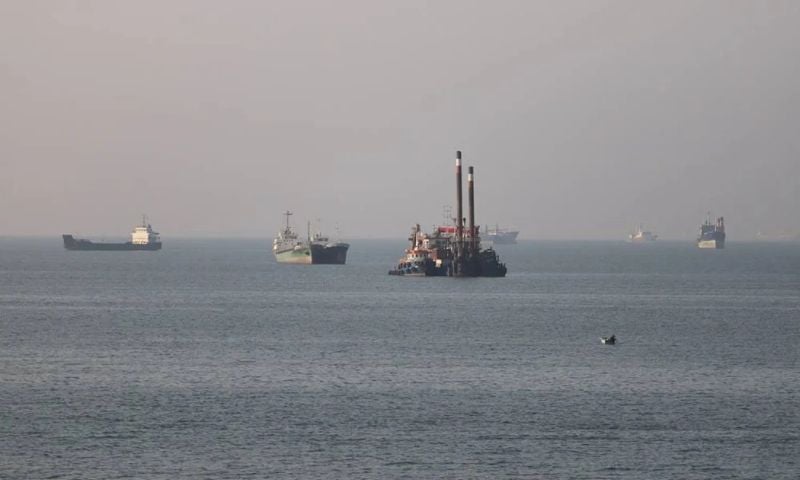
Meanwhile, the Strait of Hormuz has recorded the lowest navigational passage of ships since the signing of the Islamabad MoU on June 17, with only four ships passing since Tuesday morning.
The Islamabad MoU was signed on June 18 by US President Donald Trump, Iranian President Masoud Pezeshkian and Prime Minister Shehbaz Sharif after Pakistan brokered a ceasefire between Washington and Tehran.
Under the Islamabad MoU, the US and Iran committed to halt military operations, reopen the Strait of Hormuz to commercial shipping and negotiate a comprehensive agreement covering Iran’s nuclear programme, US sanctions and a permanent ceasefire within 60 days.
According to data from MarineTraffic, the passage includes an oil tanker and three container ships.
The navigational data also shows the four ships departing ports in Oman and the UAE before crossing the strait, but hiding their final destination and ownership registration data upon their return.
Meanwhile, oil prices have risen by over 3 percent after fresh US strikes against Iran, fuelling fears for the future of Middle East peace efforts and raising the risk of another spike in inflation.
As of 1330 GMT (6:30pm PKT), Brent North Sea Crude is up by 3.8 percent at $86.48 a barrel, while West Texas Intermediate is up 3.1 percent at $80.57 a barrel.
China urges US, Iran to restore safe passage through Hormuz
China on Tuesday called on the United States and Iran to restore safe passage through the Strait of Hormuz.
“Restoring normal and safe passage through the strait as soon as possible is a shared aspiration of the international community,” Chinese foreign ministry spokesperson Lin Jian told a regular news briefing.
The spokesperson said Beijing would continue to make “unremitting efforts to help de-escalate” the situation.
The appeal came as a series of maritime and military incidents underscored the deteriorating security situation around the Gulf and the Strait of Hormuz, through which roughly a fifth of global oil supplies pass.
The US launched a third night of strikes on Iran as President Donald Trump announced to reimpose a naval blockade on Iranian ports and floated a 20 percent fee on cargo in the vital Strait of Hormuz.
Iran started blocking the strait after US-Israel attacks in February, which prompted Washington’s blockade on Tehran’s ports — but restrictions eased after the sides agreed a preliminary deal in June.
Tankers hit in separate incidents
Norwegian shipping company Stolt-Nielsen said its chemical tanker Stolt Magnesium caught fire early Tuesday after an “explosion of an unidentified external device” while sailing in the Arabian Sea off the coast of Oman.
Its subsidiary, Stolt Tankers, said the explosion occurred at about 12:40 a.m. local time in the vessel’s engine room. All crew members were safe and accounted for, and efforts to extinguish the fire were underway.
The location matched an earlier report by the United Kingdom Maritime Trade Operations (UKMTO), which said it had received information about an incident approximately 40 nautical miles northeast of Oman’s Qalhat.
Separately, UKMTO reported that a tanker was struck by a missile around 13 nautical miles southeast of Oman’s Limah while transiting the southern outbound shipping lane of the Strait of Hormuz on July 13.
UKMTO WARNING 087-26 – ATTACK
Click here to view the full warning ⤵️ https://t.co/K9ry6dSGTe#MaritimeSecurity #MarSec pic.twitter.com/KyMMsk7AqZ
— UKMTO Operations Centre (@UK_MTO) July 14, 2026
In another attack, two United Arab Emirates crude oil tankers — Mombasa B and Al Bahyah — were struck by Iranian cruise missiles while passing through the Strait of Hormuz, according to UAE authorities.
The UAE Ministry of Defence said the attack killed one Indian crew member aboard the Mombasa B and injured eight others, including six Indians and two Ukrainians, four of them seriously.
The strikes also caused significant damage to both vessels and triggered onboard fires, which were later brought under control.
The Ministry of Defence announces that the national tankers Mombasa and Al Bahiyah were targeted by two Iranian cruise missiles while transiting the southern shipping lane of the Strait of Hormuz, within Omani territorial waters.
The attack resulted in the death of one Indian… pic.twitter.com/i1HrXY0fKP
— وزارة الدفاع |MOD UAE (@modgovae) July 13, 2026
The ministry described the attack as a “blatant assault” and “a serious violation and clear breach of international law.” It said the UAE reserved the right to take “all necessary measures” to protect its sovereignty, citizens and national interests.
Iran rejects US role in Hormuz
Iran’s military insisted that the Strait of Hormuz would never be reopened through “war, evil, and American aggression.”
Brigadier General Mohammad Akraminia, spokesman for Iran’s armed forces, cited by Mehr news agency, said that respecting the rights of the Iranian people was the only path towards reopening the strategic waterway.
“We are obligated to avenge the blood of the martyrs, especially the martyred leader of the Islamic Revolution,” he said.
🔴 Iran Army Spokesperson Brigadier General Akrami-Nia:
🔺 The Strait of Hormuz will never be opened through war, aggression, or American transgressions.
🔺 Respect for the rights of the Iranian people is the only way to open the Strait of Hormuz.
🔺 We are obligated to avenge… pic.twitter.com/0Jvv6LdVE2
— Mehr News Agency (@MehrnewsCom) July 14, 2026
Iranian state television also reported that five explosions were heard around the southern port city of Bandar Abbas near the Strait of Hormuz but gave no further details.
Earlier, the Islamic Revolutionary Guard Corps (IRGC) said it had targeted a US air base in Jordan with ballistic missiles. In a statement carried by Fars News Agency, the IRGC claimed it had no hostility towards the Jordanian people but urged them to oppose the presence of American military bases in the country.
US intensifies military campaign
The United States said it had completed a third consecutive night of military operations against Iranian targets.
US Central Command (CENTCOM) said the latest operation began at 4:45 p.m. Eastern Time on Monday and concluded about five hours later.
At 4:45 p.m. ET today, U.S. Central Command began launching the third consecutive night of strikes against Iran, at the Commander in Chief's direction. These strikes will continue imposing a heavy cost on Iranian forces and degrade their ability to attack innocent civilians and…
— U.S. Central Command (@CENTCOM) July 13, 2026
According to CENTCOM, US forces conducted precision strikes against Iranian military facilities in Bushehr, Chah Bahar, Jask, Konarak, Abu Musa and Bandar Abbas. The targets included coastal defence systems, missile and drone installations, and maritime capabilities that Washington said had been used to threaten commercial shipping.
The US military said the operation was intended to further reduce Iran’s ability to attack civilian vessels operating in the Strait of Hormuz.
— U.S. Central Command (@CENTCOM) July 14, 2026
CENTCOM added that more than 50,000 US personnel remained deployed across the Middle East and that American forces remained “vigilant, lethal and ready” to respond to further developments.
Speaking at the White House on Monday, US President Donald Trump said American forces were “hitting them very heavy tonight.”
“We’re knocking out all of their offensive capability, and we’re controlling the strait,” Trump said, adding that the United States was reinstating a naval blockade directed solely at Iran.
Iran’s military responded by warning that it would not allow the United States to “interfere” in the management of the Strait of Hormuz.