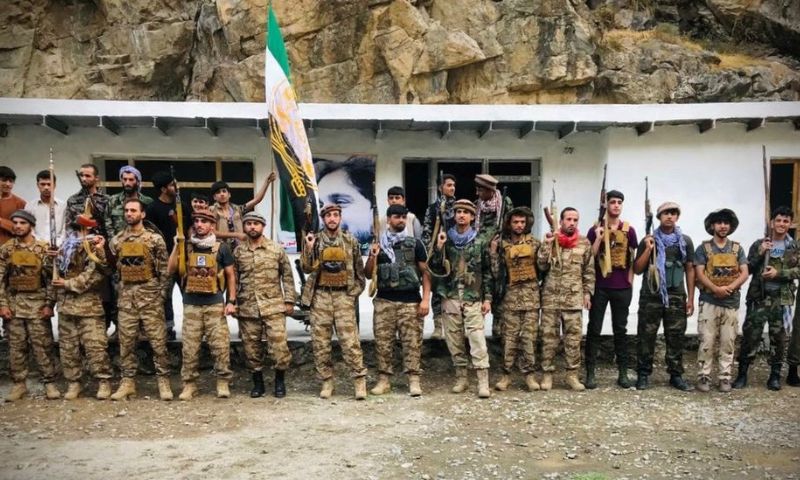
KABUL, Afghanistan: Afghanistan’s National Resistance Front (NRF) has released a new video to show its fighters carrying out attacks against Taliban regime forces in several provinces of the country, as the armed opposition group intensified its attacks against the regime.
The video comes as the NRF continues guerrilla operations across several provinces of Afghanistan against the Taliban regime, as anti-Taliban resistance groups remain active across the country.
The opposition groups’ resistance activities against the Taliban regime surged in recent months across several provinces of Afghanistan. Meanwhile, the Taliban regime is attempting to suppress news of the expanding insurgency against the group.
The NRF, led by Ahmad Massoud, son of the late anti-Taliban commander Ahmad Shah Massoud, was formed after the Taliban returned to power in August 2021 following the withdrawal of US-led forces from Afghanistan.
The movement is composed largely of former members of the Afghan National Defence and Security Forces and has since waged an insurgency, primarily in Panjshir, Kabul and several northern provinces.
The group regularly publishes statements and videos claiming attacks on Taliban regime positions.
According to reports, the resistance front has inflicted heavy casualties on Taliban regime forces.
According to its annual report, NRF said it carried out 401 targeted operations across 19 provinces during 2024, claiming that 651 Taliban regime fighters were killed and 579 were wounded.
Taliban Terrorists Suffer Heavy Losses in 401 Operations by National Resistance Front of Afghanistan’s Freedom Fighters from March 2024 to March 2025
The National Resistance Front of Afghanistan’s forces carried out 401 targeted operations across 19 provinces in 2024, inflicting… https://t.co/z9sHq1cIP9
— National Resistance Front of Afghanistan (@NRFafg) March 20, 2025
The resistance front said the operations were conducted in Kabul, Panjshir, Parwan, Kapisa, Baghlan, Kunduz, Takhar, Badakhshan, Herat, Farah, Ghor, Badghis, Nuristan, Balkh, Sar-e Pol, Faryab, Nimroz, Maidan Wardak and Laghman.
The NRF said its operations were designed to avoid civilian casualties.
A recent UN report also noted that anti-Taliban groups, including the NRF, remain operational across Afghanistan, posing a serious challenge to the Taliban regime’s territorial control.
In June 2026, the NRF said its fighters killed three Taliban regime fighters and wounded another during an operation in Kabul’s District 5, adding that none of its personnel or civilians were harmed.
Later that month, the group claimed responsibility for another targeted attack in the same area, saying a Taliban regime’s military vehicle had been destroyed while three Taliban members were killed and another wounded.
In May 2026, the NRF said it carried out a rocket attack against the Taliban regime’s intelligence directorate in Mazar-i-Sharif, claiming five Taliban fighters were killed and three wounded.
The group also announced in May 2025 that it had killed Mullah Hebat Khan, commander of the Taliban regime’s rapid reaction unit for Takhar province, along with three bodyguards in Baghlan province.
In December 2025, the NRF said its fighters killed at least 17 Taliban members and wounded five others during what it described as a complex overnight attack on a Taliban base in Panjshir province.
Dissident commander opposes Taliban for hosting terrorist groups
Last week, a dissident Taliban regime commander in Badakhshan province, Juma Khan Fateh, publicly opposed the presence of foreign terrorist groups in Afghanistan, specifically naming Tehrik-i-Taliban Pakistan and the Balochistan Liberation Army.
In a statement shared on his X account, Fateh said he had opposed the activities of such terrorist groups from the first day and continued to stand by that position.
From day one, we have opposed the presence of armed groups like the TTP and BLA on our soil. We commend and support any operations aimed at eliminating these terrorists who massacre innocent Muslim citizens, ensuring peace and security.
— Al-Haj Juma Khan Fateh (@JKFateh) July 1, 2026
He said he supported actions aimed at suppressing and eliminating foreign terrorist groups, including TTP and BLA, in order to prevent civilian killings.
Fateh also claimed that the Darwaz region and strategic mines of Badakhshan remained fully under the control of his forces. He warned that his group would not allow any encroachment on Darwaz or Badakhshan.
“Until our last breath, we will not allow anyone to encroach on Darwaz and Badakhshan,” he said.
The statement comes amid repeated concerns raised by regional countries and international bodies about the presence of foreign terrorist groups in Afghanistan.
Pakistan has repeatedly urged the Afghan regime to prevent groups operating from Afghan soil from carrying out cross-border attacks.
The development also highlights growing internal tensions within the Taliban regime, particularly between local commanders in Badakhshan and figures aligned with the group’s central leadership in Kandahar and Helmand.
Local sources previously said negotiations between a Taliban regime delegation and Juma Khan Fateh had failed. Separate reports have also pointed to the deployment of Taliban regime military convoys to the Darwaz area, signalling a possible escalation in the dispute.
Internal power struggle in Taliban regime
Dissident Taliban regime commander Juma Khan Fateh in Badakhshan province has distributed AK-47 rifles to supporters and ordered them into the mountains against Taliban regime.
Tensions in Badakhshan province are no longer merely an internal Taliban dispute. Conflict began when Kandahar-based Taliban regime leadership seized control of Badakhshan’s mountains, gold mines and other mineral resources while excluding local communities from decision-making and resource ownership.
Local sources said Juma Khan Fateh has established round-the-clock checkpoints in areas under his control.
The root of conflict lies in the Taliban regime’s takeover of Badakhshan’s gold mines and natural resources without meaningful participation or consent of local communities, who have long depended on these resources.
Local communities pointed out that the Kandahar-appointed Taliban Regime is exploiting Badakhshan province’s mineral wealth while leaving local populations politically marginalised, economically excluded and increasingly impoverished.
Arrests, beatings, intimidation and suppression of dissent reveal the Taliban regime’s preferred model of governance. Resource extraction backed by coercion instead of consent.
Juma Khan Fateh’s decision to arm supporters and prepare for confrontation reflects growing resistance against Kandahar’s monopoly over political authority, economic resources and local administration.
Reports that Juma Khan Fateh enjoys support among local ethnic communities illustrate a widening disconnect between Kandahar’s leadership and Badakhshan’s population.