The idea of Israel expanding beyond its internationally recognised borders is not new. It comes from strands of Revisionist Zionism that envisioned Israeli sovereignty across the historic “Land of Israel.” For decades, settler groups and religious nationalists promoted this vision.
Taking advantage of the casus belli provided by the attacks of 7 October 2023 by Hamas, following decades of Israeli aggression, Israeli hardliners found an opportunity to pursue these long-standing ideas more aggressively. Israel’s campaign in Gaza quickly expanded beyond a response to Hamas.
Public statements by some Israeli politicians calling for the permanent annexation of Gaza and relocation of Palestinians from the Gaza Strip reinforced perceptions of Greater Israel objectives. At the same time, continued settlement expansion in the West Bank heightened fears that annexation could eventually extend to that region.
Lebanon formed another part of the broader regional picture. Israel expanded military operations across the Lebanese border and occupied territory in Southern Lebanon while maintaining that it was addressing immediate security threats. This represented another strand of the Greater Israel project.
Syria became the clearest example of this approach. After the fall of Bashar al-Assad’s government, Israel launched hundreds of airstrikes that destroyed much of Syria’s remaining military infrastructure. Israeli forces then moved into parts of Southern Syria. These actions left Syria unable to rebuild its military strength or negotiate with Israel from a position of sovereignty. Israel expanded into a security vacuum that its own military operations had helped create.
Israel’s actions in Gaza, Lebanon, Syria and Iran, together with its growing control over strategic territory, raised questions about whether older ambitions had found new momentum. Iran’s regional network weakened, Syria’s military collapsed, and Israel saw an opportunity to reshape the Middle East. Events in 2025 and 2026 further changed the strategic environment.
Pakistan, along with brotherly Muslim countries, pushed for mediation by President Trump and instituted the Gaza Peace Plan, which guaranteed that neither Gaza nor the West Bank will be annexed and Palestinians will not be dislocated.
The June 2025 war against Iran represented another major turning point. Israel claimed that Iran’s nuclear programme posed an existential threat and secured US participation in military operations against Iran. After declaring success against Iran’s nuclear capability, Israel pushed for another major military campaign against Iran in February 2026. Washington pursued limited military objectives while Israeli conduct of war reflected much broader objectives, not limited to Iran, but igniting a regional war.
Israel expected Kurdish groups to open another front against Iran, drawing Türkiye into a wider regional confrontation by creating a new theatre of conflict along its southern border. The Strait of Hormuz, through which roughly one-sixth of the world’s oil passes, became a major security concern. Fighting intensified in Lebanon, while Syria again found itself caught between competing military campaigns.
Israeli hardliners expected conflict to draw Gulf states into direct war with Iran. A prolonged confrontation among the region’s major Muslim states would have thrown the whole Middle East into chaos, creating widespread instability, allowing Israel to consolidate territorial gains while expanding into the resulting vacuum.
Pakistan recognised Israel’s sinister designs much earlier in the conflict. Islamabad worked closely with Saudi Arabia and requested Riyadh to avoid direct military involvement despite Iranian strikes on Saudi territory. Saudi Arabia’s decision to stay out of the conflict compelled other Gulf states to avoid escalation.
Pakistan then joined Saudi Arabia, Qatar, and Türkiye in actively pursuing de-escalation and diplomacy, preventing the crisis from developing into a much wider regional war. Pakistan, Saudi Arabia, Türkiye, and Qatar emerged as key diplomatic actors. This timely action avoided a regional catastrophe.
Pakistan held a unique advantage because it maintained working relations with both Saudi Arabia and Iran. Islamabad had a Strategic Mutual Defence Agreement with Riyadh while also preserving decades of trust with Tehran.
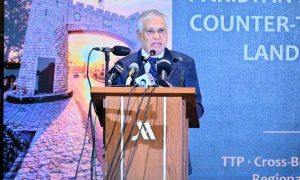
On March 29, Pakistan hosted a quadrilateral meeting in Islamabad with the foreign ministers of Türkiye, Saudi Arabia, Egypt, and Pakistan. The meeting brought diplomacy back into the crisis. Pakistan announced a ceasefire after intensive diplomatic efforts led by Chief of Defence Forces and Chief of Army Staff, Field Marshal Syed Asim Munir, and Prime Minister Shehbaz Sharif. Islamabad hosted the first round of the Islamabad Talks and proposed a 45-day roadmap that called for an immediate ceasefire followed by the phased reopening of the Strait of Hormuz.
Washington accepted the ceasefire before its own deadline for further military escalation expired. Pakistan’s diplomatic efforts eventually contributed to a ceasefire between Iran and the United States and opened the way for a broader peace process. The subsequent peace process under the Islamabad Memorandum of Understanding helped preserve Lebanon’s sovereignty and reduce the risk of further territorial expansion.
Pakistan’s strongest diplomatic signal came during negotiations over the post-war settlement. Washington proposed expanding the Abraham Accords by encouraging regional Muslim countries to normalise relations with Israel as part of a broader agreement. Pakistan rejected the proposal, preserving its principled stance on the Palestine issue.
De-escalation produced a more durable understanding between Iran and Gulf Cooperation Council states, preventing broader regional collapse anticipated by Israeli hardliners. Israel remained frustrated as it had expected the collapse of Middle Eastern states, similar to Syria.
Diplomacy by Pakistan, together with Saudi Arabia, Qatar and Türkiye, helped prevent further escalation at a critical moment by keeping diplomatic channels open when the region stood on the brink of a much larger conflict.