California, USA: The night before Bosnia and Herzegovina face off against the United States in the FIFA World Cup’s Round of 32, a small restaurant serving Balkan specialties in Santa Clara has transformed into a sea of blue jerseys, waving flags, and unbridled passion.
For the Bosnian diaspora, many of whom were displaced during the 1992-1995 Bosnian War, this tournament is about far more than football.
At Euro Grill, whose walls are adorned with posters from the 1984 Winter Olympics in Sarajevo, waiters dart through the packed venue serving heaping portions of cevapi and burek to fans who have traveled from across the United States and beyond.
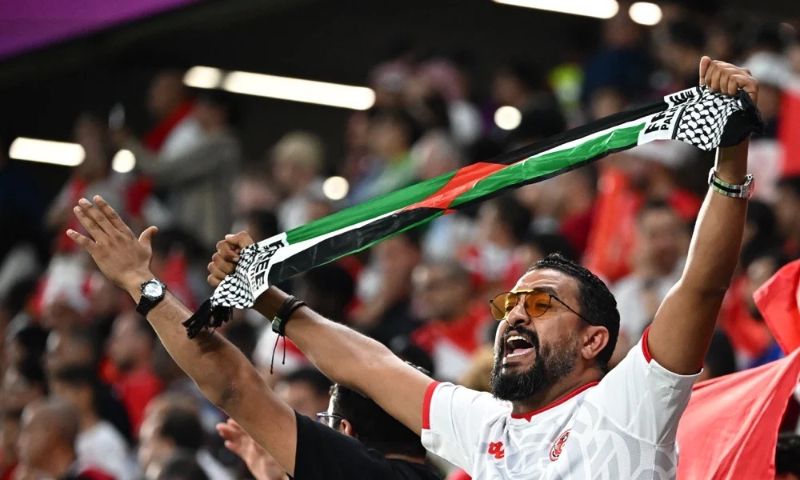
🇵🇸 🇧🇦 Palestinian chants echoed through the Seattle Stadium on Wednesday, as Bosnian fans continued their acts of solidarity in the 2026 World Cup. pic.twitter.com/ckHGU6VyS5
— Roya News English (@RoyaNewsEnglish) June 25, 2026
Outside, groups of men snap photos of vehicles decked out with flags and paraphernalia, one fan drove 25 hours from Canada in a truck covered with player faces, a Free Palestine sticker, and an enormous model of the Hulk wearing a Bosnia jersey.
“It’s like a big family,” said 60-year-old Senad Durakovic, who moved to Boston in 1996. “We’re all here for the same reason. It feels like I’m part of something bigger than me. It feels like we’ve already won.”
A diaspora united by football and memory
The tournament has placed Bosnia’s large and vibrant global diaspora in the spotlight, many of whom were scattered around the world during and after the war. Scholar Jasmin Mujanovic, who specialises in Balkan history, noted that many members of the current national team were born outside Bosnia to parents who fled the conflict.
“Prior to the war, there was hardly any Bosnian diaspora to speak of,” Mujanovic told Al Jazeera. “But they have attempted to instill a relationship with Bosnian identity and culture in their children. I think this particular team and this particular World Cup run is a really beautiful expression of that.”
Bosnia and Herzegovina qualified for the 2026 World Cup with a dramatic penalty shootout win over Italy in April, sending them to the global tournament for the first time since 2014. Helmed by 40-year-old Edin Dzeko, the team has benefitted from tenacious defense and a new generation of talent, including young stars like Kerim Alajbegovic and Ermin Mahmic.
#2026WorldCup: Ahead of the Bosnia and Herzegovina vs Qatar match, Bosnian fans are chanting for Palestine together in Seattle. pic.twitter.com/OlXSg9CkBn
— Antifa_Ultras (@ultras_antifaa) June 24, 2026
After a convincing 3-1 victory over Qatar, they now face a formidable U.S. team eager to advance as one of the host nations.
“If we play like we did against Qatar, I think we’ll pull through,” said 20-year-old Elvis Graco, who traveled from Jacksonville, Florida. “We’ll win, of course.”
Solidarity with Palestine: A bond forged through trauma
Beyond football, Bosnian fans have used the World Cup as a platform to express solidarity with Palestine, a connection they say is rooted in their own history of violence and displacement.
The Bosnian War was the bloodiest of the conflicts that followed Yugoslavia’s breakup, with an estimated 100,000 people killed. Bosniak Muslims made up a large majority of the victims, and the 1995 Srebrenica massacre of 8,372 Bosniak Muslim men and boys was declared genocide by international tribunals.
For many fans, those memories have informed their strong support for Palestinians amid Israel’s ongoing genocide in Gaza, which has killed over 70,000 people, mostly women and children, since October 2023.
“There’s a mutual traumatic experience. I think they’re going through the same things that we went through,” said 22-year-old Aldin Muminovic. “So we’ll never forget them. We’ll always be there for them.”
Palestine didn’t qualify for the World Cup but Bosnian fans made sure they aren’t forgotten🇧🇦🤝🇵🇸. pic.twitter.com/HeeFQemEf0
— 𝐌𝐚𝐥𝐜𝐨𝐥𝐦 (@Malcolm_Pal9) June 25, 2026
Videos shared on social media during the World Cup have shown crowds of supporters chanting “Palestina, Palestina” and holding Palestinian flags.
Ildaj Husovic, who manages an Instagram account showcasing the connection between Bosnia and Palestine, said, “Many Bosnians see images of Palestinian civilians’ suffering that remind them of their own past. The fans are using this opportunity to draw the world’s attention to the suffering of the people in Palestine, which they believe should be a top priority for the international community.”
“We can obviously relate to what they’re going through, because our country went through it as well,” Graco added. “We want to see justice for Palestine and for the violence to end. It isn’t in the news as much now, but we want to remind people that the Palestinians are still living through this every day.”