ISLAMABAD: In a significant development for regional stability, Pakistan has hailed the ongoing peace process between the United States and Iran as a shining example of successful diplomacy.
Pakistan Foreign Office expressed confidence that the Islamabad Memorandum of Understanding (MoU) and subsequent high-level talks in Switzerland have not only strengthened mutual trust between the two nations but also reaffirmed the power of dialogue over conflict.
🔴LIVE: Spokesperson’s Weekly Press Briefing 26-06-2026 at Ministry of Foreign Affairs, Islamabad https://t.co/8iCRIClkno
— Ministry of Foreign Affairs – Pakistan (@ForeignOfficePk) June 24, 2026
“Islamabad MoU and Lucerne Summit reinforce faith in dialogue”
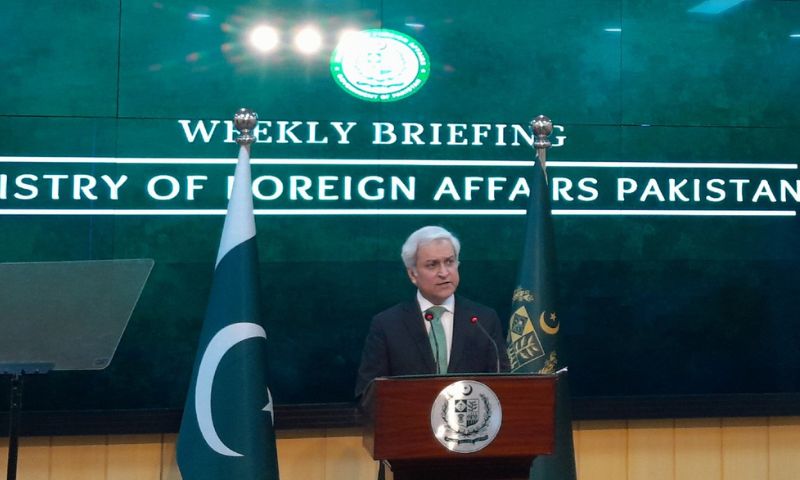
Addressing weekly media briefing on Wednesday, Foreign Office spokesperson Tahir Andrabi stated, “The Islamabad MOU and the Lucerne Summit reinforce our faith in dialogue and diplomacy as the most effective means for peaceful settlement of disputes and conflicts.”
He recalled that Prime Minister Shehbaz Sharif had announced on June 18 that the Islamabad MoU between the US and Iran had been signed electronically, calling it a historic breakthrough. As a follow-up, Pakistan and Qatar hosted the first high-level committee meeting under the MoU framework in Bürgenstock, Switzerland, on June 21.
“The meeting was successful in helping the two parties reach an understanding on various aspects of the implementation of the Islamabad MOU,” Andrabi added.
Key outcomes: Roadmap for final deal in 60 days
The spokesperson highlighted several crucial outcomes from the Bürgenstock talks. These include the formation of a high-level committee to provide political oversight over the mediation process. Chief negotiators from both sides will report regularly to the committee and lead working groups focused on nuclear issues, sanctions, monitoring, and dispute resolution.
Weekly Press Briefing by the Spokesperson @TahirAndrabi
On Iran-US Talks in Bürgenstock🇨🇭, Status of Outstanding Issues etc. pic.twitter.com/lZuwmkXjON
— Ministry of Foreign Affairs – Pakistan (@ForeignOfficePk) June 24, 2026
“An agreement has been reached upon a roadmap towards reaching a final deal in 60 days,” Andrabi confirmed.
Additionally, the parties have agreed to establish a direct communication channel to prevent incidents and miscommunication — particularly to ensure the safe passage of commercial vessels through the Strait of Hormuz. A deconfliction cell involving the US, Iran, the Lebanese government, and the mediators has also been created.
Technical teams to engage in coming weeks
A technical committee meeting was subsequently held on June 22 in Bürgenstock under Pakistani and Qatari mediation. “The technical teams from Pakistan and Qatar will continue to remain engaged with technical teams from the US and Iran in the coming weeks for effective implementation of the Islamabad MOU,” Andrabi said.
He welcomed the positive recognition Pakistan has received from governments and international partners for its role in promoting regional peace and de-escalation. “Such recognition reflects international communities’ trust in Pakistan’s commitment to advancing dialogue, peace, security and stability across the region and beyond,” he remarked.
Pakistan expresses gratitude, praises media maturity
Andrabi expressed gratitude to countries that supported Pakistan’s efforts. He also reserved special praise for Pakistani media organisations, commending their “professionalism and maturity” in respecting strict confidentiality requirements — something he described as “indispensable to any credible facilitator or mediation effort.”
“You restrained yourself and avoided speculation and sensationalism, which contributed positively to an environment conducive to dialogue and confidence-building measures,” he said, expressing hope that the media would continue its support as negotiations progress.
🔊 Transcript of the Weekly Press Briefing by the Spokesperson on Thursday, June 24 , 2026
🔗⬇️https://t.co/2G0mytHy3r pic.twitter.com/yjE3jAwSs8
— Ministry of Foreign Affairs – Pakistan (@ForeignOfficePk) June 24, 2026
Iranian President’s visit to Pakistan
Andrabi also shared details of Iranian President Masoud Pezeshkian’s recent visit to Pakistan at the invitation of Prime Minister Shehbaz Sharif. Accompanied by a high-level delegation, including the Iranian foreign minister, Pezeshkian met President Asif Ali Zardari, held talks with the PM, and also met Chief of Army Staff Field Marshal Asim Munir.
“The two sides reviewed the full spectrum of bilateral relations and explored avenues to further deepen cooperation across diverse sectors,” Andrabi said, adding that regional and international developments of mutual interest were also discussed.
Diplomatic outreach and four-party meeting in Cairo
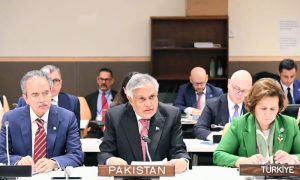
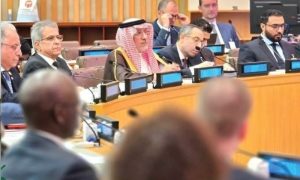
The spokesperson highlighted the fourth meeting of the foreign ministers of Pakistan, Saudi Arabia, Türkiye, and Egypt — known as the Hour Four grouping — held in Cairo on June 21. Deputy Prime Minister and Foreign Minister Ishaq Dar led Pakistan’s delegation, and the ministers reviewed progress on the Islamabad MoU and developments from the Bürgenstock talks.
The four countries issued a joint statement. Dar, along with his counterparts, called on Egyptian President Abdel Fattah el-Sisi and conveyed greetings from Pakistan’s leadership.
Andrabi noted that Dar had maintained an intensive diplomatic outreach over the previous 10 days, engaging with the foreign ministers of Switzerland, Türkiye, Egypt, Saudi Arabia, Italy, Japan, China, Canada, Bahrain, Azerbaijan, Iran, Uzbekistan, and the EU’s High Representative for Foreign Affairs.
Pakistan’s efforts to free crew from Somali pirates
Addressing the issue of Pakistani crew members held by Somali pirates, Andrabi said the matter remains a top priority for the government. “The government of Pakistan has launched a sustained diplomatic and overall political campaign to free the hostages.”
He said the Foreign Office remains engaged with Somali authorities at multiple levels. A technical team from Pakistan’s mission in Djibouti has been visiting Somalia, while Dar has spoken with his Somali counterpart. An inter-ministerial meeting has also been held to coordinate Pakistan’s response, with a decision to prioritise negotiations and humanitarian channels.
Pakistan is also seeking assistance from friendly countries, international organisations, local NGOs, and veteran human rights activist Ansar Burney.
“This is an issue which is also very close to our hearts because of the involvement of the families, and we can understand their pain. But as I said, the release is a difficult situation which is being addressed,” Andrabi said.
Pakistan joins joint statement on Palestine
On Palestine, Andrabi said Pakistan had joined eight Islamic and Arab countries in issuing a joint statement on June 18 condemning escalating violence against Palestinians in the occupied West Bank. The statement specifically denounced recent attacks on places of worship, including the Grand Mosque in Jaliliya and Al-Farooq near Ramallah.
The signatories stressed that such attacks constitute violations of the sanctity of religious sites, international law, international humanitarian law, and relevant UN Security Council resolutions.
Repatriation of Iranian nationals
The spokesperson also announced that Pakistan had facilitated the repatriation of 30 Iranian nationals this week, including eight fishermen rescued by the British vessel MMA Weller, and 22 crew members from the vessel Lenon Davina, which had been interdicted by US authorities.
“We remain in close contact with the Iranian, US, and UK authorities to ensure safe transit of Iranian nationals to their homeland, and we remain committed to the humanitarian cooperation extended to all parties if possible,” Andrabi concluded.
Pakistan’s leadership at the UN
Andrabi highlighted Pakistan’s role at the United Nations, where the Security Council unanimously adopted Resolution 2823 on Pakistan’s initiative and with Denmark’s support. Co-sponsored by 153 UN member states, the resolution seeks to strengthen accountability for crimes committed against UN peacekeepers.
“Introduced by Pakistan’s Permanent Representative to the UN, Ambassador Asim Iftikhar Ahmad, the measure reaffirms that attacks on peacekeepers are unacceptable and may constitute war crimes, while calling for credible investigations, prosecutions and accountability for perpetrators,” he said.
The resolution also mandates an annual progress report from the UN Secretariat and the appointment of a senior UN focal point on the issue.
“The resolution reflects Pakistan’s leadership role in enhancing safety and effectiveness of UN peacekeeping reforms as well as UN peacekeeping operations,” Andrabi concluded.