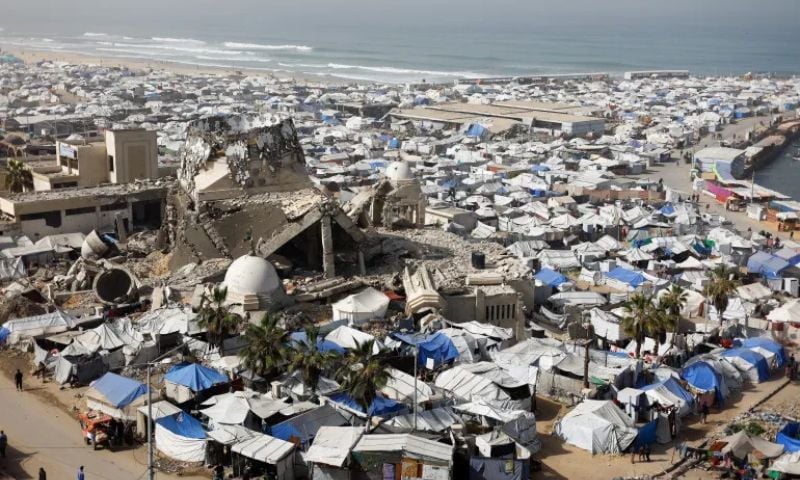
UNITED NATIONS: Nearly 1.7 million displaced Palestinians, representing about 80 percent of Gaza’s population, are living in dire conditions marked by severe shortages of water, shelter and basic services, according to a newly released assessment by the United Nations Office for the Coordination of Humanitarian Affairs (OCHA).
The findings were presented on Tuesday by UN spokesperson Stéphane Dujarric, who told reporters that civilians across Gaza continue to face significant risks amid ongoing violence and deteriorating humanitarian conditions.
“Shelling, gunfire, bombing and airstrikes continue to harm civilians across the Gaza Strip,” Dujarric said during a regular news briefing at UN headquarters.
According to the OCHA assessment, nearly 1,600 displacement sites across Gaza are hosting large numbers of displaced residents under difficult conditions.
The report found that at least 59,000 individual shelters accommodate more than eight people each, highlighting severe overcrowding. It also estimated that around 38,500 people are sleeping in the open without adequate shelter.
Dujarric said approximately 600,000 people living at the assessed sites lack sufficient access to drinking water.
The assessment further found that half of the sites lacked visible drainage systems, while nearly half reported fire hazards in close proximity to shelters.
Rodent infestations were recorded at about 80 percent of the sites surveyed, according to the UN report. Open sewage and accumulated waste were present at more than half of the locations.
The assessment also documented the presence of unexploded ordnance and other explosive hazards. Dujarric said incidents involving explosive remnants of war were reported at almost 250 sites hosting nearly 250,000 people.
The UN also highlighted the continued impact of the conflict on civilians, particularly children.
Dujarric noted that the United Nations Children’s Fund (UNICEF) had announced on social media that one of its Youth Champions, a 17-year-old girl, was killed while travelling to sit for her high school examination.
“We reiterate that civilians, including children, must always be protected,” he said.
The latest assessment underscores the scale of humanitarian challenges facing displaced Palestinians despite the ceasefire that took effect on October 10, 2025.
According to figures cited by Dujarric from Gaza’s Health Ministry, Israeli attacks since the ceasefire came into force have killed at least 1,027 people and injured 3,280 others.
The conflict began after Israel launched a military offensive in Gaza in October 2023. According to Gaza health authorities, more than 73,000 Palestinians have been killed and over 173,000 injured since then.
The war has also devastated Gaza’s infrastructure. The United Nations has previously estimated that around 90 percent of the Palestinian territory’s civilian infrastructure has been damaged or destroyed and that reconstruction could cost approximately $70 billion.