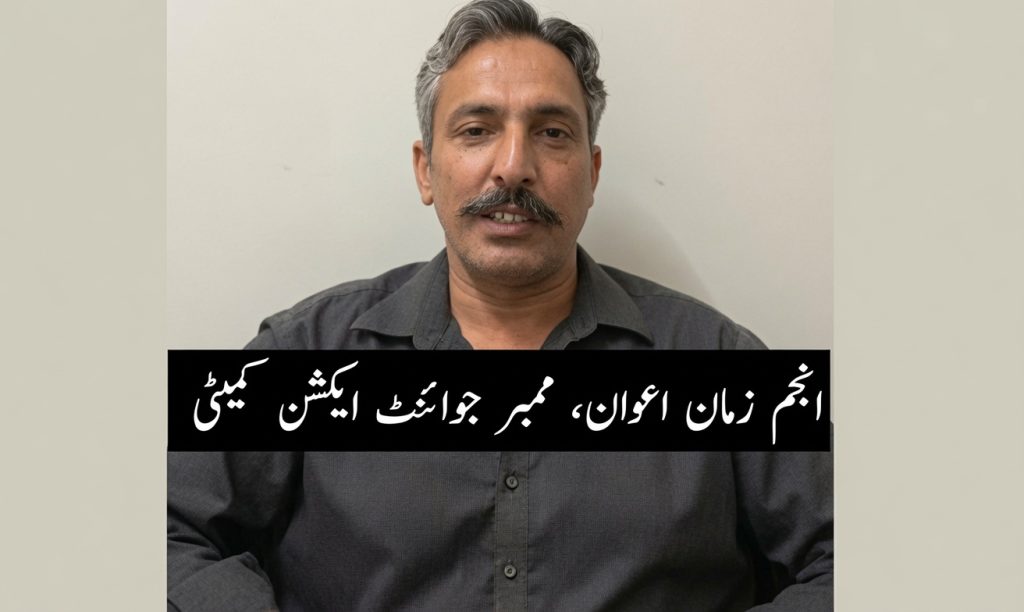



ISLAMABAD: The banned Joint Awami Action Committee (JAAC) suffered another setback on Monday after one of its key members, Anjum Zaman Awan, announced that he was severing all ties with the group over involvement in disruptive activities and embracing “destructive politics”.
In a video message, Anjum Zaman Awan expressed serious reservations over the banned organisation’s current narrative, activities and politics, saying that it has deviated from its original peaceful objectives and the youth are being pushed on misleading paths.
Earlier, another core member of the organisation, Advocate Amjad Ali Khan, also parted ways from the banned JAAC, showing growing differences within the organisation and decreasing trust in the leadership.
Anjum Zaman Awan announced that he had completely detached from the banned JAAC, accusing the organisation of abandoning its original peaceful mission and embracing “destructive politics.”
He said a movement that initially sought peaceful change had gradually been transformed into one marked by disorder, insecurity, and unlawful activities, causing significant harm to the prospects of young people in the region.
Awan further alleged that certain external actors, vested interests, and anti-state elements had exploited the youth for political objectives, contributing to unrest and instability.
Calling on young people to remain vigilant, he urged them to reject misleading narratives, separatist ideologies, and unconstitutional actions, stressing that they should not jeopardise their future for what he termed the politics of chaos.
He appealed to the public to keep a distance from elements promoting the anti-state agenda and be part of the constitutional, legal, and positive political process.
The successive departures of key leaders have further highlighted the growing crisis, internal differences, and weakening narrative within the banned JAAC.
Kashmir government declares JAAC proscribed organisation
The Azad Jammu and Kashmir government declared the Joint Awami Action Committee a proscribed organisation under anti-terrorism laws on June 5, saying the group was “engaged in terrorism, acting in a manner prejudicial to the peace and security of the State”.
Authorities argue that concerns regarding the committee’s intentions intensified after a series of statements and actions that they say went beyond peaceful political activism.
Officials said that rhetoric directed against state institutions, calls for the withdrawal of security forces, disruption of educational activities and inflammatory narratives contributed to growing suspicions about the organisation’s real objectives.
Government officials further contend that support expressed by hostile foreign media outlets, anti-state social media accounts and Indian media platforms for the committee’s activities raised serious questions about the forces seeking to exploit unrest in the region.
According to security analysts supporting the government’s position, these developments gradually exposed an organised effort to challenge state authority under the cover of a public rights movement.
The AJK government had also registered a case under Section 124-A of the Azad Jammu and Kashmir Penal Code (APC) against Khawaja Mehran Arshad, a key ringleader of the proscribed Jammu Kashmir Joint Awami Action Committee (JAAC), following a highly provocative speech targeting the country’s security architecture.
The First Information Report (FIR) was formally lodged at the Civil Secretariat Police Station in Muzaffarabad after intelligence and local monitoring units verified the contents of Arshad’s address, delivered on June 14, 2026, at Dreck, Rawalakot.
The state has vowed to take unyielding action against all facilitators of the network, reiterating that while peaceful negotiation remains open for civic groups, zero tolerance will be extended to entities attempting to orchestrate institutional anarchy.