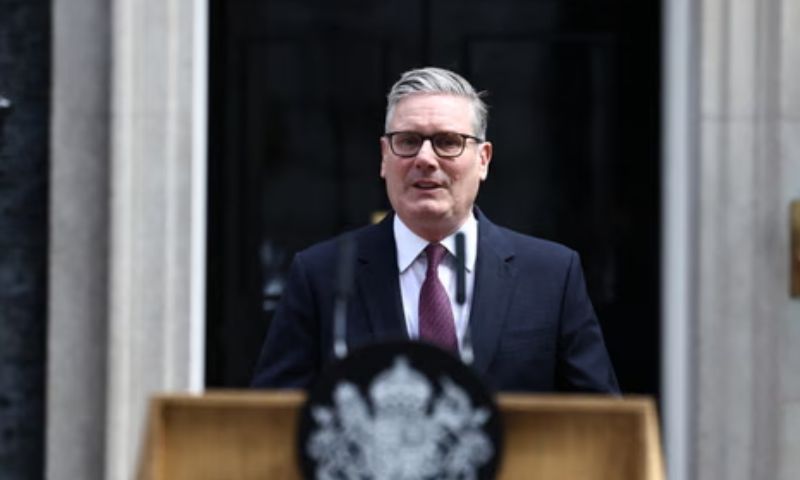
LONDON: UK Prime Minister Keir Starmer has resigned from his post as Prime Minister and leader of the Labour Party, according to live reporting by BBC News.
In a statement delivered outside 10 Downing Street on Monday, Starmer said his time in office had been guided by efforts to “put the country first.” He confirmed he had informed King Charles III of his decision earlier in the day.
Starmer said he would remain in office temporarily to ensure an orderly transition of power until a new leader is chosen. He added that the Labour Party’s National Executive Committee would open nominations for leadership on July 9, with the process expected to conclude before Parliament returns in September.
Visibly emotional at points, Starmer thanked his family, describing his wife as a “rock” and saying he intends to focus more on his children after leaving office. He also pledged full cooperation with his successor during the handover period.
He said Britain he was leaving behind was “stronger and fairer” than when he first took office, and thanked colleagues, Downing Street staff, and the civil service for their support.
According to BBC, senior political figures are already positioning themselves for the leadership contest that will follow, with early speculation around potential successors expected to intensify in Westminster in the coming days.
Pressure on Starmer intensified
Pressure on Keir Starmer had been mounting for months and escalated sharply after Greater Manchester Mayor Andy Burnham won a parliamentary by-election on Friday, defeating a Reform UK candidate backed by the party that has topped national opinion polls for more than a year.
Burnham victory boosts Labour hopes
Burnham’s win renewed hopes among Labour lawmakers that the experienced politician, known for his communication skills, could revive the party’s fortunes after support and Starmer’s approval ratings fell to record lows for a British leader.
Emotional farewell
In his resignation statement, Starmer thanked colleagues for their support and paid tribute to his wife and children, becoming emotional during his remarks.
Markets remain calm
The pound and British government bonds showed little reaction immediately after the announcement, as investors had largely anticipated Starmer’s departure.
Questions over Burnham’s policies
Despite expectations of a smooth transition, uncertainties remain over Burnham’s stance on foreign policy, the economy and defence. Apart from pledging fundamental change and lower living costs, he has yet to outline detailed policies.
Economic constraints persist
Like Starmer, Burnham could face limited room for action because of pressure from bond markets and public frustration over living standards.
Britain currently has the highest borrowing costs among G7 nations, reflecting high debt, weak growth, spending pressures and rising defence needs.
Investors divided
Some investors questioned whether Burnham would maintain fiscal discipline, citing his previous criticism of excessive reliance on bond markets. Burnham later said his remarks had been misunderstood.
Economists at Citibank said a Burnham-led government would inherit a fragile fiscal position with limited options to bring about major change.
Starmer reverses course
Although Starmer said on Friday he would contest any leadership challenge, his position appeared to shift over the weekend, paving the way for his resignation.
Political instability continues
Starmer’s successor will become Britain’s seventh prime minister since the 2016 Brexit referendum, highlighting a decade of political upheaval driven by voter dissatisfaction over stagnant living standards, strained public services and illegal immigration.
Planned transition suggested
Political consultancy Eurasia had suggested that the most orderly outcome would be for Starmer to announce his departure in September, allowing him to attend a UK-EU reset summit in July while giving Burnham time to prepare for office.