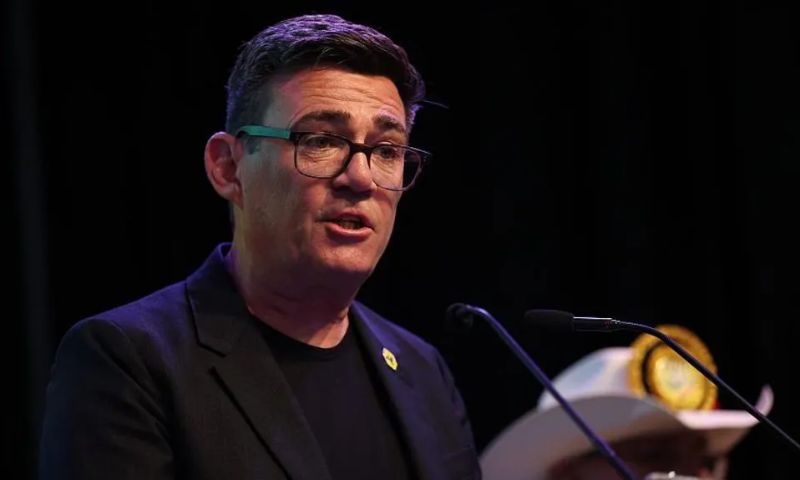
LONDON: Greater Manchester Mayor Andy Burnham has won the parliamentary by-election in Makerfield by a comfortable margin, clearing the way for a potential challenge to Prime Minister Keir Starmer for the leadership of the Labour Party.
Burnham, standing for Labour in one of the party’s long-established strongholds, secured 24,927 votes, defeating Reform UK candidate Robert Kenyon by more than 9,000 votes.
The victory gives Burnham the House of Commons seat required to mount a bid for the party leadership and, potentially, the premiership.
The by-election was triggered after Labour MP Josh Simons stepped down to allow Burnham to return to Westminster.
Around 75,000 voters were eligible to take part, with turnout reaching 58.75 per cent, higher than the figure recorded at the 2024 general election.
Addressing supporters after the result, Burnham said the outcome could represent a turning point for British politics, arguing that many people felt the country was not functioning as it should.
He pledged to dedicate himself fully to delivering change and insisted Makerfield would not serve merely as a route back to national politics.
“This will never be a stepping stone to me, but my touchstone,” he said, promising that the constituency would remain central to his political priorities. Burnham’s victory has increased speculation over the future of Sir Keir Starmer’s leadership.
Several of the mayor’s allies have openly suggested that the Prime Minister should consider an orderly transition, although Starmer has repeatedly dismissed calls to resign and has vowed to contest any challenge.
Former Cabinet minister Louise Haigh, who managed Burnham’s campaign, said she hoped the Prime Minister would reflect on both the Makerfield result and Labour’s disappointing performance in local elections earlier this year.
Should Burnham proceed with a leadership bid, he is expected to face competition from former Health Secretary Wes Streeting.
Any change at the top of government would make Britain’s next leader the seventh prime minister since the country voted to leave the European Union in 2016.
Burnham, often referred to as the “King of the North” because of his popularity across northern England, has built a strong profile during his time as Greater Manchester mayor.
Since first winning the post in 2017, and being re-elected in 2021 and 2024, he has frequently criticised what he describes as the excessive concentration of political and economic power in London.
Campaigning on a promise to “change Labour” and “change politics”, Burnham has sought to appeal to communities that feel neglected by Westminster, emphasising regional inequality and the decline of traditional industries.
Recent polling has suggested he enjoys broader public support than Starmer. An Ipsos survey published earlier this week found that 25 per cent of British adults viewed Burnham as their preferred prime minister, compared with 12 per cent for the current Labour leader.
Starmer, who led Labour to a landslide victory in the 2024 general election, has faced growing criticism over the past two years amid falling public approval and internal party tensions.
Twenty ministers have resigned from his government during that period, with several citing disagreements over policy or concerns about his leadership.
Meanwhile, separate by-elections in Scotland produced mixed results. The Scottish Conservatives captured Aberdeen South from the Scottish National Party, marking their first Westminster by-election gain in more than half a century.
Douglas Lumsden won the seat convincingly and pledged to defend the North Sea oil and gas sector. In Arbroath and Broughty Ferry, however, the SNP retained the constituency comfortably.
Candidate Lara Bird won by more than 5,000 votes and declared that voters had rejected “division and hate”, describing the area as inclusive and optimistic.
Burnham’s return to Westminster now places him firmly at the centre of Labour’s future direction, with expectations growing that a contest for the party leadership could soon reshape British politics.