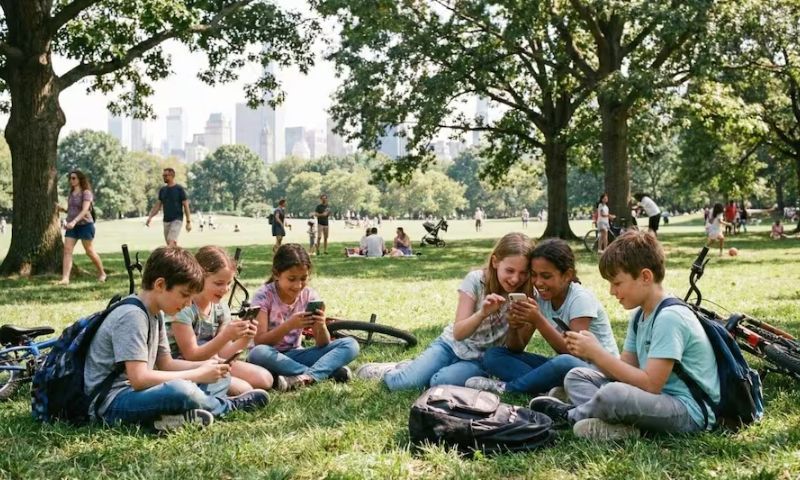
LONDON, UK: No more endless scrolling. No more strangers sliding into Direct Messages (DMs). No more late-night TikTok spirals.
British Prime Minister Keir Starmer on Monday announced a sweeping ban on social media for children under 16, along with new restrictions on gaming platforms and livestreaming services, a crackdown on big tech that goes further than any other country in the world.
We are banning social media access for under 16s.
These days kids must find their feet in a world where technology intrudes into every area of their life.
I just can’t let that go on anymore. So we’re giving children their childhoods back. pic.twitter.com/jn7iQrcwk8
— Keir Starmer (@Keir_Starmer) June 15, 2026
The landmark proposal, which Starmer said would “give kids their childhood back,” targets platforms including Snapchat, TikTok, Instagram, YouTube, Facebook and X. It also extends to gaming sites that allow strangers to contact children, a move that sets Britain apart from Australia, the first nation to ban social media for minors, by applying controls to the gaming industry as well.
“It is clear to me a full ban is the right choice,” Starmer told reporters. “It will make a huge difference. It will make our children safer, it will make our children happier, it will give them more time, more security, more freedom to grow up, more opportunity.”
Under the proposed measures, the government is also considering overnight curfews and curbs on infinite scrolling for under-18s. “World-leading blocks” on livestreaming and on strangers contacting children will also be imposed.
However, messaging services such as WhatsApp and Signal will be exempt from the ban, the government confirmed.
Starmer drew a sharp comparison between the online and offline worlds to justify the intervention. “Is there a situation in the offline world where you would just let your child pair up with a stranger, an adult that you don’t know anything about?” he asked.
Starmer to announce ‘Australia plus’ ban on social media for under-16s | Social media ban | The Guardian https://t.co/j81160jO7W
— Ahsan Iqbal (@betterpakistan) June 15, 2026
Enforcement challenges and expert skepticism
A ban could be in place as early as next spring, Starmer said, underpinned by existing powers and new regulations expected by the end of the year. The restrictions will likely require age checks to be expanded to all users, something Britain’s regulator Ofcom has already introduced for porn sites. Ofcom said it was ready to work on implementing the new measures.
However, Starmer acknowledged that enforcement would be difficult, and experts have raised doubts about whether a blanket ban would actually work.
Research Professor Amy Orben from the University of Cambridge noted that enforcement in Australia, which passed similar legislation last year, remains incomplete, with the majority of young people still accessing social media at similar rates.
“However, a ban is likely to change public perceptions, and make social media use less acceptable in younger age groups,” she added.
A group of school children in London told Reuters they had a conflicted relationship with the technology, supporting the idea of protection but wary of being cut off entirely from their social worlds.
UK Prime Minister Keir Starmer:
“Today I can announce that the government will ban access to social media for all children under the age of 16.”
pic.twitter.com/SJ17HUfaXu— The Post Millennial (@TPostMillennial) June 15, 2026
Tech industry pushes back
Social media companies, which have already introduced child safety measures in response to tightening regulations in Britain and elsewhere, pushed back against the proposed ban.
YouTube said it had invested in “expert-led, age-appropriate experiences and default protections for teens for over a decade,” adding that the platform is “a vital resource for young people, educators and parents.”
Snapchat warned that an outright ban would disconnect teens from private messaging between friends and family, which accounts for the majority of time spent on its service, and called for the scope of the ban to be reviewed.
Meta, the owner of Facebook and Instagram, said the experience in Australia suggested that bans risk isolating teens from online communities and driving them to unregulated alternatives that lack protections and parental controls.
A legacy-defining move
Starmer, facing a likely leadership challenge in the coming weeks, acknowledged that children would inevitably find ways around the restrictions. But he argued that a ban, which could become his main legacy, would bring long-term cultural change.
What you need to know about the new Social Media Ban in the UK:
1. All persons under 16 are prohibited from accessing social media platforms without verified parental supervision.
2. Parental supervision must be logged digitally through the UK. gov app.
3. Parents must approve… pic.twitter.com/wEFunIilb4
— Harry Stabbings (@harrystabbings) June 10, 2026
Laws are rules, but they’re also an expression of our values,” he said.
A growing number of countries are now looking to regulate children’s access to social media amid mounting concerns over mental health, safety and the impact of algorithm-driven content. With this announcement, Britain has positioned itself at the forefront of that global movement, whether the policy ultimately works or not.